Mercedes' Kimi Antonelli won the Belgian Grand Prix from pole position on Sunday to extend his lead at the top of the drivers' championship to 45 points. Mercedes' George Russell retired from the race after contact with Lewis Hamilton on the first lap, while Ferrari's Charles Leclerc finished second and Red Bull's Max Verstappen took third.
Russell has now dropped to third in the standings, with Hamilton moving into second place after finishing fourth. F1 correspondent Andrew Benson answers your latest questions after the race at Spa-Francorchamps.
Antonelli near-perfect but too much drama for Hamilton - driver ratings
Russell 'numb to disappointment' after bitter blow to title hopes
Why was Hamilton penalised for the Russell clash but Leclerc was not for the Piastri incident?
The stewards' different decisions in the Hamilton-Russell and Leclerc-Piastri incidents were based on several factors, many of them tied to the Formula 1 drivers' guidelines.
In the collision between Hamilton and Russell on the first lap, the decision said Russell had got his car far enough alongside Hamilton's Ferrari on the outside as they approached the corner to be making a legitimate overtaking attempt and was therefore
entitled to racing room.
The stewards said the contact was triggered by Hamilton's car sliding and that he hit Russell's car despite
applying corrective steering.
Russell
remained within the available racing room and the collision was caused by [Hamilton] being unable to maintain sufficient separation.
Hamilton was therefore
wholly at fault for the collision.
The normal penalty in these circumstances is 10 seconds. This was reduced to five seconds for Hamilton because he
acknowledged the presence of [Russell], attempted to leave appropriate racing room and made a genuine attempt to avoid contact.
In addition, the incident was not caused by
an aggressive or deliberate manoeuvre, and it happened on the opening lap, when more leeway is applied.
As for the incident between Leclerc and Piastri, the racing rules were again applied closely.
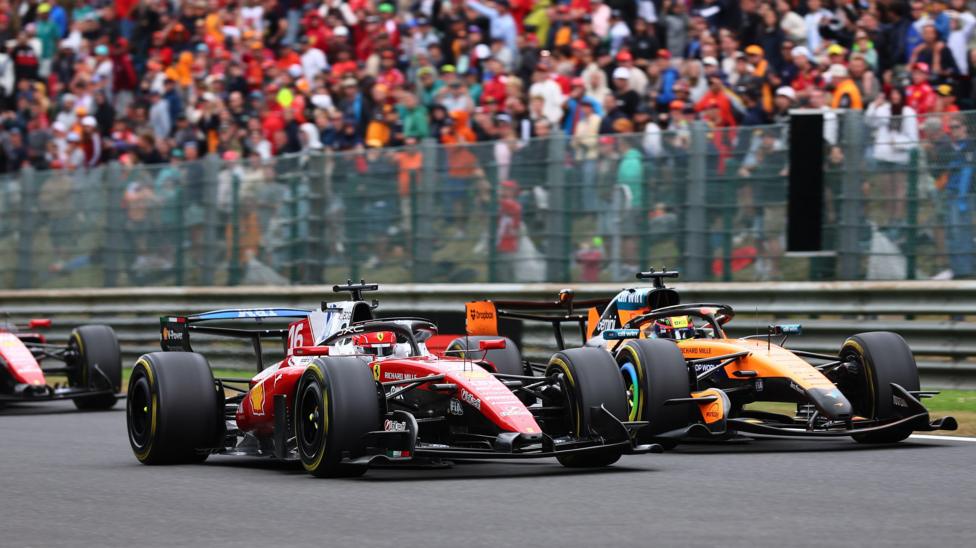
The stewards ruled that Piastri was not far enough alongside the Ferrari to be entitled to the same treatment as Russell.
This was because while he had
some overlap, Piastri's
front axle… was not ahead of the front axle [of Leclerc] and there was no possibility of completing an overtake from that position.
Objectively, it is difficult to disagree with that conclusion up to that point.
The next part of the ruling was more subjective.
[Leclerc] did not deliberately crowd [Piastri] off the edge of the track. [He] followed the racing line before the entry to Turn Five by moving slightly to the left… and side to side contact occurred between the two cars.
There was an interesting episode in the green room before the podium. This incident played out on television while Leclerc was sitting watching with Max Verstappen and Kimi Antonelli.
Leclerc's eyes widened and he sucked in a breath as he watched the contact, and he said:
This one was…
Verstappen interrupted and said:
Was calculated.Leclerc looked at him, they both laughed and then Leclerc sat back looking sheepish and put his cap over his face.
It is clear he recognised the move was on the edge, and a case can be made that he did not comply with the rule that says a driver defending their position by changing line must leave a car's width on the outside if they move back to the racing line.
McLaren team principal Andrea Stella was asked for his view after the race.
He said he had not yet reviewed the stewards' reasoning, but added:
When the cars are staying alongside each other for such a long time, we should make sure that the car that is not on the racing line, because it's defending the inside, does leave enough space, because if there's a contact that is not controlled, then the crash is going to be very big.
Ferrari's Charles Leclerc and McLaren's Oscar Piastri side by side during the Belgian Grand Prix
Does the FIA care more about money than fan and driver views when deciding the calendar?
F1 said the attendance at the Belgian Grand Prix this year was an all-time record of 400,000 over the weekend as a whole.
On a point of fact regarding the question, the calendar is compiled by F1, not the FIA, which merely rubber stamps the schedule at its world council.
In determining which races feature, F1 weighs a number of different factors. Finances are one of them, but money is not everything.
Some races pay smaller fees than others, and one reason for this is that they are considered to have greater intrinsic value to the sport.
This would apply to Spa, which has a history and circuit layout that surpasses the vast majority of the rest of the calendar.
However, historic European classic tracks such as Spa and Silverstone - and other events such as Austin - simply cannot afford to pay the same fees as races funded by nation states using them for PR purposes, such as Saudi Arabia and Bahrain, for example.
This is not an easy conundrum to resolve. F1 wants tracks such as Spa on the calendar for all the obvious reasons, but they also have to make financial sense.
It is in trying to find an acceptable compromise to this scenario that the latest situation has arisen, with Spa hosting the Belgian Grand Prix for four out of six years of its current contract.
That means that in 2028 and 2030 Spa will be replaced by another race.
Of course, from the point of view of anyone who appreciates the sport and what it is about, that is not ideal. But it is better than having no Spa at all.

Why are Mercedes struggling to understand George Russell's straight-line deficit?
At the Belgian Grand Prix, Mercedes experienced unexplained behaviour from their power unit.
Russell suffered as a result, with a mystery lack of energy over a lap in qualifying. It cost him some, but not all, of his deficit to team-mate Kimi Antonelli. Mercedes team principal Toto Wolff put the loss from the engine at about 0.2-0.25 seconds.
A pretty much identical thing happened at McLaren to Oscar Piastri in relation to Lando Norris.
Both drivers also experienced a shortfall of energy on the first lap that contributed to Russell's incident with Hamilton and Antonelli being passed by Max Verstappen on the approach to Eau Rouge.
As Wolff said:
All Mercedes engines had a lack of energy out of Turn One so that wasn't only George. It affected him more than Kimi but also Kimi had that issue to a certain degree.
The one in the race was, Wolff said,
a new issue.
Mercedes said they did not understand why either situation had happened.
The fundamental issue is that the latest F1 hybrid engines are highly complex, as are the rules by which they have to be operated, and the manufacturers and teams are still learning about them.
One of the impacts of this is that small nuances of driving can have a disproportionately large impact on energy availability. It is one of the reasons why the drivers do not like these engines.
McLaren team principal Andrea Stella, among the best technical communicators in the sport, has talked about this extensively this season.
At the weekend in Spa he said:
To operate these power units, you don't operate them in an open-loop way, whereby I would be able to have an off-line simulation and say, 'Oh, that's how the electrical power will be deployed and it will always be identical to itself'.
There's a large component of the controller that operates the power unit that happens with live calculations and the power unit forward-thinks, forward-calculates what it has to do. There's a lot that happens as the car goes.
This is why it's not so easy to understand what kind of calculations have been made as the car was going.
I'm sure we will understand the reason, but at the same time you need to be able to anticipate and make sure that the operation of the power unit unfolds as expected.
Because this is not only for the influence it has in the power-limited sections, [and] in the straights, but also because it affects the braking points.
Because if you have an additional amount of harvest before braking, then you are approaching the braking 10km/h slower and your braking point changes.
This is quite difficult to master for the drivers, and it's one of the reasons why they talk about the difficulties of exploiting the power unit from a driving point of view.
It's not only to get the most out of the power unit, but also because the variations of the power unit affect the references as you approach a corner.
But the variations that are significantly relevant are so small that they may happen from one lap to the other, even if you have learned from the previous laps.
This complexity also explains why McLaren have been frustrated this season by some aspects of their relationship with Mercedes, particularly in terms of how much information they have been given about the operation of the engine.
As Stella said:
It's only now, and we are mid-season, that we are starting to have the required tools in order to be able to anticipate, optimise, and study these sensitivities.
Title race would be 'done and dusted' without Mercedes reliability issues
Why are drivers allowed to sacrifice qualifying to give a tow to a team-mate?
This is a reference to the way Red Bull ran qualifying in Belgium.
Isack Hadjar gave Max Verstappen a tow in the final session that made a difference of about 0.3secs. It allowed Verstappen to qualify on the front row rather than sixth.
If this were to happen routinely, then there might well be consequences.
But this particular station was entirely understandable, and completely normal.
Hadjar had a 30-place grid penalty for exceeding his allowance of power unit components. So, having made it into Q3, he was only ever going to be starting the race at the back, no matter what lap time he set.
In those circumstances, it made complete sense for Red Bull to ask him to give Verstappen a slipstream to maximise his chances.
Is Verstappen to Mercedes a likely move?
## Get in touch
Send us your question for F1 correspondent Andrew Benson
##
##
Antonelli wins to extend lead after Russell crashes out
Mercedes driver scout Lagrue joining Red Bull