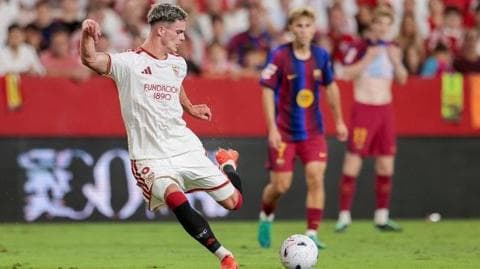
Robbie Ure, composed and self-assured at 22 years old, completed a full 90 minutes for Sevilla against Barcelona over the weekend, marking time alongside Pau Cubarsi, who earned man-of-the-match honours in the World Cup final, and Rodri, the tournament's standout player, while sharing the pitch with emerging talent Lamine Yamal. The Scottish striker is now part of a fresh cohort of uncapped forwards hoping to earn their first international appearance on Saturday away to Slovenia in the Nations League.
Ure represents a new chapter for Scottish football after a significant turnover in the national squad. The absence of Lyndon Dykes and George Hirst, combined with injuries sidelining Che Adams, Lawrence Shankland and Ross Stewart—all of whom featured at the World Cup in the United States—has created space for emerging talent. Joining Ure in Sébastien Pocognoli's first squad are James Wilson of Hearts and Kieron Bowie of Sassuolo, each with two caps, alongside Oli McBurnie of Hull, whose last of 16 international appearances occurred five years ago.
The narrative surrounding Ure encapsulates a broader conversation in Scottish football about youth development. He is the embodiment of what happens when a young player is denied opportunity at home but finds his level abroad. Three years ago, he departed Rangers as a teenager, his final senior appearances for the Glasgow club consisting of one minute against St Mirren in November 2022 and another minute against Hibernian in May 2023.
Why did Ure leave Rangers?
The striker's departure from Rangers was driven by a realistic assessment of his prospects at that stage of his development. He explains that he felt unprepared for the demands of playing regularly at Ibrox, a situation he views as entirely normal for an 18-year-old. Rather than allowing this to undermine his confidence, he recognised that he needed to find a competitive environment where he could develop through consistent playing time. His first destination was Anderlecht in Belgium, a move that provided the foundation for what would follow.
Ure has become a focal point in the Scottish Football Association's push to encourage clubs to invest more heavily in youth development pathways. His trajectory demonstrates the risks of prematurely dismissing young talent, but also the rewards available to those willing to seek opportunities elsewhere when domestic options are limited.
How did Ure become a target for Sevilla?
The turning point in Ure's career came during his time at IK Sirius in Sweden. In the 2025-26 season, he recorded 11 goals across 30 appearances, establishing himself as a prospect worth monitoring. However, it was his form between April and July of this year that transformed his standing in European football. During that four-month spell, he featured in 14 matches and scored 15 goals, including a four-goal haul in a single game against Mjallby. According to reports on his Swedish performances, this prolific run made him one of Europe's most sought-after young forwards.
Reflecting on that period, Ure describes it as the happiest phase of his career to date. He was scoring with remarkable consistency, his team was competing at the top of the league, and he was receiving the trust and playing time essential for a young player's development. The sensation of scoring so regularly created a psychological state he had never previously experienced in football—a feeling that every shot would find the net. That four-goal performance marked his first hat-trick, a milestone that crystallised his emergence as a serious talent.
Sevilla moved to secure his services in the summer, paying £5.5 million with an additional £2.5 million in performance-related add-ons. His contract with the Spanish club runs until 2031, reflecting the long-term commitment both parties have made to his development.

What has Ure's experience at Sevilla revealed?
The transition to La Liga has placed Ure in an entirely different sphere of competition. In his seven appearances for Sevilla since arriving from Sweden, he has already faced 12 members of Spain's World Cup-winning squad. The Barcelona match exemplifies the calibre of opposition he now encounters regularly. Though Sevilla lost that fixture 3-1, Ure completed the full 90 minutes in a baptism of fire against players of extraordinary quality.
He has not yet scored for his new club, but he views this period as an invaluable education rather than a disappointment. When discussing the Barcelona encounter, he acknowledges the relentless pressure exerted by elite opponents. He singles out Raphinha's current form as an example of the standard he is now witnessing, noting that at this level, defenders cannot afford to make mistakes—one lapse typically results in a goal. Despite the defeat, Ure describes the experience as genuinely rewarding, confident that exposure to this standard of football will accelerate his development.
The first half, we were good. But as the game goes on, they wear you down. Raphinha at the moment. I mean…
There is a knowing smile when he reflects on the quality surrounding him. He adds:
I really enjoyed it. But against these players, you give them one chance and most of the time it's a goal. For me, it was a really good experience. I'm only going to get better as a result of it.
How does Ure reflect on his Rangers departure?
Leaving Rangers was undoubtedly difficult for Ure, who had known nothing but the club since childhood, arriving at the academy around eight years old. However, he recognised that remaining would have meant limited opportunities. He emphasises that this realisation did not damage his self-belief; rather, it was a pragmatic acknowledgment that at 18, breaking into Rangers' first team would have been exceptionally challenging. He accepted this reality and sought an environment where he could develop through regular football at an appropriate level.
Yeah, it was. All I'd ever known was Rangers. Going in every single day since I was probably eight years old but it was something that I felt I had to do.
He continues:
I felt like I wasn't good enough to play for Rangers at the time, which is normal for many 18-year-olds. It was nothing that affected my confidence. I would have loved to have stayed but I knew myself that I wasn't going to play, which I accepted.
Ure stresses that at a club of Rangers' stature, it is inherently difficult for any teenager to secure regular minutes. He needed a change of environment and a fresh beginning, circumstances that Anderlecht ultimately provided. His willingness to leave Scotland proved transformative, as he discovered the playing time and developmental support necessary for his progression.
What does Ure's path suggest about Scottish football?
The broader context of Ure's journey speaks to ongoing debates within Scottish football regarding player development and pathway creation. He acknowledges that every player develops at a different pace and requires different conditions to flourish. The critical factor, he argues, is providing young players with patience and meaningful opportunities to develop through competitive football at an appropriate level. In his case, that level was not available domestically, necessitating a move abroad.
Everyone's different. You have to give players patience and give them time to develop but the way to do that is, of course, playing minutes at a level where you can develop at. I couldn't find that level in Scotland, so I had to look elsewhere and I'm happy that I did that.
His success in Belgium and Sweden, followed by his move to one of Spain's most prestigious clubs, validates this approach. While he has not yet scored in La Liga, the level of football he is now experiencing represents an extraordinarily steep learning curve—one that will ultimately benefit his development as a player.
What happens next for Ure?
Ure will make his Scotland debut in the coming weeks as part of Pocognoli's squad for the Nations League campaign. Scotland's first fixture under the new manager is away to Slovenia on Saturday, 26 September 2026, at Stadion Stožice in Ljubljana. With four Nations League matches scheduled in quick succession, Ure will have multiple opportunities to establish himself on the international stage. He has earned this opportunity through his performances in Sweden and his continued development at Sevilla, and he arrives at the national team with genuine momentum behind him.