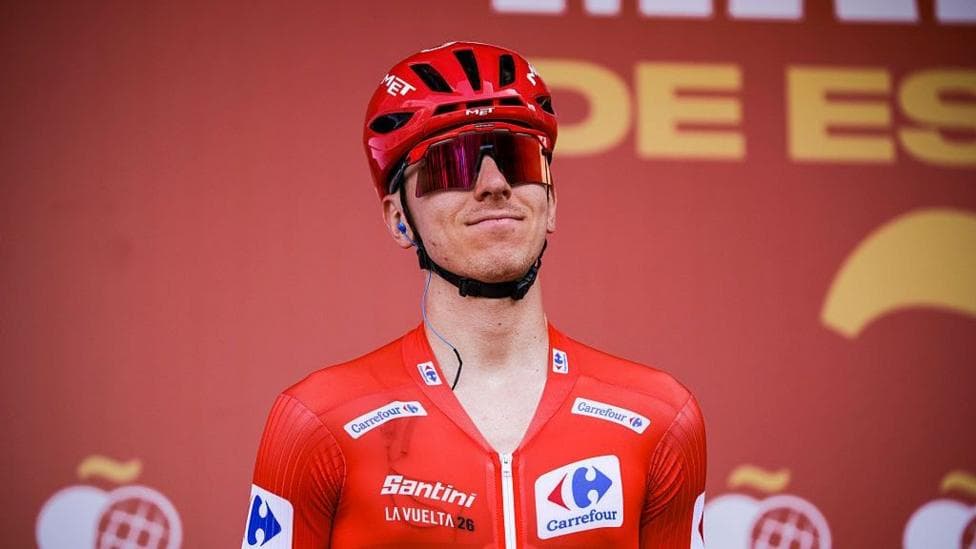
Five-time Tour de France champion Tadej Pogacar says he is grateful to have survived his season-ending crash, describing himself as "just happy to be alive" two months after sustaining three fractured vertebrae during the Vuelta a Espana in August. The 28-year-old Slovenian underwent surgery for a broken collarbone and initially received a diagnosis of a neck fracture, but subsequent medical imaging in his home country identified additional spinal injuries that forced him to abandon his bid to complete a sweep of all three Grand Tours.
According to BBC Sport, Pogacar revealed the full extent of his injuries during an interview with The Athletic. "I knew I had a C7 fracture, but then we saw I had two more broken vertebrae, the T1 and T2," he explained. "At that moment, I was happy I didn't do the European Championships, which had been my initial goal. When I saw I had three broken vertebrae? I'm just happy to be alive actually, or just to be standing."
The crash occurred during stage eight of the Vuelta while Pogacar held a commanding lead in the race. Cycling News reported that Pogacar later clarified the incident was caused by a large rock, dismissing alternative explanations as "fake news."
How severe was the concussion?
Beyond the spinal fractures, Pogacar suffered a significant concussion that created unexpected challenges during his early recovery. The neurological impact left him experiencing dizziness, nausea and poor coordination in the weeks following the accident, symptoms severe enough to prevent him from performing basic daily tasks independently.
"I had to be showered with the help of the team doctor. I could not shower. I was getting dizzy as soon as I stood or when I put my head down,"Pogacar said.
"I was just completely out of it and it was so tough."
The concussion's severity meant his mental state suffered alongside his physical recovery. Pogacar acknowledged that the initial weeks were psychologically difficult, describing himself as "mentally not OK" and "not a fun person to be around" during that period.
What was Pogacar's original goal at the Vuelta?
When he crashed during stage eight, Pogacar was pursuing a historic achievement: completing the Grand Tour trifecta by adding the Vuelta to his single Giro d'Italia victory and five Tour de France wins. His injuries prevented him from defending his rainbow jersey at the World Championships in Montreal in October, ending what would have been a dominant season.
The crash also meant he could not pursue his initial goal of competing in the European Championships, a decision that in retrospect proved fortunate given the severity of his injuries.
How has Pogacar's recovery progressed?
Pogacar's mood and physical condition improved markedly once he resumed structured rehabilitation and indoor training. Domestique Cycling reported that he restarted training approximately two weeks before an October 31 virtual community ride, marking a significant milestone in his recovery timeline.
"When I started to get on the home trainer, to go to physio every day, then I started to feel better, also in the head. But it was a day-to-day fight,"Pogacar said of his rehabilitation process.
"I don't have discomfort any more. I have to be careful not to crash on the bike, or do some heavy lifting with my left arm or with my neck. But I can do basically everything normal now."
His team, UAE Team Emirates-XRG, announced that Pogacar would not race again until 2027, a decision designed to allow him to return to full health without artificial pressure to meet a specific competition timeline.
What concerns does Pogacar have about returning to racing?
Despite his physical recovery, Pogacar remains cautious about the psychological implications of his crash. The severity of his injuries has made him acutely aware of the risks inherent in professional cycling, particularly the consequences of another fall.
"If I crash again on the bike now, it can be very problematic. Everybody says that I was lucky, and you're always lucky after a crash where you can walk away and you're fine,"Pogacar said.
"You see it's pretty serious and not to joke around. It's a bit scary, to be honest, to think about it."
This cautious mindset will shape his approach to racing in 2027, with Pogacar prioritising safety alongside competitive ambition.
What are Pogacar's plans for 2027?
Pogacar has identified the Tour de France, World Championships and Vuelta as his major targets for 2027, with his agent indicating that a Vuelta return appears more likely than a Giro d'Italia start. Cycling News reported that agent Alex Carera said Pogacar's schedule remains unsettled, with the team expected to decide his full race programme at its December training camp.
The Vuelta represents unfinished business for Pogacar, who was leading the race when his crash ended his 2026 season. A return to the Spanish Grand Tour would give him the opportunity to complete the Grand Tour set he was pursuing when his accident occurred.