Team Northern Ireland finished the Commonwealth Games in Glasgow with 16 medals, taking their overall total at the Games to 158 and moving past the 150-medal mark. Kate O’Connor, Jon McConnell, Ellie McCartney and Gary Kelly were among the athletes to return with medals from the slimmed down event, which produced Northern Ireland’s second-biggest haul after the 18 won in Birmingham four years ago.
The build-up to the 2026 Games had been dominated by a change of host, a scaled-back schedule and a number of big-name withdrawals. Yet after 10 days of competition in Scotland, the sport left the lasting impression and again underlined why the Commonwealth Games matter so much to athletes from Northern Ireland, especially in the wider sporting picture.
The figures also show how consistent Northern Ireland’s success has been over the decades. The 16 medals in Glasgow were made up of three golds, four silvers and nine bronzes, and the overall tally of 158 makes Northern Ireland one of the most decorated teams in Commonwealth Games history relative to size.
The Commonwealth Games fall at the halfway point of the Olympic cycle and, in the case of Glasgow, only months before qualification in many sports gets under way for Los Angeles 2028. For some athletes, it is a chance to take stock of where they are and where they are going; for younger athletes, it is a first opportunity to experience a multi-sport event at senior level.
The Games have long been a bridge to greater things. Lady Mary Peters won Commonwealth medals before the Olympic pentathlon title in 1972, while boxers Wayne McCullough and Aidan Walsh also became Commonwealth medallists before they stood on an Olympic podium. More recently, Rhys McClenaghan’s first major title on the pommel horse was a Commonwealth gold in 2018, while swimmer Daniel Wiffen won a silver medal at the Commonwealths four years ago. Both men are now Olympic and world champions.
What do the medal numbers say about Northern Ireland’s history at the Games?
The medal totals show a long pattern of success across different eras, with Northern Ireland competing in all but two Commonwealth Games. The first medals as Northern Ireland came in 1934 in London, when the men’s fours team claimed a silver in bowls, while William Duncan and Jimmy Magill won boxing bronze medals.
After a medal-less 1938 Games and no Northern Ireland representatives in Auckland when the Games resumed in 1950 after the end of the World War Two, the first two gold medals arrived in Vancouver in 1954 - the first year it was known as the Empire and Commonwealth Games. Thelma Hopkins won the high jump, while William Rosbotham and Percy Watson - remarkably also one of the 1934 silver medallists - won the men's pairs in bowls.
Edinburgh has been a productive city for Northern Ireland in the Commonwealths, and 1970 brought two gold medals for Dame Mary Peters, in the pentathlon and shot put, while Mike Bull took gold in the pole vault. Sixteen years later, Northern Ireland had their most successful Games up to that point with 15 medals.
Phil Beattie’s 400m hurdles win and Freda Elliott and Margaret Johnston’s women’s pairs triumph in bowls were the only two golds, but four silvers and nine bronze medals made it NI’s most fruitful Games yet.
The 1994 Commonwealths in Victoria set a new Northern Ireland record for the number of gold medals at a single competition with five, as Johnston claimed a singles title, Neil Sinclair and Jimmy Webb won gold in the ring, while David Calvert and the duo of Tom Hewitt and Samuel Allen were successful in shooting.
Calvert would strike again four years later with two golds, one of which came in the pairs event with Martin Millar, and another individual double followed in 2002 in Manchester. The 2010 Games in Delhi are remembered for a hat-trick of boxing golds as Michael Conlan, Paddy Barnes and Eamonn O’Kane all won, and the former pair became double Commonwealth champions in Glasgow four years later.
Rhys McClenaghan’s triumph on the Gold Coast in 2018 was a first gymnastics medal for Northern Ireland and seven silver medals plus four bronze matched the tally of 12 medals from Glasgow. But it was in Birmingham in 2022 that Northern Ireland had, by some distance, their most successful Games to date with seven gold medals, seven silvers and four bronze.
Aidan and Michaela Walsh, Jude Gallagher, Dylan Eagleson and Amy Broadhurst all won golds in boxing, while Bethany Firth came out on top in the women’s 200m S14 and the men’s four quartet of Martin McHugh, Ian McClure, Sam Barkley and Adam McKeown were triumphant in bowls. There were also notable silvers for Daniel Wiffen and McClenaghan, who both would go on to become Olympic champions two years later, while Ciara Mageean and O’Connor, who won NI’s first gold in 2026, finished second in the 1500m and heptathlon respectively.
How did Kate O’Connor use the Games to build her career?
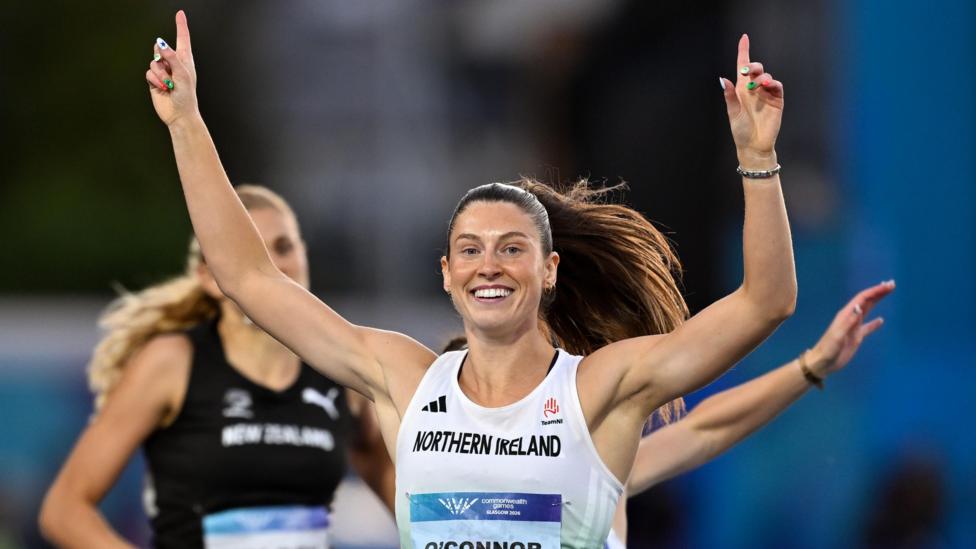
Kate O’Connor, Northern Ireland’s golden girl in Glasgow, was a silver medallist from four years ago and went on to finish second at the World Championships in between Games. This was her third Commonwealths, having competed as a 17-year-old in Gold Coast in 2018, and she says the competition “has been so good to me”.
“Having that opportunity whenever I was a 17-year-old to travel across the world and compete against senior athletes on an international stage, and compete against that many people, not many 17-year-olds get that experience,” O’Connor told NI.
“Then in 2022 and I was in with a chance of a medal, I’d had that experience from the previous Games.”
O’Connor said that winning gold in Glasgow was part of her journey, and charted her progress from a junior athlete into regular medal contention on the world stage.
“This year I was in a really privileged position where I’d come in and I was the favourite, but that obviously comes with its own pressures and I think I navigated it very well.
“I’m really proud of how I managed to deal with the last three Games and how I’ve grown as an athlete.
“The Games have definitely stood to me. I’m so thankful that I’ve had the opportunity to compete in them.”
How are young athletes benefiting from their first Games?
The Commonwealth Games also has its own progression pathway. The boxing team produced six medals, another impressive haul from a much less experienced team than in recent editions of the Games.
Jon McConnell, 23, is now Commonwealth champion, defending the title won last time by Aidan Walsh. Can he now go on to win an Olympic medal like Walsh did? He might, if he stays off Love Island….

Kaci Rock is also 23 and a silver medallist and is already looking ahead to Olympic qualification.
“I’ve such a hunger now to move forward and the next big thing is the Olympics in Los Angeles and I’m going to do everything I can to get there. I’ve stood on the podium at the Commonwealth Games and now I want to stand out he podium at the Olympics,” she said.
Swimmer Ellie McCartney won a magnificent bronze medal in the 100m breaststroke. Three years ago, the Enniskillen swimmer’s potential was noticed after winning two golds at the Youth Commonwealth Games. Since then, the 21-year-old has reached a first senior world final and taken a medal in Glasgow.
There were other notable achievements from some of the youngest members of Team NI and, like O’Connor, this experience will hopefully help them in the future. Athlete Nick Griggs was sixth in the final of the men’s 5000m while in the pool, 16-year-old Emily Hughes, the youngest member of Team NI, was a member of the 4x100m freestyle relay squad that set a new Irish Senior record.
A pair of 18-year-olds, Matthew Hamilton and Adam Bradley, also set Irish Junior records. Another athlete waiting on A-Level results, weightlifter Harrison McGrogan was fifth.
Why did the bowls medals mean so much?
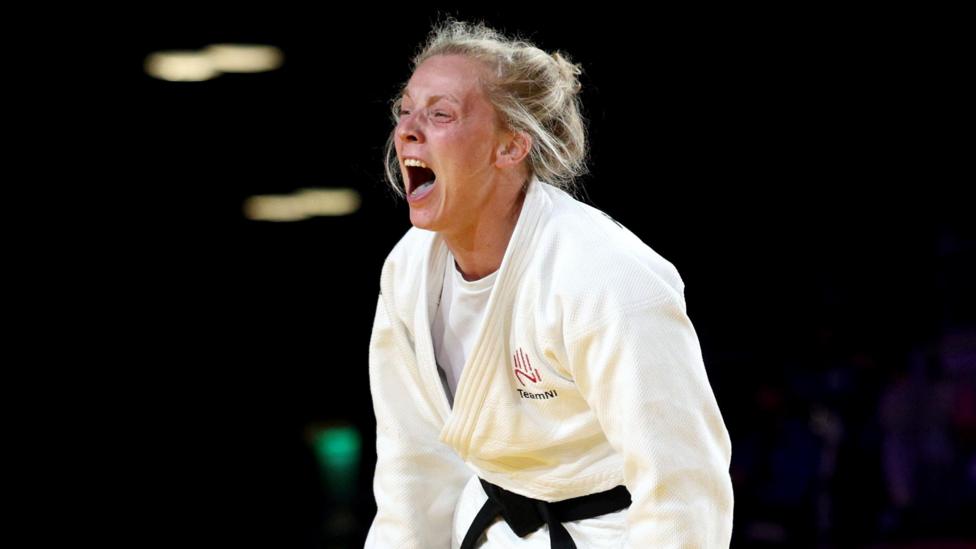
Then there was the emotion. The scream that judoka Rachael Hawkes let out on winning bronze after losing the same fight four years ago was almost primal, and it meant so much to her.
There were the tears of bowler Chloe Wilson after winning bronze with Shauna O’Neill in the women’s pairs. Wilson, 23, and O’Neill, 26, have put to bed forever the myth that bowls is only played by pensioners.
Winning a medal is one thing but doing it with your best friend is something special.
“Words can’t even describe how much it means. Just to be standing up there with Shauna, it’s something really special,”
O’Neill said the moment “is going to live with me for the rest of my life.”
Gary Kelly had won bronze in the men’s singles bowls in Delhi in 2010 and a silver four years ago. In Glasgow it was another bronze in the singles, but that elusive gold would finally come in the men’s pairs with Adam McKeown, himself now a two-time Commonwealth Games champion.
Bowls is not an Olympic sport, so the Commonwealth Games is the pinnacle for competitors in the discipline.
“The Commonwealth Games is the biggest opportunity for us, for media exposure, and for people that maybe wouldn’t normally view our game and our sport,”
“It’s incredibly important, and it’s been fantastic for it to be part of this and for it to be respected as one of the six core sports of the Commonwealth Games. I think it deserves that.”
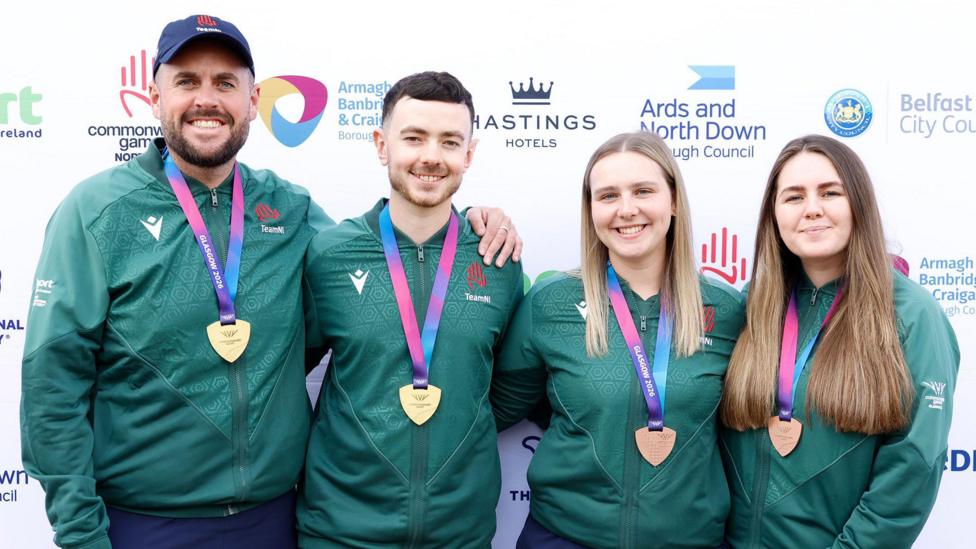
The second outlet’s figures highlight how important bowls remains to Northern Ireland’s medal record. The sport has now delivered 25 Commonwealth medals overall, including six golds, and has provided many of Team NI’s most reliable podium finishes across the years.
At athlete level, the numbers are also striking. Shooter David Calvert is the most successful Northern Ireland competitor in Commonwealth Games history with eight medals, four of them gold, while Martin Millar won four medals, Lady Mary Peters won four, Mike Bull won four and Michaela Walsh became the first boxer to win four medals for Northern Ireland after her silver in Glasgow added to previous medals.
Kelly’s Glasgow gold also added to his own long record at the Games, while Northern Ireland’s broader record includes medals in archery, triathlon, weightlifting, judo, cycling, wrestling and para-sport.
What does the future of the Games look like?
The Chef de Mission of Northern Ireland, Conal Heatley, believes strongly that the Commonwealth Games have prepared athletes for future successes.
“It was a very important part of their program,”
Heatley said on the 65 NI athletes in Glasgow.
“Whether it’s Commonwealth Games, that’s their pinnacle, or whether they will look to go on to Olympics, but each and every one of them strove to do their best here for Team NI.”
The Indian city of Ahmedabad has already been announced as hosts for 2030. Two years ago the future of the Commonwealth Games was uncertain when Victoria in Australia pulled out of hosting.
Glasgow stepped in, and while smaller and cheaper, the Games provided competitive sport and enjoyment for spectators and athletes alike. History shows how important the Commonwealth Games have been for athletes from Northern Ireland in building for the future while still winning medals at this level.
“Many, many of our athletes who have gone on to win Olympic medals have come through Commonwealth Games,”
“It gives them an incredible opportunity to gain experience and prepare for the future.”
That combination of medal success and development value helps explain why the event remains central to Northern Ireland sport, even in a reduced format. For some athletes it is the pinnacle; for others, it is a stepping stone to Olympic and world-level success.
How have Team NI athletes described the event's value?
The Glasgow Games reinforced the idea that the Commonwealths can be both a proving ground and a destination. O’Connor’s progress from teenage debutant to gold medallist, McConnell’s rise to champion, McCartney’s breakthrough bronze and the bowls pair’s emotional medal all showed the different ways the event can shape careers.
The numbers also underline the scale of Northern Ireland’s achievement. With 158 medals now collected across Commonwealth Games history, and with success spread across boxing, bowls, athletics, swimming, judo and other sports, the event has remained a regular source of international podium places.
For younger athletes, Glasgow offered exposure to senior competition and the pressure of representing Team NI on a major stage. For established names, it offered another chance to add to long medal tallies and to measure progress ahead of the next Olympic cycle.
The Games in Glasgow may have been smaller than recent editions, but for Northern Ireland athletes they again delivered medals, memories and momentum.
Key Facts
- Team Northern Ireland won 16 medals in Glasgow: three golds, four silvers and nine bronzes.
- The total took Northern Ireland’s Commonwealth Games medal tally to 158.
- That is Northern Ireland’s second-highest medal haul at a single Commonwealth Games, behind Birmingham 2022.
- Kate O’Connor won Northern Ireland’s first athletics gold in 40 years.
- Gary Kelly and Adam McKeown won bowls gold in the men’s pairs.