President Donald Trump said he was not sure whether he should provide Patriot missiles to Ukraine, describing the move as a “big step”. Ukrainian president Volodymyr Zelenskyy had asked Trump for Patriot air defense interceptors to help defend against Russian attacks when the two presidents met earlier this week.
“These weapons are incredible,” Trump said. “We have to be very careful about letting somebody build them. … You have to be very judicious, but you have to be very careful. … it’s a hard thing to give away that kind of technology, and I don’t think this would ever happen, but, you know, those people that you get that technology, they can someday turn on you. You know, that is possible.”
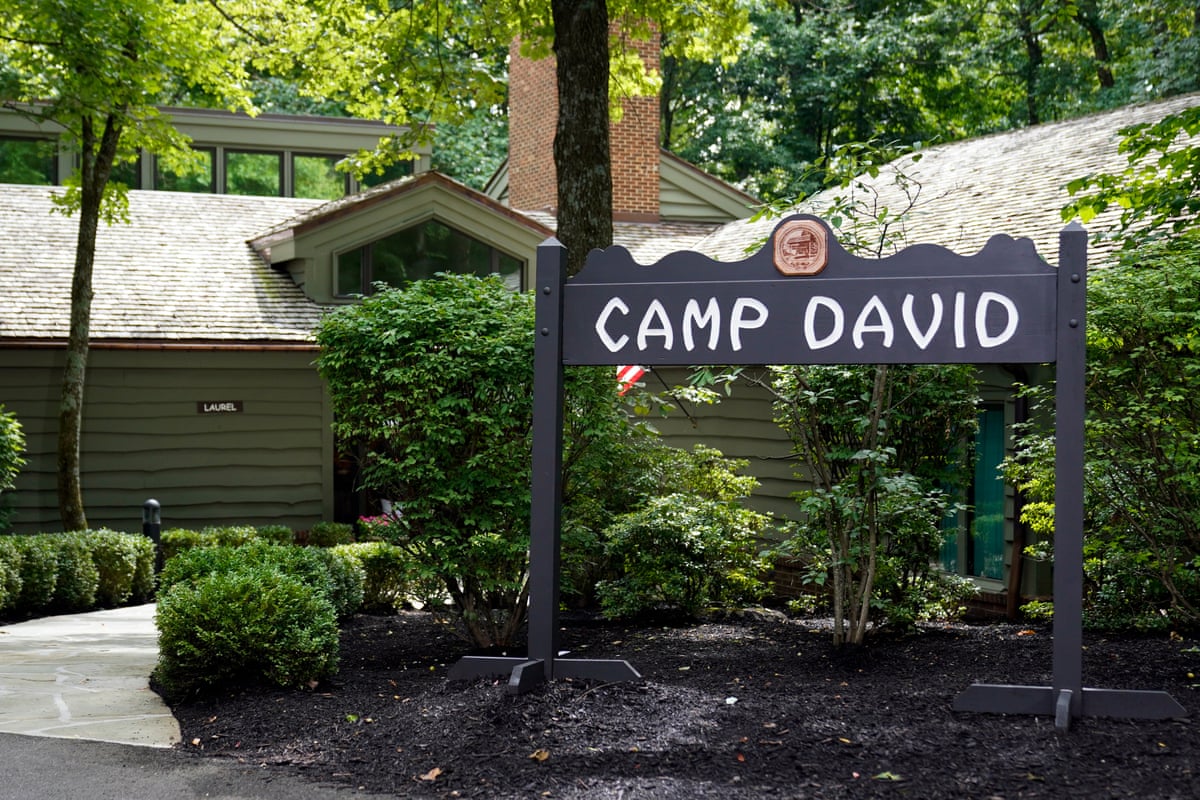
Trump also spent much of the day in Camp David defending his approach to Iran, criticizing Minnesota leaders over a cyberattack on water systems and attacking Republican senator John Cornyn over a nomination fight involving Todd Blanche. The president said the US would be “hitting them very hard” in relation to Iran, while also arguing that a disputed IRS settlement fund was intended for people who were “weaponized” by the Biden administration.
What did Trump say about Patriot missiles for Ukraine?
Trump said he was unsure about granting Ukraine’s request for Patriot missiles, framing it as a significant decision because the systems involve sensitive technology. He said the US must be “very careful” and “very judicious” about who receives such weapons and suggested he did not think the transfer would happen.
Zelenskyy had asked for the interceptors earlier this week when he met Trump, according to the original account. The request came as Ukraine continues to seek additional air defense against Russian attacks.
How did Trump describe the risk of sharing the technology?
Trump said the technology could one day be turned against the United States. He repeated that the systems were “incredible” but warned that it is “a hard thing to give away that kind of technology”.
What else happened at Camp David?
Trump met with his Cabinet at Camp David and used the meeting to defend the war in Iran, blame Minnesota officials for a cyberattack on the state’s water systems and discuss other administration priorities. He also criticized Cornyn, defended the IRS settlement fund and repeated attacks on political opponents and federal institutions.
When asked about negotiations with Iran, Trump said the US would be “hitting them very hard”. He also said, “We just want to win,” and described Iran’s military as severely weakened, saying, “We’re doing very well, trying to be nice, as nice as you can be in a situation like that, but, you know, they’re being decimated. They have no Navy. They have no air force, they have no anti-aircraft. They don’t have any capability. They have some, but very little.”
“We just want to win,” he said. “We’re doing very well, trying to be nice, as nice as you can be in a situation like that, but, you know, they’re being decimated. They have no Navy. They have no air force, they have no anti-aircraft. They don’t have any capability. They have some, but very little.”
After Trump’s remarks, officials around the table spoke about their work on administration projects. JD Vance discussed his fraud task force, followed by Marco Rubio and then Pete Hegseth.
What did administration officials say during the meeting?
Rubio criticized the International Criminal Court as an “illegitimate international organization”, and Trump joked, “there’s no indication they’re after me” about the court. Rubio also referred to “far-left” and “antifa” groups, saying the administration would continue to target “far-left violent terrorism”.
Hegseth praised efforts to remove diversity, equity and inclusion programs from the military.
“When you rip out DEI, when you rip out social engineering and social justice, and you put in merit, and then you untie the hands of commanders to be commanders, to enforce discipline and accountability, to get back to basics, then you get historic reenlistment inside our ranks,” Hegseth said.
Trump also listed what he called his achievements, including lower prescription drug prices, an immigration crackdown and savings accounts for children. He compared the length of the conflict in Iran with other wars, saying the US had been in the current war for five months and had “obliterated their military capacity”.
Why did Trump criticize Minnesota leaders?
Trump blamed Minnesota’s leaders for a cyberattack on the state’s water systems, rejecting suspicions that Iranian hackers were responsible. He said, “We heard in Minnesota there was a cyber-attack, and they blame it on Iran. I don’t think so. I think I blame it on Minnesota because they’re grossly incompetent. There was a cyber-attack of 30 water plants, and I would blame it on Minnesota and the governor, the corrupt governor of Minnesota. They like to say, oh, it’s Iran. Iran should be so lucky. Iran’s got bigger problems than worrying about Minnesota.”
State and federal investigators have said they suspect Iranian hackers were behind the attacks on the water systems, though that was not a final conclusion and could change.
What happened in Indiana and Texas politics?
Indiana senate president pro tem Rodric Bray said he would not run again to lead the chamber. Trump applauded the decision after clashing with Indiana Republicans over redistricting.
Bray had been important in blocking Indiana from pursuing mid-decade redistricting, unlike several Republican-led states that moved ahead after pressure from Trump, which in turn prompted Democratic-led states to redistrict to offset Republican gains. Bray, who has served as president pro tem since 2018, said on Friday that he would not seek reelection to the leadership role but would remain in office as an elected senator until November.
In a Truth Social post, Trump said he was “pleased to announce” Bray’s decision and accused him of having “foolishly” led the chamber.
“Better yet would be if he would resign from Office, completely, but he will be met by us at the Indiana Polls,” Trump wrote. “Rodric Bray should be ashamed of himself for costing our Country, mainly the Republican Party, two U.S. House Seats, and for costing all of his colleagues who went along with him, an Election loss!”
Trump and his allies backed challengers to state lawmakers who refused to redistrict, and voters backed Trump’s preferred candidates in the primaries earlier this year. Trump also thanked Indiana voters for ousting the “wayward Senators, led down the Path of Destruction by a FOOL named Rodric Bray”.
In Texas, Trump attacked John Cornyn over his opposition to Todd Blanche’s nomination as attorney general. He said Cornyn’s objections were tied to Trump’s endorsement of Cornyn’s opponent, Ken Paxton, in the Republican primary, which Paxton won.
What is the dispute over the IRS settlement fund?
Trump defended the IRS settlement fund that would pay people who say they were targets of political weaponization and also grants Trump and his businesses immunity from past tax investigations. The fund has become part of the dispute over Blanche’s nomination, with Cornyn and Thom Tillis refusing to move forward without written assurances.
Trump said the fund was “dead” but that he wished it were not, because he wanted people who had been targeted to be paid. He said the fund was not for him and insisted that he had given up payments for himself.
“This fund was not for me,” he said. “This fund was for those people that have been weaponized that have been abused. I was abused, they attacked my house, Mar-A-Lago, where I live. And I was, you know, big damages should have been given to me. I don’t want anything. I’m not talking about myself. I think that there’s a group of people in this country, history will show that were treated like nobody else has ever been treated, so badly, so horribly. … They’ve committed suicide. People that were very successful and wanted to go to a rally or an event and ended up spending the rest of their lives in horror.”
In a separate post, Trump said the fund “will not benefit me, but rather the great American Patriots who were hunted down like dogs and whose lives were unfairly and illegally destroyed by the Crooked Joe Biden Administration”. He also wrote that he had “gave up any payments for myself, which would have been substantial”.
“I will always feel that these victims of government abuse should be paid back for what they were forced to endure, their lives have been ruined!” Trump wrote. “Millions of people agree with me, as was proven in my landslide Presidential win, where this was a major subject of debate, and so did John Cornyn, until he lost his Election to an opponent that I Endorsed.”
How did Alexandria Ocasio-Cortez describe the Democratic mood?
New York congresswoman Alexandria Ocasio-Cortez said she had been surprised by polling showing her strength as a potential presidential candidate in 2028. She said that in her travels across the US, “people are pissed off” about the state of the country.
She said the Democratic Party has changed in the eight years since she entered Congress. Ocasio-Cortez said that on data centers, in particular, a cross-partisan coalition is pushing back, creating an opening for Democrats to build a “majoritarian” argument.
She said successful political messaging requires a moral case, an economic case and a political case at the same time. She said that when Democrats make all three arguments together, they can build a coalition capable of winning.

“I think we always have to be making three arguments at the same time for any issue: moral argument, an economic argument, and also a political argument. And when we’re able to argue for something in a chorus of all of those three, then we’re able to build a majoritarian coalition to actually win on them,” she said.
Ocasio-Cortez is co-sponsoring a bill to place a moratorium on data centers. She said the effort has drawn support not only from the “expected lefty members of congress” but also from more moderate Democrats who are responding to “outrage among the electorate”.
“I do think that the revolt that is happening in these communities is very palpable and powerful,” she said.
She also discussed her support for Abdul El-Sayed, the progressive candidate in Michigan’s US Senate primary. She said she has used her fundraising skills to help candidates willing “to take a risk and buck convention” in support of the left movement.
“The reckoning that we’re seeing in some of these primaries is that what is different between Trump 1 and Trump 2 is that I think your median Democratic voter desperately wants to do everything to get Trump out of power and get out of power,” she said. “And in Trump 1, they trusted the establishment to do that. And in Trump 2, they do not. And we are seeing how that is playing out in real time.”
How are Democratic primaries reflecting internal party tensions?
Ocasio-Cortez said that when she first arrived in Congress, the Democratic Party had a fixed idea of what sort of candidate could win a swing seat. She said that approach was “very conservative” and “very cookie-cutter”.
She said her motivation is “winning” and argued that requires “a lot of different players on the field”. She linked the party’s internal debates to primaries now unfolding in swing states after the 2024 loss.
“These weapons are incredible,” Trump said. “We have to be very careful about letting somebody build them. … You have to be very judicious, but you have to be very careful. … it’s a hard thing to give away that kind of technology, and I don’t think this would ever happen, but, you know, those people that you get that technology, they can someday turn on you. You know, that is possible.”
She said the difference between Trump 1 and Trump 2 is that many Democratic voters now do not trust the establishment to defeat Trump.
What do the latest polls and party groups show?
Ocasio-Cortez said polls showing her strength as a possible 2028 presidential candidate surprised her, but they may reflect broader voter anger.
A new survey of voters in 18 congressional toss-up districts by the Working Families Party found that voters, especially independents, want candidates who challenge the political system. The poll found that 80% of voters agreed elected officials care more about wealthy donors and powerful interests than people like them.
When respondents were offered a choice between a generic experienced elected official focused on “practical reforms” and backed by established donors, or a “political outsider who says the system is broken” calling for change, the outsider led by 14 points, including among independents and moderates.
A polling memo from the Working Families Party said the data do not show that every progressive policy or organizing cue works equally well. Instead, it argued that candidates should challenge concentrated power, show independence from party leadership and connect change to material improvements in people’s lives.
The party concluded that changing the political system, rather than moving conventionally toward the center in a competitive district, is a more winnable strategy.
“The survey does not show that every progressive policy or organizational cue is equally effective,” a polling memo from the Working Families Party says. “Instead, it points to a broader candidate posture: challenge concentrated power, demonstrate independence from party leadership, and connect change to material improvements in people’s lives.”
“The strongest candidate in this environment is therefore not simply the most progressive or the most moderate,” the memo says. “It is the candidate who can credibly demonstrate that they are independent of entrenched power, willing to challenge their own party, and focused on delivering meaningful improvements for working people.”
What else was highlighted in Politics Weekly America?
In this week’s Politics Weekly America, host Jonathan Freedland explored the current moment for leftwing Democrats, including Zohran Mamdani’s rise in New York City, Abdul El-Sayed’s campaign in Michigan and speculation over whether Ocasio-Cortez will run for president in 2028.
Freedland spoke with Bhaskar Sunkara, the president of the Nation magazine and founding editor of Jacobin, about whether democratic socialism is moving from the fringes toward the mainstream and how swing voters might respond.
Listeners can watch or listen on ’s website or wherever they get their podcasts.
What is the broader context for Trump’s Camp David meeting?
Trump’s Camp David meeting came as he faces pressure over the Iran war, gasoline prices and the political fallout heading into the November midterm elections. White House press secretary Karoline Leavitt said at a briefing last week that it would be the 13th Cabinet meeting of Trump’s second term and “a lot of fun and something different for the cabinet to experience together”.
The agenda was expected to focus heavily on foreign policy, reported. Trump is engaged in tit-for-tat strikes against Iranian targets with no end in sight to a conflict that he initially said would last only a few weeks but has now been going on for five months.
The war has driven gasoline prices higher and hurt Trump’s popularity nationwide. A -Ipsos poll this week found only one in three Americans support the war, the lowest level since the conflict’s early days.
In another foreign policy development, Trump announced on Thursday night that his so-called “Board of Peace” had reached an agreement for the complete disarmament of Hamas militants and other armed groups in Gaza. Israel had not yet responded officially to the plan.
Trump also said he may withdraw Todd Blanche’s nomination for attorney general until senators John Cornyn and Thom Tillis leave office. The Republicans have demanded written assurances about the settlement of the president’s lawsuit against the Internal Revenue Service. Cornyn recently lost the GOP primary in Texas, and Tillis is not seeking reelection.
The US Senate narrowly rejected a largely symbolic effort to check Trump’s war in Iran, with a war powers resolution to end hostilities failing in a 49-50 vote.
The House Democratic Women’s Caucus called on Thursday for an ethics committee investigation into Republican congressman Max Miller, a former Trump aide who has been accused by his ex-wife and former girlfriend.
New Fox News polling showed Texas Democrat James Talarico narrowly ahead of Trump-backed Republican attorney general Ken Paxton in their race for a seat in the state.
Two tax-return-related details also emerged from the broader reporting on other political figures. Tax returns released by his office showed that the Democratic governor and his wife made from $1.7m to $2m annually from 2022 through 2024 and paid about half a million a year in federal and state taxes.
The governor’s office released more than 700 pages of tax filings spanning four years for reporters to review, offering a window into his finances as he prepares to leave office and considers a 2028 presidential bid. His office did not release returns for 2025 because the couple filed for an extension and will complete those returns in October.
The returns show the couple’s income has stayed relatively consistent since he took office in 2019, when they reported $1.7m in annual income. The exception was 2021, when the family sold a house in Marin county for nearly $6m and made roughly $800,000 from the sale. That year, they made $4.2m and paid more than $1m in federal and state taxes. They earned roughly $2m in 2022.
The release came as the couple’s finances had been under scrutiny after the US justice department launched investigations into the Newsoms, the governor announced last month. He has criticized the investigations as politically motivated.
Key Facts
- Trump said he was unsure about sending Patriot missiles to Ukraine, calling it a “big step”.
- Zelenskyy asked Trump for Patriot air defense interceptors earlier this week.
- Trump met his Cabinet at Camp David and discussed Iran, Minnesota’s water systems and several domestic political disputes.
- Alexandria Ocasio-Cortez discussed 2028 speculation, Democratic primaries and support for Abdul El-Sayed.
- A Working Families Party poll found voters in toss-up districts prefer political outsiders over established insiders by 14 points.