

Three men convicted of murder in three different states were put to death on 14 August 2026, marking the first time since 2010 that three executions took place in the United States on a single day, according to a national broadcaster's report. Anthony Darrell Hines, 66, was executed in Tennessee; Jeremy Williams, 41, in Alabama; and Carlos Cuesta-Rodriguez, 71, in Oklahoma. The triple execution underscores a sharp national rise in capital punishment, coming as the US carried out far more executions in 2025 than it did just a few years earlier.
Why did executions rise so sharply?
The number of executions nationwide has climbed dramatically in a short period. In 2025, 47 people were executed across 11 states, more than four times the total recorded in 2021 and up from 25 executions in 2024 - the highest annual figure since 2009, according to a report from a Florida news outlet. Analysts point to a mix of political will at the state level, procedural changes that make death sentences easier to secure, and renewed federal support for capital punishment under President Donald Trump.
What role has President Trump played?
Trump has long championed capital punishment, describing it as follows:
"an essential tool for deterring and punishing those who would commit the most heinous crimes and acts of lethal violence against American citizens"
During his first term, in 2020, he ended a nearly two-decade pause on federal executions, ordering 13 executions within six months. That moratorium was reinstated under President Biden, but on the first day of Trump's second term in 2025 he signed an executive order restoring the federal death penalty. No federal execution has yet taken place under that order, and the Department of Justice has said it has broadened the range of permitted methods - including firing squads and lethal injection - while streamlining internal procedures to speed up death penalty cases.
Trump's order also pushed states to seek capital punishment whenever a law enforcement officer is killed, and directed the attorney general to help ensure states have adequate supplies of lethal injection drugs. Justin Mazzola, deputy director for research at Amnesty International USA, an organisation that opposes the death penalty, cautioned that the full effect of these policies will not be clear for years.
"Because of the length it takes for the actual case to happen, and then also all the appeals that are built in once there is a conviction," said Mazzola.
Why is Florida central to the increase?
Florida has been the single biggest contributor to the national rise, accounting for roughly 40% of all US executions in 2025 - 19 in total - and 12 of the first 19 executions carried out by mid-2026, according to a report on a Florida double execution, which noted that the state carried out two executions on the same day, 28 July 2026, its first double execution in the modern era of capital punishment. Experts attribute the surge largely to Republican Governor Ron DeSantis.
"He is the reason we are seeing a record number of executions. He is the reason why Florida is an outlier compared to the rest of the United States," said Robin Maher, executive director of the Death Penalty Information Center, a research organisation that does not take a formal position on capital punishment.
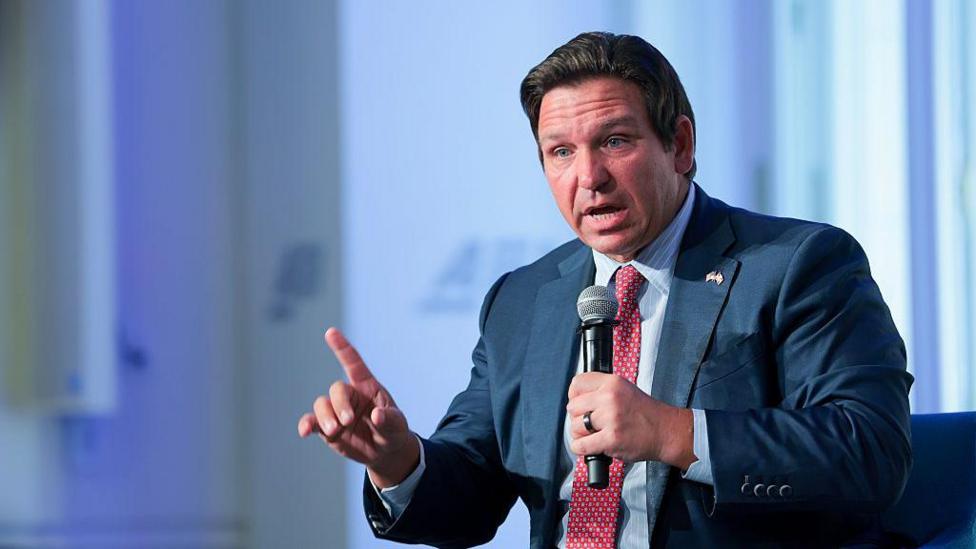
DeSantis has backed legal changes that lower the bar for imposing death sentences. In 2023, Florida reduced the number of jurors required to recommend a death sentence from a unanimous 12 to just eight. Separately, sexual battery against a child under 12 was made eligible for capital punishment. DeSantis has defended the policy as follows, describing the death penalty as a "strong deterrent" and "an appropriate punishment for the worst offenders." Florida's governor holds unusual authority: unlike most states, the office can sign death warrants for prisoners who have exhausted their appeals without further court oversight. Pennsylvania has a comparable process but has not carried out an execution since 1999.

Do most Americans still support the death penalty?
Support remains a majority position but is eroding. Just 52% of Americans say the death penalty is morally acceptable, according to Gallup polling cited in the original reporting - the lowest figure recorded since the 1970s. Death Penalty Information Center's Robin Maher said that although a majority still back it, the trend line is unmistakably downward, and that shift is echoed in how juries behave: in the 1990s, US juries handed down more than 300 death sentences a year, but in 2025 that figure fell to just 23.
"That tells us something very important: These are regular citizens that are sitting in judgment of people who are accused of committing the worst possible crimes, and then deciding what sentence fits those crimes," Maher said. "Those juries are increasingly saying that a death sentence is not the right answer."
Prosecutors in Florida remain firmly supportive. Attorney General James Uthmeier has pursued capital cases aggressively, calling the death penalty "the ultimate form of punishment" for "depraved" offenders. Florida State Attorney William Sheiner told Central Florida Public Media in a recent interview:
"The people that engage in this type of conduct, their punishment is frankly earned, and it's up to a jury of 12 to determine if that sentence is appropriate or not."
"Just because I pursue death as an option doesn't mean that that's going to be the sentence. It's basically me saying to the community: this is up to you guys to decide if death is appropriate."
Neither Uthmeier's nor Sheiner's offices responded immediately to requests for comment.
How are executions actually carried out, and what could go wrong?
The method of execution has become nearly as contentious as the punishment itself. Pharmaceutical companies have resisted having their products used for lethal injections, creating shortages that have pushed some states toward alternatives. Facing such a shortage in 2025, South Carolina began carrying out executions by firing squad. Idaho has since followed a similar path, becoming the seventh US state to adopt a firing squad chamber, a move detailed in our earlier coverage of Idaho's new execution chamber, which noted rising concern over botched executions and allegations that some firing squad procedures have caused prolonged suffering.
Botched executions remain a persistent concern. The Death Penalty Information Center estimates that about 3% of US executions between 1890 and 2010 went wrong in some way, with lethal injection carrying the highest rate of complications; in 2022, the organisation found more than a third of executions were botched or highly problematic. In May 2026, Tennessee officials spent over an hour attempting and failing to administer a lethal injection to Tony Von Carruthers, who had been on death row for decades. Witnesses said blood streamed down his chest as he groaned and told staff he was in pain. Governor Bill Lee granted Carruthers a one-year reprieve but disputed that the execution was botched, saying medical staff simply could not establish intravenous access. Hines, who was executed in Tennessee on 14 August 2026, had been scheduled to die under the same lethal injection protocol that failed with Carruthers roughly twelve weeks earlier.
Who were the three men executed and what were their cases?
Anthony Darrell Hines, 66, had maintained his innocence for decades and was reportedly bedridden before his execution in Tennessee. Jeremy Williams, 41, was convicted of raping and murdering a five-year-old girl in 2021 in Alabama; he dismissed his attorneys and volunteered for execution, and Governor Kay Ivey said beforehand that she did not plan to grant clemency. Carlos Cuesta-Rodriguez, 71, was convicted of murdering a woman in Oklahoma in 2003 and had asked for neither clemency nor mercy; experts had noted before the execution that his advanced age heightened the risk of complications during lethal injection.
How does this compare with past same-day executions?
Same-day multiple executions are historically rare in the modern era of US capital punishment. Since the death penalty was reinstated in 1976, states have carried out three or more executions on the same day 13 times, with the largest single-day total recorded on 9 December 1999, according to a historical analysis of US execution records. The last time three executions occurred on the same day before 2026 was on 7 January 2010, when Louisiana, Ohio and Texas each carried out an execution, per the report from the Florida news outlet cited above.
What happens next?
A federal execution remains possible under the policy Trump signed in January 2025, but no date has yet been announced for any federal case. Florida's death chamber is expected to remain the busiest in the country through the rest of 2026, with the state's execution calendar continuing at a pace far above other states, according to the CNN report on Florida's double execution.
Key Facts
- Three men - Anthony Darrell Hines, Jeremy Williams and Carlos Cuesta-Rodriguez - were executed on 14 August 2026 in Tennessee, Alabama and Oklahoma respectively.
- It was the first same-day triple execution in the US since three states did so on 7 January 2010.
- The US carried out 47 executions in 2025, up from 25 in 2024 and more than four times the 2021 total.
- Florida accounted for roughly 40% of 2025's executions and 12 of the first 19 executions in 2026, including a double execution on 28 July 2026.
- Public support for the death penalty has fallen to 52%, the lowest level recorded since the 1970s, while annual jury-issued death sentences have dropped from over 300 in the 1990s to just 23 in 2025.


