

A federal appeals court has ordered a halt to construction on President Donald Trump's $400m (£297m) White House ballroom, dealing a fresh blow to the project and setting up a likely showdown at the Supreme Court. The U.S. Court of Appeals for the District of Columbia Circuit ruled 2-1 on Friday, 7 August 2026, upholding an earlier injunction and giving the administration a two-week window to seek emergency relief from the nation's highest court, according to reporting on the ruling.
The panel's majority wrote that the decision over such a major addition to the presidential residence belongs to lawmakers, not the White House acting on its own.
"Whether or not a massive ballroom should be constructed is for Congress to decide and is not a matter for Executive self-help," the panel's majority said.
The injunction stems from a lawsuit filed by the National Trust for Historic Preservation, which took legal action after the East Wing was torn down to clear space for the project without lawmakers' sign-off. The judges found that no president has been granted the kind of sweeping authority the administration claimed to remake the building.
"Congress has not ceded unfettered authority to the Executive Branch to dramatically redesign, reshape, and reconstruct the White House — the People's House — to fit a particular President's desires," the panel said.
The three judges framed their reasoning around the idea that occupancy of the White House does not equate to ownership of it.
"Each President is a temporary tenant, not the owner, of the White House and its Executive Residence."
"The President has no — and claims no — constitutionally assigned authority over that property, which is designed and maintained for the use of all Presidents, current and future, and for the American people," the opinion said.
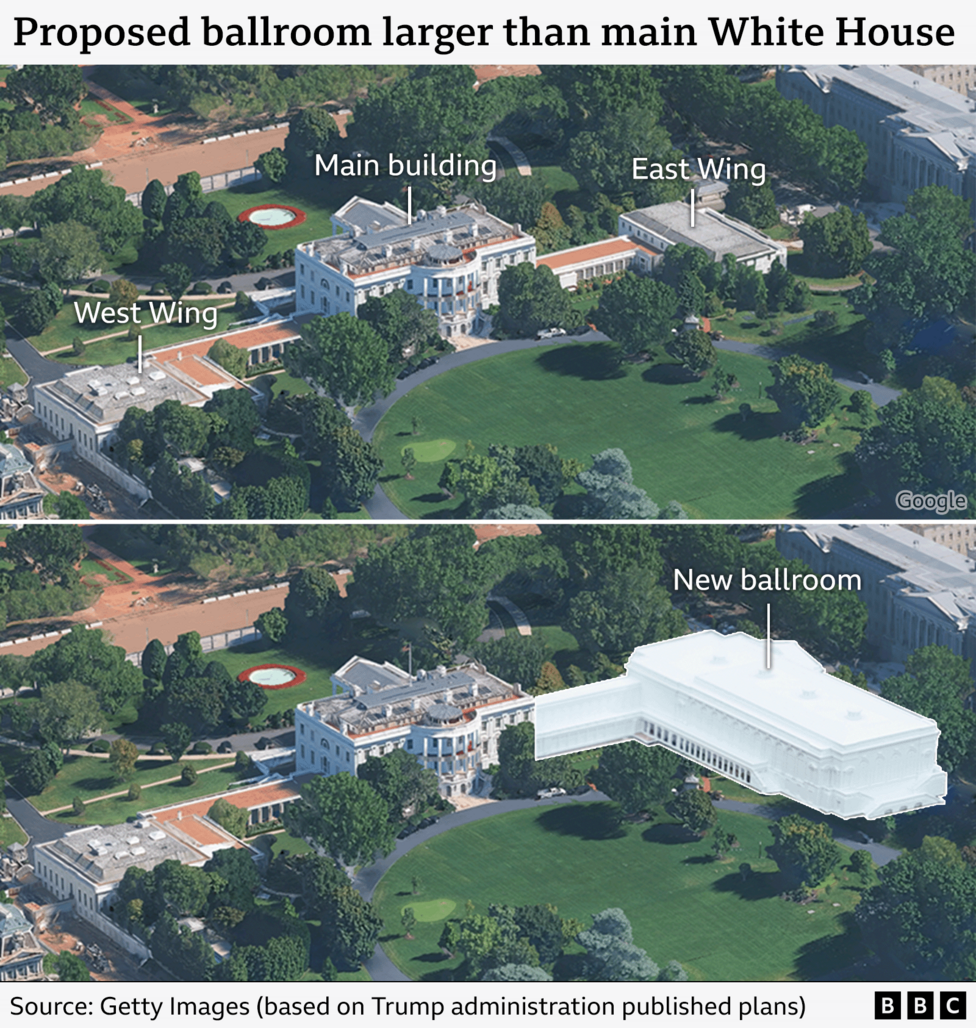

How big is the project, and who is behind the legal challenge?
The planned addition would span roughly 90,000 square feet (8,360 square meters), according to coverage of the case. The National Trust for Historic Preservation, the organisation that brought the suit, filed its complaint in December 2025, arguing that the project needed to be paused until federally mandated review and public-comment procedures had been completed.
What has the litigation looked like so far?
A district judge had twice ordered the administration to halt above-ground work at the site while permitting excavation and other underground activity to proceed. Construction had briefly resumed in April after a stay was granted so the appeals court could review written arguments and hear oral arguments the following month, according to the BBC's US media partner CBS. Friday's ruling reaffirms the block on above-ground building without congressional approval, though the court has paused enforcement for 14 days to let the administration pursue an appeal to the Supreme Court. The BBC has reached out to both the White House and the Department of Justice for comment.
This is not the only instance in which courts have pushed back on Trump-era changes to federally overseen sites and monuments. Earlier this year, a judge ordered Trump's name stripped from the Kennedy Center following a separate court order, and subsequently demanded an explanation after a tarp appeared covering the venue's facade. In a related case, a judge also directed the reinstatement of national park plaques that had been removed under a 2025 executive order. Taken together with a broader pattern of legal and political pushback facing the administration, including a dispute over the Reflecting Pool and Todd Blanche's bid to become attorney general, the ballroom ruling adds to a string of setbacks for the White House on matters involving federal property and oversight.
Why does the administration say the ballroom is necessary?
Trump has argued that the addition is needed to host large-scale events, including state visits, and has separately described the space as important for national security purposes. His justification for the project intensified following an assassination attempt at the White House Correspondents' Association dinner in April.
The appeals panel was careful to note that its ruling does not pass judgment on the merits of the ballroom itself, nor rule out its eventual construction.
"[This ruling] has nothing at all to do with whether the proposed ballroom is desirable," nor does it weigh in on whether the administration may ultimately construct the ballroom.
"What it does mean is that the Defendants may not do so during the district court's expeditious litigation without securing Congress's authorization, as the Constitution and laws require," the order said.
What happens next?
The D.C. Circuit's order will remain on hold for two weeks, giving the Trump administration a window to petition the Supreme Court for emergency intervention before the pause on enforcement lapses, according to reporting on the case. Should the administration seek that relief, the dispute over presidential authority to alter the White House complex without congressional approval would move to the nation's highest court. This report is being updated as new details emerge.
Key Facts
- The D.C. Circuit Court of Appeals ruled 2-1 on 7 August 2026 to uphold a block on above-ground construction of the ballroom.
- The project is estimated to cost $400m (£297m) and would cover approximately 90,000 sq ft (8,360 sq meters).
- The National Trust for Historic Preservation filed suit in December 2025 after the East Wing was demolished without congressional authorization.
- The court's order is stayed for 14 days to allow the administration to appeal to the Supreme Court.
- Underground construction has been permitted to continue even as above-ground work remains blocked.


