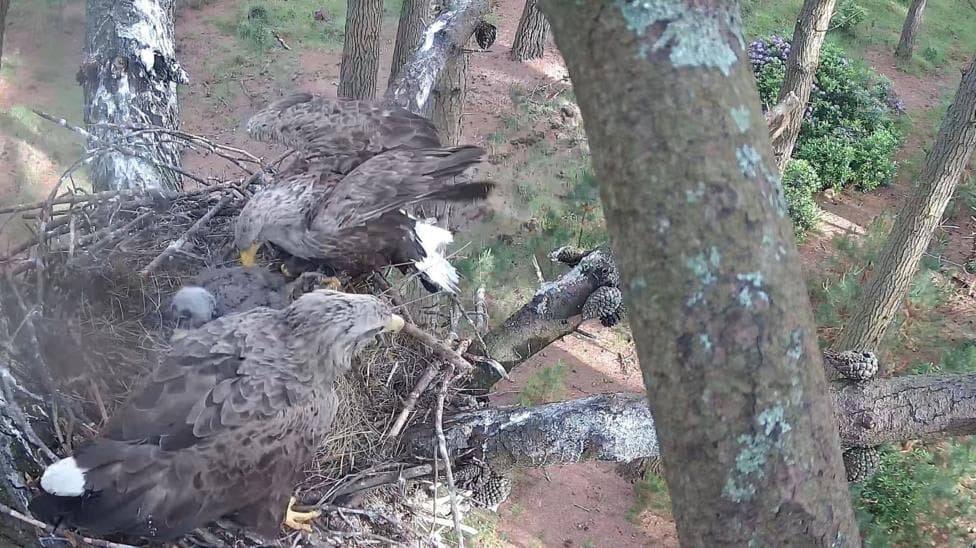
Young white-tailed eagles have successfully left their nests in the wild for the fourth year running, marking continued progress in a species restoration effort that has already transformed the English landscape. Three chicks fledged this year—one from a Dorset nest and two from Sussex—as two of five breeding pairs managed by the reintroduction initiative produced offspring.
The programme, operated jointly by Forestry England and the Roy Dennis Wildlife Foundation, began releasing birds in 2019 with the goal of re-establishing white-tailed eagles across England after centuries of absence. Since the project's launch, nine birds have been born in the wild, with this year's breeding season representing another milestone in the species' recovery.
This year's breeding success is another important milestone in the return of this lost species to England; it shows what can be achieved by very skilled wildlife managers, said Roy Dennis OBE from the foundation.
The foundation has described the breeding attempts as remarkable, particularly noting that one of the adult male birds successfully raised young despite having lost a leg five years earlier. Such resilience demonstrates the adaptability of the species even under challenging circumstances.
How did white-tailed eagles disappear from England?
Human persecution drove the species to extinction in England, with the last breeding pair recorded in southern England in 1780. The birds vanished entirely from the country for nearly two centuries before the reintroduction effort began.

What is the scale of the reintroduction effort?
The project has released a total of 56 young white-tailed eagles to date. According to Forestry England, the initiative aims to restore the species by releasing up to 60 birds over its lifetime. Chicks typically fledge at approximately 10 to 11 weeks old, allowing them to develop the strength needed for independent flight.
For the first time this year, the programme expanded its geographical reach by releasing six additional birds at Exmoor National Park in partnership with the Exmoor National Park Authority. According to recent reporting, this Exmoor phase is planned to continue with up to 20 additional birds over the next three years, significantly expanding the reintroduction's scope.
What support does the project require?
Restoring a species takes many years and requires the support of a wide range of communities and organisations, in particular landowners and farmers, Dennis explained. The project's success depends on cooperation across multiple stakeholder groups who share the vision of returning the species to its historical range.
Steve Egerton-Read, white-tailed eagle project officer for Forestry England, commented:
We are delighted that these three chicks made it through and will be closely watching their progress as they begin to explore the landscape.
The Exmoor expansion received formal backing from Natural England, which issued a licence permitting the next phase of releases to proceed. This regulatory approval signals confidence in the project's methodology and conservation value.
What happens next?
Project partners have committed to long-term management and monitoring of the reintroduced birds and their offspring for 20 years. The Exmoor releases are planned over a three-year period, with further birds expected to be introduced as part of the expanded programme. This extended timeline reflects the reality that restoring a species requires sustained effort and patience, but the early breeding successes suggest the approach is working.
Key Facts
- Three white-tailed eagle chicks fledged in 2026, continuing four consecutive years of successful wild breeding in England
- The reintroduction project has released 56 young eagles since 2019 and aims to release up to 60 over its lifetime
- Nine birds have been born in the wild since the programme began, exceeding initial expectations that breeding would not occur until 2024
- Exmoor National Park became a new release site in 2026, with plans for up to 20 additional birds over three years
- The species was hunted to extinction in England by 1780 and will be monitored for 20 years as part of the restoration effort