The UK government has cautioned local authorities against pursuing pedestrianisation schemes without thorough planning, warning that removing traffic from high streets can create accessibility problems and harm local economies if not handled carefully.
In evidence submitted to BBC News reported, the Ministry of Housing, Communities and Local Government (MHCLG) acknowledged that pedestrianisation can enhance high streets by making them "more attractive, safe and welcoming". However, the department stressed that such initiatives demand rigorous consideration, as eliminating vehicles could reduce accessibility and undermine commercial viability.
"Local leaders pursuing pedestrianisation must be aware of the risks and work to mitigate them, within a broader spatial strategy,"the government's submission to the Housing, Communities and Local Government Committee stated.
An MHCLG spokesperson confirmed that the government has not yet issued formal guidance to local authorities on pedestrianisation. The department intends to release a comprehensive high streets strategy later this year, with the spokesperson noting:
"We support local leaders to make their own choices about pedestrianisation based on the needs of their communities. Our upcoming high streets strategy will also set out more detail on how we are bringing high streets back to life and making sure they are accessible for everyone."
Why has pedestrianisation become more common?
Traffic bans on high streets have grown increasingly prevalent across UK city and town centres in recent years. During the Covid pandemic, several councils trialled pedestrianisation experiments, which sparked wider discussion about how outdoor public spaces should be utilised. The committee's inquiry also examines unwanted retail and service uses, council regeneration powers, business rates and the government's Pride in Place Programme, alongside pedestrianisation.
What has happened with Oxford Street?
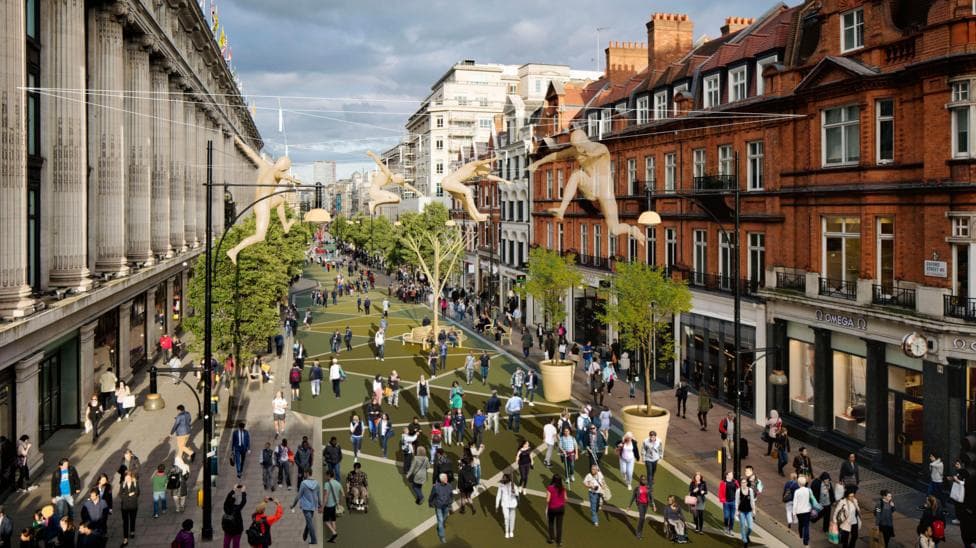
London's Oxford Street has become the most high-profile pedestrianisation case in the country. London Mayor Sadiq Khan proposed removing traffic from parts of the street in 2017, though an earlier plan was blocked by Westminster Council. The mayor subsequently clashed with the local council over revised proposals to make sections traffic-free.
The first phase of Oxford Street pedestrianisation is scheduled to begin on 26 October 2026. According to ground.news, the initial traffic-free phase will divert 10 bus routes, though emergency services will retain access to the area. The scheme's first phase covers nearly 1 km, from Orchard Street to Great Portland Street, with initial public-realm changes being temporary in nature.
The Oxford Street Development Corporation has framed the initial phase as a test, with feedback from visitors, residents, businesses and accessibility groups intended to inform later designs. More substantial temporary public-realm improvements are expected during 2027, with the full street transformation anticipated by spring 2027.
Westminster City Council has raised concerns that diverted traffic could spill onto nearby smaller streets and stated that questions about how the scheme would operate remain unanswered.
What does the evidence show about economic impact?
Most pedestrianisation schemes face some degree of local opposition, according to Professor Lee Ivett, who heads the School of Architecture at the University of the Built Environment. While opposition typically centres on short-term disruption to local businesses, research indicates that pedestrianisation can increase the economic viability of high streets over time.
However, Professor Ivett stressed that pedestrianisation must be accompanied by improvements in public transport infrastructure to realise those economic benefits.
"If you want to defeat the argument that a reduction in the amount of traffic will reduce the amount of trade, then you need to also be able to make an argument that an investment in public transport infrastructure is actually going to be the vehicle that still keeps providing accessibility to the centre,"he told the BBC.
What does government policy say?
In urban design guidance and previous high street strategies, the UK government has endorsed making high streets more attractive and pedestrian-friendly. The 2021 high street strategy, published when the Conservatives held power, stated the government wanted to see more town and city centres "designed with a sense of place and to be attractive to people walking, cycling and using public transport".
The government's current approach has emphasised providing local authorities with tools and flexibility to make their own decisions on pedestrianisation. Pedestrianising roads involves a lengthy and complex legal process, including consultations with residents and impact assessments.
Which pedestrianisation schemes have succeeded or failed?
Outcomes have been mixed across the country. West Berkshire Council ended Newbury's evening pedestrianisation trial last month after 75% of public consultation respondents opposed it. In contrast, the majority of Stevenson Square in Manchester's Northern Quarter has successfully transitioned into a permanent pedestrian-friendly space following a successful trial.
What happens next?
Bus route changes for the Oxford Street scheme are scheduled to begin on the evening of 25 October 2026, with traffic restrictions commencing the following day. The Housing, Communities and Local Government Committee said it would publish remaining written evidence submissions during the week of 19 October 2026. The government's new high streets strategy is expected later this year, which will provide further detail on how the administration plans to revitalise high streets while ensuring accessibility for all users.