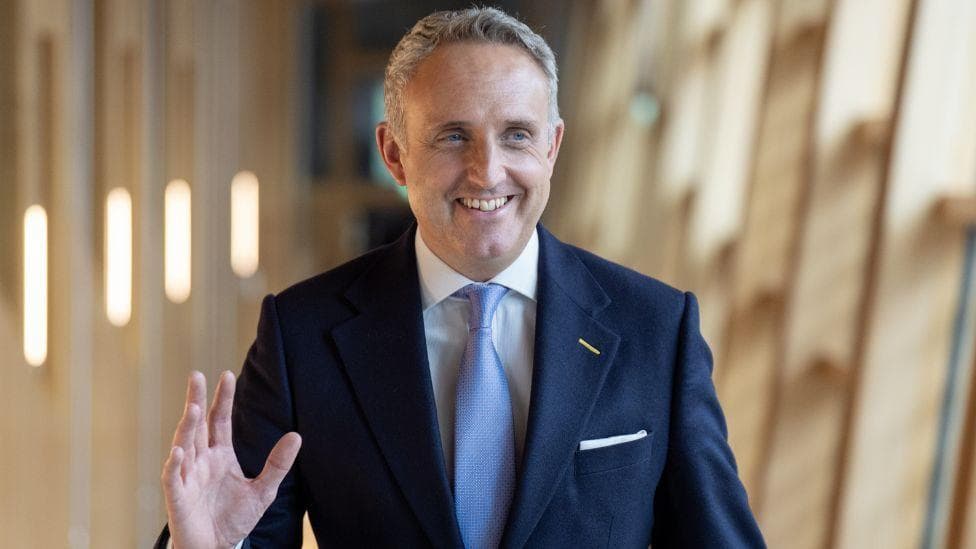
The Scottish Liberal Democrats are the most influential party at the Scottish Parliament, according to leader Alex Cole-Hamilton, who made the claim while addressing the UK party's conference in Brighton on 22 September 2026.
The party achieved its strongest result in two decades during May's election, winning 10 seats—an increase of six—yet remains the smallest parliamentary group. Cole-Hamilton argued that this apparent paradox reflects the party's pivotal role in the legislature, where the SNP and pro-independence parties depend on Lib Dem support to pass legislation.
Cole-Hamilton told delegates:
"The SNP went backwards, losing both votes and seats, leaving their plans for another referendum on Scottish independence in tatters."He credited his party with halting the Scottish National Party's momentum after John Swinney's administration had sought a majority of 65 seats to secure a mandate for a second independence referendum. Although the SNP fell short with 58 seats, pro-independence parties maintained overall control after the Scottish Greens secured a record 15 seats.
How does the Lib Dems' small size translate to influence?
Cole-Hamilton explained that the party's leverage stems from its ability to determine the outcome of parliamentary votes.
"The SNP know they will have to fight to win us over on every vote,"he said, adding:
"Our price will be steep."The party has already demonstrated this negotiating power by securing government commitments on renewable energy and coastal community support.
The Lib Dems won a Scottish Parliament vote backing an amendment on renewable-energy community benefits, with energy spokesperson Sanne Dijkstra-Downie leading efforts to expand local participation in onshore wind projects. According to party sources, the Scottish Government's own February 2026 proposals had set £6,000 per megawatt per year for onshore wind, which the Lib Dems characterised as a real-terms reduction compared with 2014 levels. The party also secured backing for extending an Islands Resilience Fund to coastal towns including Dunoon, Ardrossan and Mallaig.
The Lib Dems' institutional position was strengthened in April 2025 when they gained membership of the Scottish Parliament's Parliamentary Bureau, ending the SNP's majority on that body and providing the party with additional procedural leverage.

What was the party's election performance?
The Lib Dems' 10 MSPs represent their largest parliamentary group in 20 years. The party won in four constituencies, including a significant victory in Caithness, Sutherland and Ross, the UK's largest constituency by area. David Green of the Scottish Liberal Democrats defeated SNP incumbent Maree Todd in that seat, which spans nearly 4,942 square miles.
Cole-Hamilton described the result as a
"massive leap forward,"telling the conference:
"We won in places we have never won before."The party's manifesto, published before the election, had positioned it as a potential kingmaker, offering extensive policy proposals on health, education, local government, energy, arts, disability employment and carers.
How did Cole-Hamilton attack Reform?
Cole-Hamilton used his Brighton platform to criticise Reform UK, which won 17 seats in May to become Holyrood's joint second-largest group. He dismissed the party's leadership and promises to voters, saying:
"Nigel Farage isn't offering change. It's all a con—like some Wizard of Oz, sitting behind £72m worth of dodgy curtains."
"Reform, in Scotland, promised voters the earth, but so far they've achieved absolutely nothing,"he added. Cole-Hamilton positioned the Liberal Democrats as an alternative, stating:
"We liberals are the antidote to Reform. We may never match the crypto in their bank accounts, but they'll never match us on the doors."
Cole-Hamilton's remarks reflected a broader Lib Dem strategy, with party leader Sir Ed Davey positioning the Liberal Democrats as a political barrier against Reform and Farage at the autumn conference, while addressing internal criticism about the party's relevance and public profile.
What happens next?
Cole-Hamilton is expected to continue leveraging his conference platform to press for further concessions from the Scottish Government ahead of the next Holyrood election cycle, with the party publicly aiming to build on its 2026 gains. The party's ability to extract policy wins on renewable energy and coastal support suggests a strategy of demonstrating tangible results to voters in constituencies where it is seeking to expand its presence.
Key Facts
- The Scottish Liberal Democrats won 10 seats in May 2026, their largest group in 20 years, but remain the smallest party at Holyrood.
- Cole-Hamilton argues the party wields disproportionate influence because the SNP must secure Lib Dem support to pass legislation.
- The party has already won parliamentary votes on renewable energy community benefits and extending coastal support funds.
- Reform UK won 17 seats to become Holyrood's joint second-largest group, prompting Lib Dem criticism of the party's record.
- The Lib Dems gained membership of the Scottish Parliament's Parliamentary Bureau in April 2025, strengthening their institutional position.