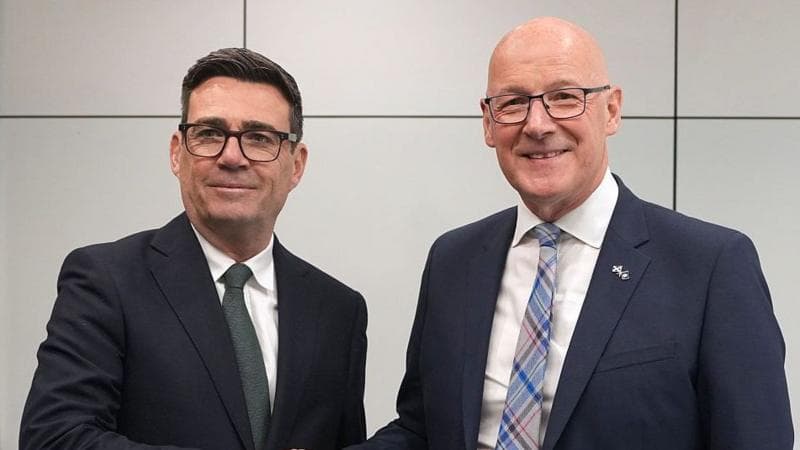
Prime Minister Andy Burnham will travel to Scotland to propose a partnership with First Minister John Swinney focused on devolving power to local communities and generating economic opportunities across the country. The visit occurs during the SNP's annual party conference in Aberdeen and will see Burnham deliver remarks in North Lanarkshire emphasizing the potential for joint working between the two administrations.
Burnham, who previously served as Mayor of Manchester, has made devolution to local areas a cornerstone of his government's agenda. His visit comes as Swinney continues to advocate for Scottish independence, having called for a second independence referendum by 2031. The timing also coincides with Conservative leader Kemi Badenoch's engagement in Glasgow, creating a three-way political contest for influence in Scotland.
What is Burnham proposing for Scotland?
The Prime Minister intends to frame devolution as an alternative pathway to independence, arguing that greater local control can deliver tangible benefits without constitutional change. In his remarks, Burnham is expected to state:
"During my first week in office, I told the first minister that I wanted to work with him to spread opportunities to communities across Scotland's regions and cities. Through No10 North, we are rewiring the state and I want to make sure regions in Scotland are fully part of this. This is me making an offer to the Scottish government. With us working together, there is no limit to what we can achieve for the Scottish people."
Burnham will also contend that Scotland's devolved administration represents one of Europe's most centralized devolved governments, suggesting that Holyrood concentrates too much authority rather than distributing it to communities best positioned to understand local needs. Despite Westminster having transferred substantial powers to Scotland over the past 27 years, the Prime Minister will argue that further decentralization within Scotland itself remains necessary.
He will call for collaboration between No10 North, the Scotland Office, and the Scottish government to establish what he describes as
"a new model of regional empowerment for Scotland, ensuring communities with their own strengths, identity and ambitions can seize new economic opportunities and unlock their potential."
Where is common ground between the governments?
Local devolution represents a policy domain where Westminster and Holyrood have signalled potential for cooperation. Both administrations have publicly stated willingness to advance power-sharing arrangements that place authority in city regions and local communities rather than at the centre.
Deputy First Minister Jenny Gilruth has welcomed Burnham's visit, viewing it as an opportunity to discuss public-service reform and advance discussions on devolving additional powers to the Scottish Parliament, according to reporting on the visit. Scotland's government is already pursuing a public-service reform programme that includes consultation on reorganizing local councils, with the country's 32 local authorities potentially being reduced in number.
However, Swinney has cautioned Burnham against overstepping boundaries by diminishing Holyrood's authority. The First Minister remains committed to his independence agenda and is expected to use his keynote address at the SNP conference on Saturday to renew his push for constitutional change. Notably, SNP conference delegates voted to abolish the Scotland Office on the day before Burnham's visit, signalling the party's resistance to Westminster's institutional presence in Scotland.
Swinney previously indicated openness to Burnham's suggestion that a border poll could be considered in both Scotland and Northern Ireland if there was clear consensus and public opinion had shifted. However, Burnham subsequently clarified his position during a Glasgow meeting with Swinney, stating that a second Scottish independence referendum remains
"off limits."
What is the Conservative position on devolution?
Conservative leader Kemi Badenoch has stated that her party currently holds
"no plans"to withdraw powers from the Scottish Parliament, though she has suggested that
"maybe we need a review"into how devolution is functioning. Speaking during a Thursday visit to Edinburgh, Badenoch characterized devolution as an evolving process rather than a fixed principle, saying:
"Devolution is a process. It's not a religion which we should worship. This is a process. If a process isn't working, how can you improve the process rather than just say the process is there, there's nothing we can do? We are about solutions."
She emphasized that the Conservatives' focus is on improving living standards rather than redistributing constitutional powers, adding:
"We don't have any plans to take powers away. What we do have plans for are how to make people's lives richer."
What happens next?
The SNP's 92nd annual conference runs at TECA in Aberdeen from 15 to 17 October 2026, providing the platform for Swinney to outline his party's vision for Scotland's future. Burnham's visit and speech will precede the First Minister's keynote address, setting the terms of debate around devolution and independence during the conference proceedings.
The competing visions presented by Burnham, Swinney, and Badenoch reflect broader disagreements about Scotland's constitutional future and the distribution of power between Westminster, Holyrood, and local communities. Whether the common ground on local devolution can translate into concrete cooperation remains to be seen as both governments navigate their fundamentally different constitutional objectives.