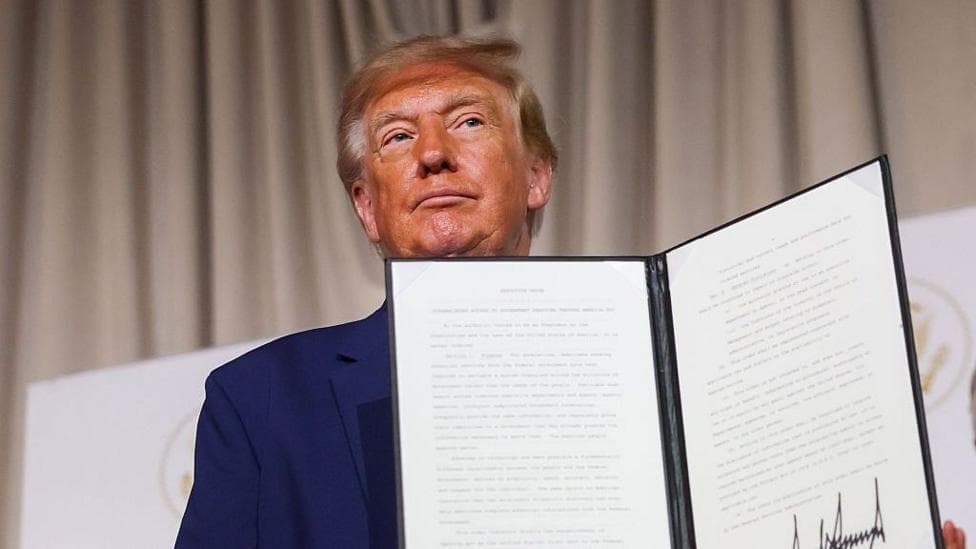
US President Donald Trump has ruled out any joint venture with China in artificial intelligence, contending that cooperation would amount to
giving away secretsto America's primary economic competitor. Speaking at an event in Washington on 29 September 2026 marking the launch of America.gov—a new AI-powered portal for government services—Trump reasserted his opposition to technology restrictions that he believes would hinder future growth, even as public anxiety about AI risks intensifies.
The president's remarks came days after Chinese President Xi Jinping visited the White House, following which Beijing and Washington announced a new AI dialogue framework with additional discussions scheduled for November. The two nations also established a dedicated communications channel designed to prevent misunderstandings stemming from AI-related incidents.
What is America.gov and how will it work?
America.gov functions as an AI-powered chatbot designed to streamline access to federal government services by drawing answers from official sources. According to reporting on the platform launch, the system was developed using Google's Gemini and SpaceXAI's Grok technology. The platform represents the first phase of a broader initiative; a second phase planned for early 2027 will enable users to apply for, enroll in and track benefits directly through the chatbot.
Trump signed an executive order directing federal agencies to integrate their public-facing services with America.gov within 90 days. According to Politico's reporting on the directive, the order applies to online services used by more than 100,000 people in a 12-month period, while excluding IRS tax filing and national-security-sensitive services.
Why does Trump oppose US-China AI cooperation?
Trump argued that the United States is
leading by a lotin the AI sector and should not
mix it upwith potential rivals. He contended that any partnership would expose American technological advantages to competitors.
If we do that, we're going to be giving a lot of secrets that we have that they [China] would want to have, or anybody else,Trump stated. He added that
there is nobody in third place...it's all between us and China.
Trump noted that AI was discussed during his recent meeting with President Xi but that he remained opposed to any formal cooperation on technology development.
Then they're going to be able to immediately gain access to things that we know that they don't know,he said, emphasizing that
we're leading now over China and everyone else, and I want to keep it that way.

However, Xi's public statements offered a contrasting perspective. According to reporting from the summit, Xi described the US and China as having a shared responsibility to develop and manage AI for good and to keep it under human control—a more cautious framing than Trump's account of their discussion.
What commitments did tech leaders make?
At a White House lunch with representatives from government agencies and technology companies including OpenAI, Anthropic and Meta, Trump said participants expressed
a belief that there should be tremendous self-regulation.Technology leaders signed what Trump described as a
morally bindingdocument intended to serve as
a form of protectionfrom potential AI hazards.
Trump announced that a
Super Intelligence Czarwould likely be appointed in the coming days. An executive order signed on 29 September formally changed the terminology used in government documents, replacing
artificial intelligencewith
Super Intelligence.This terminology shift reflected Trump's earlier proposal at the United Nations General Assembly the previous week, where he had suggested the US continue racing ahead in AI and proposed renaming the technology.
How does this address public concerns about AI safety?
Domestically, Trump faces mounting public concern regarding AI's potential dangers and calls for stronger safeguards. A poll published by Politico in late September found that two of every three Americans believe there is at least a
moderaterisk that AI could destroy humanity. A significant portion of Trump supporters surveyed—44 percent—indicated they would prefer if AI development could be paused.
Trump has repeatedly dismissed safety concerns, referring to them as a
hoaxand comparing them to what he characterizes as the
global warming scambeing
perpetrated by radical left Dumocrats.His administration's approach emphasizes industry self-regulation over government-imposed restrictions, arguing that regulatory constraints would stifle innovation and American competitiveness.
What happens next?
Federal agencies have 90 days from the executive order's signing to integrate their public-facing services with America.gov. The second phase of the platform, scheduled for early 2027, will expand functionality to allow citizens to complete benefit applications, enrollments and tracking through the AI chatbot interface. The appointment of a Super Intelligence Czar is expected to be announced within days, though no candidate has been publicly identified.
Prior to Trump's meeting with Xi, China's foreign ministry had warned that
narratives of threatand confrontation hindered effective AI governance, signaling Beijing's preference for collaborative rather than competitive approaches to the technology's development and oversight.