Business confidence faces mounting pressure as fresh data reveals UK companies are grappling with their sharpest cost increases in three years, while the economics world prepares to honour its most influential thinkers. Energy prices, raw material shortages and weakening domestic demand are combining to squeeze corporate margins ahead of the government's autumn fiscal statement.
Accountancy firm BDO's latest inflation index climbed to 103.65 in September, up from 102.18 in August and marking the highest level since June 2023. The deterioration reflects surging energy and fuel costs alongside broader material price pressures. Manufacturing and services output both contracted last month as consumer spending softened, the firm found.
Scott Knight, head of growth at BDO, outlined the mood among business leaders:
Businesses head into this Budget with one clear message: no surprises. Cost pressures continue to squeeze margins, hiring intentions are low and growth is starting to plateau. Firms are not looking for grand interventions, but they do need certainty. Right now, concerns about further downside risks outweigh expectations of positive change.
How are energy markets responding?
Oil prices have edged lower following reports that Ukraine and Russia agreed to halt attacks on each other's energy infrastructure, though the gains remain modest. Brent crude fell 0.25% to $104.46 a barrel after initially dropping around 2% earlier in the session, following a US diesel-supply arrangement with Moscow announced on Friday.
Kyle Rodda, senior financial market analyst at Capital.com, cautioned that the improvement is limited:
A highly contentious US deal with Russia to allow the export of more diesel to ease pressure in the market for the critical industrial fuel helped slightly with optics. But the true impact is piecemeal, especially as Middle East refining remains heavily compromised and Ukrainian forces strategically strike Russian refineries.
The tentative energy ceasefire unravelled almost immediately, with Ukraine reporting that Russian forces launched a targeted strike on a power plant in Kharkiv shortly after the agreement was announced.
What is happening to UK government borrowing costs?
Interest rates on UK government debt have fallen slightly, reversing some of the recent losses from the bond market downturn. The yield on 10-year gilts dropped 4 basis points to 5.41%, while 30-year bonds also fell 4 basis points to 5.91%. The modest decline may reflect optimism that an energy ceasefire could ease oil prices and reduce inflationary pressure, though the durability of any such agreement remains uncertain.
What fiscal challenges does the UK face?
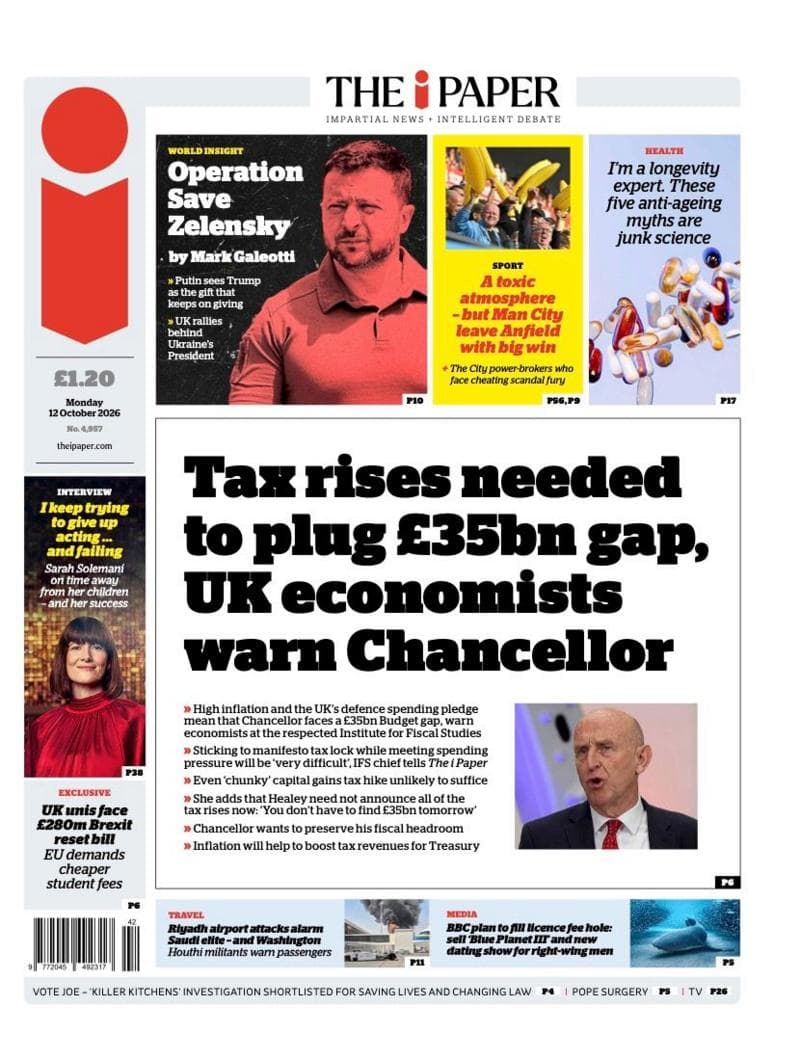
The Institute for Fiscal Studies has warned that Chancellor John Healey confronts a funding shortfall of up to £35 billion as inflation erodes the real value of departmental budgets and pushes up government borrowing costs. According to analysis from fiscal watchdogs, inflation could require up to £35bn in additional departmental funding by the end of the decade to preserve budgets' real-terms value. The IFS cautioned that Healey's budget announcement later this month risks becoming a
work of fictionunless he outlines concrete plans to address these spending pressures, including increased defence expenditure.
Healey is heading to Bangkok this week for the Annual Meetings of the International Monetary Fund and World Bank, where he will emphasise the need for international cooperation to manage global economic shocks.
The consequences of conflict in the Middle East and Europe are hitting countries worldwide, leading to higher prices at the pumps and more expensive mortgages at home, but Britain and our allies can face up to these challenges together. I will work with our international partners to keep trade moving, support families and businesses, and make Britain's economy stronger and more resilient to deliver good growth in every postcode. My Budget will build on this approach with fiscal discipline helping to deliver economic resilience. This means breathing space for today, and hope for the future.
How are financial markets opening?
London's FTSE 100 index opened 53 points higher, or 0.5%, at 10,604 points. Banking stocks led the gains, with HSBC rising 2.1% and Standard Chartered climbing 1.8%.
Recruitment firm Hays reported weaker results, with shares falling 9% after net fees declined 3% in the July-September quarter due to reduced demand for permanent placements. Chief executive Mark Dearnley noted that
the decline in Group net fees eased to 3% in Q1 driven by good Temp & Contracting growth in several of our countries. Perm activity remains mixed with sustained strong growth in North America but ongoing fragility in Northern Europe.The firm added that it was making progress on structural cost initiatives and remains confident in achieving medium-term targets.
What trade restrictions is the EU imposing?
The European Union has confirmed plans to limit hybrid electric vehicle imports from China to 350,000 cars annually under a four-year agreement negotiated in Beijing last week. The quota is expected to halve China's current market share of 6%, as hybrid exports have surged to approximately 800,000 units expected this year.
What is the Fight Inequality Alliance demanding at the IMF meeting?
The Fight Inequality Alliance is pressing finance ministers attending the IMF and World Bank meetings in Bangkok to consider debt cancellation for developing nations. The group argues that austerity policies have ended and that lending conditions forcing governments to prioritise creditor payments over healthcare and education must cease.
FIA General Secretary Jenny Ricks stated:
The IMF and World Bank are legacy institutions still writing the economic rules for the rest of the world. Their austerity programmes force governments to cut funding from hospitals and schools while every dollar sent to creditors is a dollar taken from a classroom, a clinic or a family's food budget. Cancel the debt, tax the super-rich, and stop making ordinary people pay for a crisis they didn't create. Bangkok will deliver more of the same. The era of the IMF and World Bank is over. Workers, teachers, nurses and young people from Nairobi to Jakarta are already building an economy for the 99% and they are not waiting for permission.
The alliance is calling for governments to cancel debts crushing poorer nations, end austerity by raising taxes on the wealthy instead of cutting services, implement a global tax on billionaires, prevent privatisation of public services, and ensure developing countries have genuine voting power within international financial institutions.
Who might win the Nobel Prize in Economics today?
The Sveriges Riksbank Prize in Economic Sciences in Memory of Alfred Nobel will be announced from 10.45am UK time at the Royal Academy of Sciences in Stockholm. The prize recognises outstanding contributions to economic science and has become one of the world's most prestigious academic honours, though it was not among the original Nobel prizes established by Alfred Nobel's will.
Prediction markets suggest several leading candidates. David Autor, a labour economist at the Massachusetts Institute of Technology, tops the betting at 30%. His research has examined how technological change reshapes employment and wage structures, particularly how computerisation has widened wage gaps between skilled and unskilled workers in the United States.
Ariél Pakes, the Thomas Professor of Economics at Harvard University, stands at 19% in prediction markets. His work has developed empirical methods to analyse how markets respond to environmental and policy changes, including mergers and deregulation. His contributions include the Berry–Levinsohn–Pakes approach to demand estimation, which models how consumers choose between products and predicts the price effects of corporate consolidation.
Susan Athey, the Economics of Technology Professor at Stanford Graduate School of Business, is at 12%. She was the first woman to win the John Bates Clark Medal, awarded to the top economist under 40, and her research has focused on auction theory and the empirical models underlying auction design.
Michael Woodford, an American macroeconomist and monetary theorist currently at 10%, is another contender. He helped develop modern forward guidance, the principle that central banks can influence economies by shaping public expectations about inflation rather than solely through interest rate adjustments.
The 2025 economics prize was shared by Joel Mokyr, Philippe Aghion and Peter Howitt for work on innovation-driven growth and sustained growth through technological progress. The 2026 prize announcement is scheduled for 11:45 CEST at the earliest on 12 October, though the laureate has not yet been listed on the Nobel Prize site.
Key Facts
- BDO's inflation index reached 103.65 in September, the highest since June 2023, driven by energy, fuel and raw material cost increases
- The Institute for Fiscal Studies warns the government faces a £35 billion funding gap due to inflation eroding departmental budgets and raising borrowing costs
- Oil prices fell modestly to $104.46 a barrel after reports of an energy ceasefire between Ukraine and Russia, though the agreement quickly deteriorated
- The EU will cap hybrid electric vehicle imports from China at 350,000 cars annually, expected to halve China's current 6% market share
- The Nobel Prize in Economics will be announced at 10.45am UK time, with labour economist David Autor leading prediction markets at 30%