
Botticelli's Venus has stepped down from her shell and arrived at your doorstep for a nocturnal encounter. Her luminous hair shimmers against the darkness as she gazes beyond you toward something only she comprehends, while your attention traces those flowing locks downward to a hand that gathers fabric between her legs. She is unmistakably the goddess inhabiting Botticelli's masterpiece in the Uffizi Gallery in Florence. This nearly identical work from approximately 1490, also created by Botticelli and his workshop, demonstrates how thoroughly his Uffizi painting had become an icon—so much so that a patron commissioned this variant, stripped of the zephyrs and emerald sea but retaining that commanding divine form.
In artistic tradition, Venus functions as shorthand for "female nude." Botticelli established an appetite for sensual painted goddesses that has persisted unbroken. From his mesmerizing canvases emerged a succession of voluptuous divine figures—rising, reclining, commanding European art through centuries until Michelangelo Pistoletto's ironic 1967 assemblage, also featured in this exhibition, where discarded clothing spills from a corner around a marble nude viewed from behind, merging beauty with disorder in a composition resembling a refuse-scattered Neapolitan square.
Yet this exhibition bears a different name and tells a fragmented story. Rather than tracing Venus through artistic history, it reframes her as a Roman appropriation of the original Greek love goddess Aphrodite—who herself, the show argues, derives from an earlier matriarchal deity venerated on Cyprus. The result combines world-class artworks with an archaeological thesis that shapes the entire narrative.
The tension between curatorial ambition and execution becomes apparent immediately. A classical marble Crouching Aphrodite, borrowed from the royal collection, opens the display with no examination of its subsequent artistic influence. This Roman reproduction of an ancient Greek sculpture carries a remarkable provenance: Cromwell's republican government sold it after executing Charles I, and the artist Peter Lely acquired it. Lely subsequently painted his own enigmatic nude masterpiece, Nymphs by a Fountain, as a defiant anti-Puritan statement. After the Restoration, he also depicted Nell Gwyn unclothed—his fascination with this Venus figure drove genuinely creative work. Rubens, too, had studied this same statue and created his painting Venus Frigida in response.
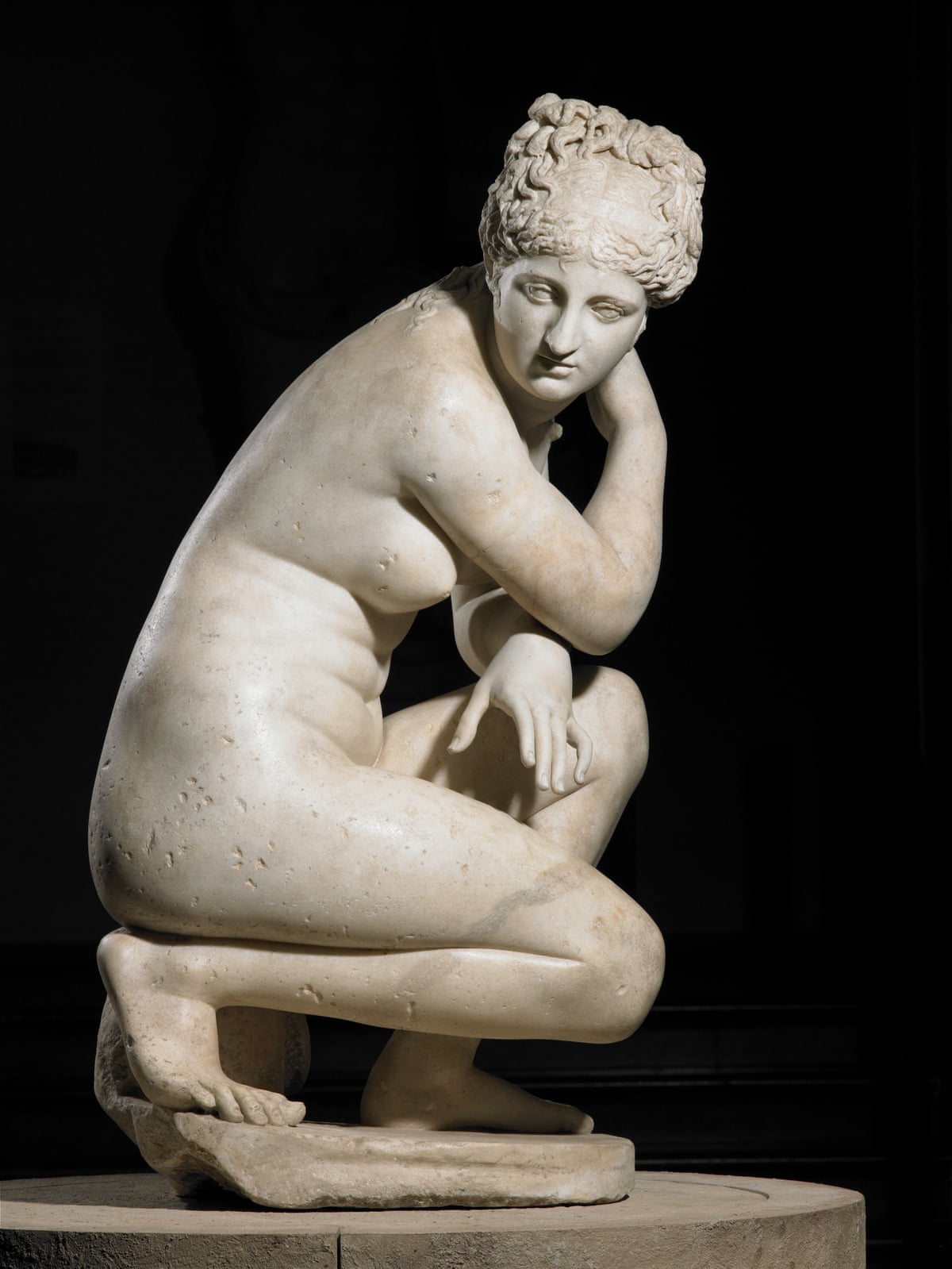
This history alone suggests that Aphrodite and Venus in art constitute an enormous, intricate narrative. The exhibition's modest scale struggles to contain such scope, and considerable wall space remains underutilized. Still, every exhibition must begin somewhere. The opening gallery surveys the multiplicity of Aphrodite's representations in ancient Greece, including a red-figure vase depicting her alongside rival goddesses Hera and Athena as they prepare for the beauty contest she will win—the competition that triggers the Trojan War. This room pulses with mythological richness. The marriage of Aphrodite to Hephaestos, the smith-god, and her affair with Ares, god of war, receives cursory treatment, illustrated by an obscure 16th-century print. Then the exhibition makes an abrupt temporal leap backward to confront what the curators claim was the authentic, primordial Aphrodite.
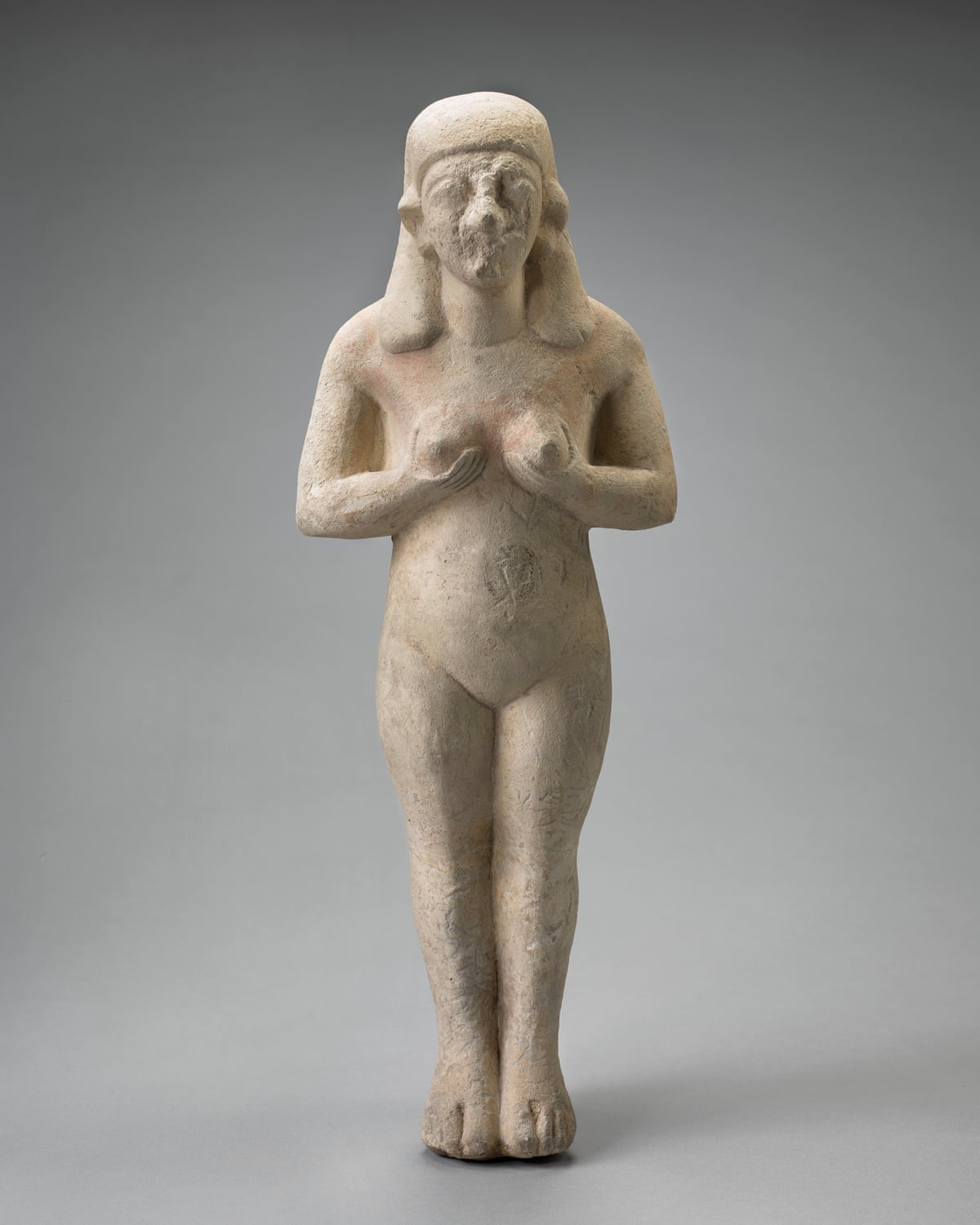
In classical mythology, Aphrodite maintains a profound connection to Cyprus: her shell carries her to Cypriot shores in The Birth of Venus. According to this exhibition's argument, the Greek Aphrodite represents an appropriation of a female deity who wielded supreme power on the island. Prehistoric totems with simplified bodies, and in one instance a bird's head, testify to this cult's significance. Terracotta figurines depicting childbirth and motherhood may have functioned as votive offerings from women to this unnamed goddess. Other artifacts blend her with Egyptian and Phoenician deities. Yet the exhibition fails to convincingly demonstrate how these elements explain the emergence of the Greek and Roman love divinity. More troublingly, this material appears chronologically misplaced—why not establish this foundation before advancing through time?
What remains undeniable is that ancient Greeks transformed nudity into their cultural signature. Nakedness embodied their sense of distinction from neighboring civilizations. Yet the Capitoline Venus demands cautious viewing. This second-century AD Roman marble copy reproduces a lost work that scandalized antiquity: Praxiteles' Venus of Knidos. Before Praxiteles, Greeks did not depict Aphrodite nude. When unveiled in the fourth century BC, her vulnerability astonished viewers. Aphrodite stands caught mid-bath, attempting unsuccessfully to conceal herself with her arms. One infatuated visitor allegedly entered her sanctuary after dark and pressed himself against the statue's cold marble thigh, leaving a stain.
Encountering this after viewing evidence of the ancient Cypriot Aphrodite produces discomfort. The progression suggests the Greeks appropriated a matriarchal deity and transformed her into an object of desire. The Romans adopted that nude image and disseminated it across their dominion: a crude, graffiti-like relief from a fort north of Hadrian's Wall depicting a naked Venus bathing offers both humor and fascination.
Botticelli emerges as the true devotee of Aphrodite and Venus. For a thousand years following Rome's collapse, Christianity banished her from worship. The Renaissance revived her veneration. When observing the inscrutable gaze in his Venus, viewers too become believers that love constitutes a sacred force deserving divine representation.
The exhibition, curated by Dr Anja Ulbrich with co-curation by Dr Peter A. Thompson, Liam McNamara and Dr Jennifer Sliwka, encompasses more than 200 objects spanning from 1400 BCE to the 21st century. Notable loans include a Capitoline Venus from the Louvre, Yves Klein's Blue Venus, and a Loewe dress by Jonathan Anderson worn by Beyoncé. The Ashmolean's own collection features a copper-alloy figurine dated to around 1200 BCE, described as the earliest known representation of Aphrodite.
When does the exhibition open?
The exhibition opens to the public on 8 October 2026 and runs through 11 April 2027. Ashmolean members receive early access with a preview on 7 October 2026. Curator Anja Ulbrich will deliver an exhibition talk on 17 October 2026 from 2–3pm, available both in person and online.
Key Facts
- The exhibition traces Aphrodite from her origins as a Cypriot matriarchal deity through her transformation into the Roman Venus and her revival during the Renaissance
- The show features more than 200 artworks and artifacts spanning 3,400 years, from prehistoric Cypriot totems to contemporary works
- A Roman marble Crouching Aphrodite from the royal collection anchors the display, with significant loans from major international museums including the Louvre
- The narrative argues that ancient Greeks appropriated an earlier female deity and reimagined her as a nude love goddess, a form the Romans then spread throughout their empire