

Why Frank at Tottenham was a gamble that ended in bitter failure
Thomas Frank's appointment as Tottenham Hotspur head coach represented a significant risk for both the club and the manager. Ultimately, this gamble did not pay off, culminating in a period marked by considerable tension and dissatisfaction.
Frank transitioned from the stability and well-structured environment at Brentford, where he had achieved notable success, to the more volatile and high-pressure setting at Spurs. Unlike Brentford, where owner Matthew Benham and director of football Phil Giles provided a solid foundation, Frank entered a club with intense scrutiny and expectations. Notably, even winning the Europa League—the club’s first trophy in 17 years—did not secure Ange Postecoglou’s position, Frank’s predecessor, illustrating the unforgiving nature of the Spurs environment.
For Tottenham, hiring Frank meant entrusting a coach who had not previously operated under such intense media and fan pressure. This mismatch quickly became apparent, as Frank struggled to adapt to the demands of managing a club of Spurs’ stature.
The tenure was characterized by a lack of joy and increasing hostility from the majority of Tottenham supporters, who rapidly concluded that Frank was unsuitable for the role and the club’s ambitions.
Frank’s dismissal is a significant disappointment for the Danish coach, who had earned his opportunity at Spurs through his achievements at Brentford, including guiding them to the Premier League and maintaining their status there for four seasons.
Frank sacked by Spurs after eight months in charge
Reaction after Frank sacked as Tottenham boss
Frank's Spurs lacked identity
Frank inherited a Tottenham side that finished 17th in the Premier League the previous season, having suffered 22 defeats. Although the club secured the Europa League title, league performance remains the primary indicator of a team’s quality, and by that measure, the squad was underwhelming.
The expectation that Frank could significantly overhaul or transform the team within a few months was unrealistic. Tottenham required not only changes in personnel but also a cultural shift, a factor that contributed to Frank’s challenges.
Since Mauricio Pochettino’s departure—six months after Spurs’ 2019 Champions League final loss to Liverpool—the club has struggled to find a manager who commands similar support and popularity.
Frank’s dismissal places him among a list of recent Spurs managers who have failed to meet expectations, including accomplished figures such as Jose Mourinho and Antonio Conte, as well as Nuno Espirito Santo and Postecoglou, the latter having delivered the club’s recent silverware.
Ultimately, Frank was unable to master the complex demands of the role, a struggle that visibly affected him and left him appearing worn down and beleaguered.
His Tottenham teams lacked a clear identity, hampered by inconsistent tactics and a cautious, safety-first approach when decisive action was required.
Two home defeats stand out as particularly emblematic of Frank’s tenure: a loss to Chelsea and a heavy defeat in the North London derby against Arsenal. Statistically, these matches represented some of the weakest attacking performances by any Premier League team this season. Spurs registered an expected goals (xG) of just 0.1 in the 1-0 home loss to Chelsea and 0.07 xG in the 4-1 defeat at Arsenal.
Frank’s defensive and conservative tactics, especially in the Arsenal game where a five-man defense was deployed, invited sharp criticism as it appeared to be a strategy aimed at damage limitation rather than competitiveness. The fact that Eberechi Eze—whom Spurs had pursued but lost to Arsenal in a £60 million transfer—scored a hat-trick in that match added to the humiliation.
While the Arsenal defeat was particularly painful for fans, the home loss to Chelsea was arguably more concerning, as Spurs were nearly overwhelmed but for a combination of Chelsea’s inefficiency and goalkeeper Guglielmo Vicario’s outstanding performance.
This defeat marked the beginning of a difficult downward trajectory for Frank’s tenure.
Boos after Newcastle hand Tottenham another home defeat
At Brentford, Frank was known for his clear strategic thinking, effective communication, and problem-solving skills. However, these qualities seemed diminished as Spurs’ performances deteriorated following initial Premier League victories under his leadership.
It became unclear whether Frank’s instructions lacked clarity or if the players failed to embrace his methods. Observers struggled to identify a coherent style or tactical approach, with the team appearing as a collection of disparate ideas rather than a unified system.
Frank began his Spurs tenure with two wins: a home victory against Burnley and an away win at Manchester City. However, as with Postecoglou, this promising start was not sustained.
At Brentford, Frank’s approach emphasized quick, direct play and intense pressing, both in open play and set-piece situations. His squad featured quality forwards such as Ivan Toney, Bryan Mbeumo, and Yoane Wissa.
In contrast, Frank failed to establish a recognizable playing identity at Tottenham. Fans quickly grew disillusioned, perceiving his tactics as either overly pragmatic or outright negative.
Both supporters and players frequently appeared confused or unconvinced by Frank’s strategy, with the manager himself sometimes seeming surprised by the team’s decline.
One of Frank’s early decisions was to appoint Cristian Romero as captain, succeeding Son Heung-Min. This choice proved controversial. Despite Romero’s status as a World Cup winner, he was often a liability on the pitch, prone to disciplinary issues, and off the field, he made contentious public statements.
Romero received red cards in matches against Liverpool and Manchester United and publicly criticized the club’s management twice. Initially, he accused the hierarchy of dishonesty in an Instagram post that was later edited, and subsequently described the lack of available players as "disgraceful."
These incidents undermined Frank’s authority and did more harm than good.
Failed Eze deal and injuries hit Frank's plans
Frank’s challenges extended beyond tactics and fan relations; he was also hindered by unfortunate circumstances regarding player availability.
Injuries sidelined several key performers, and the departure of influential forward Son Heung-Min further weakened the squad.
A significant setback was the drawn-out pursuit of Eberechi Eze. The club’s delay allowed Arsenal to intervene and secure the Crystal Palace midfielder’s signature.
Similarly, Tottenham believed they were close to signing Nottingham Forest’s Morgan Gibbs-White for £60 million, with a medical tentatively scheduled. However, Forest’s owner Evangelos Marinakis disputed this, and the player ultimately signed a new contract with Forest.
Both Eze and Gibbs-White represented potential match-winners who could have been invaluable to Frank’s plans.
Dejan Kulusevski, one of Spurs’ most dynamic attacking players, did not feature under Frank due to a patella injury requiring surgery sustained the previous season.
Dejan Kulusevski's long-term knee injury robbed Frank of a crucial attacking weapon
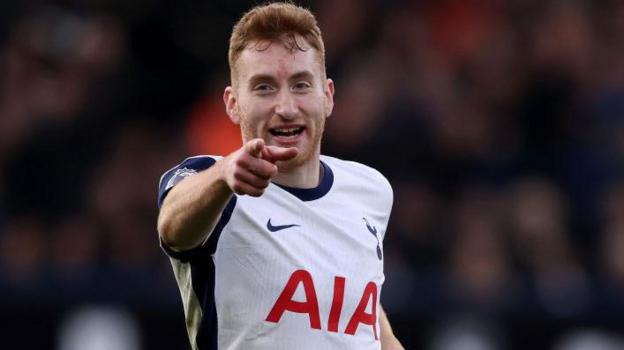
England midfielder James Maddison, who had been in and out of the team under Postecoglou, suffered an anterior cruciate ligament injury during a pre-season friendly against Newcastle in June, ending his chances of contributing under Frank.
Dominic Solanke, the club’s £60 million striker, was also sidelined for months following ankle surgery. Additionally, £55 million signing Mohammed Kudus and Richarlison endured long-term injuries.
These absences severely limited Frank’s options and contributed to the team’s struggles.
Frank failed to connect with fans
Former chairman Daniel Levy was often the focus of fan frustration. His departure in September was broadly welcomed but left Frank more exposed to criticism without Levy as a buffer.
At Brentford, Frank was highly regarded not only for his on-field success but also for the strong rapport he built with supporters. His post-match lap of honour and personal acknowledgments of fans were common and well-received.
Ironically, one of the most hostile moments of Frank’s Spurs tenure occurred at Brentford’s Gtech Community Stadium on New Year’s Day, when he was jeered by visiting Spurs fans after a goalless draw.
Building a close connection with fans proved difficult in Tottenham’s large, modern stadium, which seats over 61,000. Such bonds typically require positive results, which were scarce, with the team winning only two of 11 home league games under Frank.
Frank’s attempts to engage fans became contentious, especially after defenders Djed Spence and Micky van de Ven refused to join him on a lap of honour following a home defeat to Chelsea, although both later apologized.
This incident, perceived as disrespectful to Frank, raised questions about his authority within the squad.
Further scrutiny followed after Spence’s reaction to being substituted during a 3-0 loss at Nottingham Forest, leading to uncomfortable questions for the manager.
The tenure was marked by frequent dissatisfaction and disconnect between the team, management, and supporters.
Unlike at Brentford, Frank publicly criticized his own supporters on occasion, a move that rarely yields positive outcomes. After a defeat by Fulham, he described the booing of goalkeeper Vicario as
"unacceptable" and not the actions of "true Spurs supporters".
This candidness was risky, especially given the lack of victories to mend relations.
At Brentford, Frank’s honesty, positivity, and results made him a beloved figure; at Spurs, the experience was the opposite.
Time and patience, which were abundant at Brentford, were in short supply at Tottenham. This scarcity was due not only to the club’s new leadership post-Levy but also to fans who never fully accepted Frank, doubting his experience and methods.
Many supporters believed from the outset that Frank’s background at a smaller club did not equip him to manage the complexities of Tottenham Hotspur.
Frank needed an immediate impact to dispel these doubts but was unable to deliver.
Latest Tottenham news, analysis and fan views
Ask about Tottenham - what do you want to know?


