

Samson Guides India to Five-Wicket Win to Reach Last Four
For the third consecutive T20 World Cup, England will face India in the semi-finals after the co-hosts defeated West Indies in a de facto quarter-final on Sunday night. This victory secured India’s place in the final four and eliminated the West Indies from the tournament.
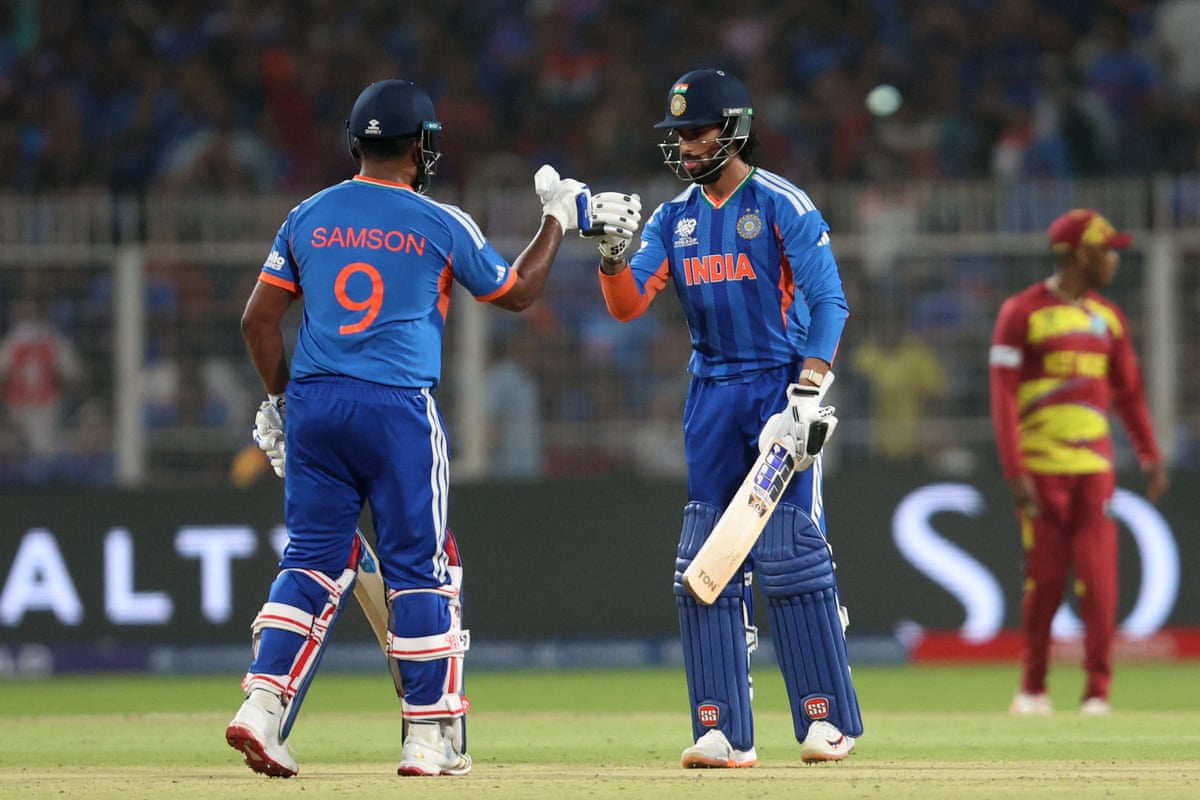
Sanju Samson, who was initially dropped from the squad just before the tournament but recalled following India’s disappointing Super 8s loss to South Africa, made a remarkable comeback. He batted throughout the innings, finishing unbeaten on 97 runs. Chasing a target of 196, India maintained control with the 31-year-old at the crease. Samson sealed the win by hitting the winning runs over mid-on on his 50th delivery, securing a five-wicket victory with four balls to spare.
West Indies Batting and Fielding Performance
West Indies were put into bat first. Roston Chase, opening for the first time in T20 internationals, provided a strong start with partnerships of 68 runs off 53 balls alongside Shai Hope, and 34 runs off 16 balls with Shimron Hetmyer. The latter partnership ended when Jasprit Bumrah dismissed both batsmen in a single over. Jason Holder and Rovman Powell contributed 76 runs off the last 35 balls. However, the innings was hampered by Hope’s slow innings of 32 runs off 33 balls and a series of fielding errors, including three dropped catches.
Upcoming Semi-Finals and Tournament Context
India and England will meet in Mumbai on Thursday. In the previous two tournaments, the winner of their semi-final clash went on to win the title, with England triumphing in 2022 and India prevailing in Guyana two years earlier.
The other semi-final is scheduled for Wednesday between New Zealand, who finished as runners-up in England’s Super 8s group, and South Africa, who topped their group by defeating Zimbabwe by five wickets in Delhi. These teams also faced each other in the first group stage, where South Africa won by seven wickets, maintaining their 100% record against New Zealand in five T20 World Cup encounters. Prior to this tournament, the two teams had not met in 12 years.

Venue Decisions and Tournament Scheduling
The weekend concluded with clarity on the semi-final matchups and venues. The possibility of relocating a semi-final or the final to Colombo was eliminated after Pakistan, needing a decisive win against Sri Lanka on Saturday, won by only five runs. Due to this uncertainty, tickets for the matches went on sale only the previous Tuesday. Additionally, ticket sales were launched on short notice for two finals in two different countries.
England completed their last Super 8s match on Friday but had to wait two days in Colombo for confirmation of their semi-final venue, despite early results in the other group providing near-definitive outcomes.
The International Cricket Council’s decision not to schedule the final round of group fixtures simultaneously extended this uncertainty. Simultaneous scheduling would have enhanced sporting integrity and allowed all four matches to be played on the same day. Instead, each match was given its own primetime broadcast slot, spreading the games over three days.
Impact on Teams and Fans
While some may find it unfair that India had the advantage of knowing only a Pakistan win could have shifted their semi-final from Mumbai, not all aspects of co-hosting have favored them. To accommodate their fans, India has played their first seven games across six different cities. In contrast, England has played in four cities, New Zealand in three, and South Africa in only two. Should South Africa reach the final, they will have played six of nine games at the Narendra Modi Stadium in Ahmedabad, the venue for the final. If India sought to influence conditions, these fixtures would be most advantageous.
Organizational Challenges and Future Prospects
For television audiences, the complex arrangements have had minimal impact. However, for attendees required to plan travel across multiple cities with last-minute cancellations, the tournament’s organization may seem confusing and costly. Hoteliers in host cities face thousands of last-minute cancellations, while staffing, policing, and catering arrangements for canceled matches add further complications.
The upcoming 50-over World Cup co-hosted by India and Bangladesh in five years presents an opportunity to apply lessons learned from this tournament’s logistical challenges.


