

First Test: England 140; New Zealand 61-6
Paceman’s Stunning Return Gives England the Edge
After a two-year absence, Ollie Robinson re-entered the England cricket team and quickly impressed supporters with a remarkable performance. Charging in from the Nursery End, Robinson delivered a devastating first over, claiming three wickets, and finished with four wickets overall, shaping an extraordinary opening day against New Zealand.
A total of 16 wickets fell within just 60 overs of rain-affected play. If this Test match were held in Australia, the groundsman might be concerned about the pitch conditions ahead of Saturday’s play. While the pitch may become less challenging, fast bowlers on both sides will hope it remains as lively as it was.
Kyle Jamieson initially dominated with his seam bowling, taking five wickets for 62 runs to dismiss England for 140, marking a disappointing start for the post-Ashes England side. However, Robinson’s impactful spell then shifted momentum by dismantling New Zealand’s top order, leaving them at 61 for six by stumps.
It was fitting that fans adapted Jimmy Anderson’s old song as Robinson began his spell. Robinson was expected to succeed Anderson in 2024 but had previously fallen short of England’s preparation standards, casting doubt on his return. The 32-year-old’s skills, however, were never questioned and were fully displayed here, as he trapped Devon Conway lbw with his third ball, caught Kane Williamson at short leg with his fifth, and concluded the over by bowling Rachin Ravindra.
Robinson’s relentless six-over spell also included dismissing Daryl Mitchell, who was bowled after shouldering arms. Meanwhile, Gus Atkinson and Josh Tongue took wickets on either side of Robinson’s spell. The conditions were ideal for bowling, with overcast skies and the Dukes ball moving significantly. This performance was a remarkable turnaround for England at the innings break.
Reviewing England’s first innings scorecard might suggest another collapse fueled by reckless shots and unconventional strokes. However, aside from Harry Brook’s dismissal on 56—when he chose to accelerate with the tail—this was a less chaotic collapse than usual. Nonetheless, it was a suboptimal performance, especially considering New Zealand lost their lead bowler Matt Henry to back spasms after his initial spell.
Amid the action, a heartening story emerged. Kyle Jamieson, returning to Test cricket after more than two years due to lower back stress fractures, earned a place on the Lord’s honours board as a reward for his dedication to rehabilitation and training.
Despite New Zealand’s excellence—including a superb one-handed slip catch by Kane Williamson to dismiss Ben Stokes—England’s approach showed some caution. This suggested a team still adjusting after four years of strict mental conditioning were undone in Australia.
Ben Duckett’s departure after facing only two balls in the morning session was an early warning sign. Duckett, who values feeling the ball, had previously thrived but now appeared intent on adopting a more responsible role this year, though its suitability remains uncertain.

Emilio Gay, recently presented with his England cap by fellow Bedford School alumnus Alastair Cook, had a promising start in Test cricket. Jamieson’s full toss was driven through cover for four to open Gay’s scoring. However, before the first rain delay, Gay managed only one additional boundary—a crisp on-drive—before Jamieson found his line and length, trapping Gay lbw with a delivery that moved away and inducing a low catch at first slip. This was a challenging introduction to Test cricket for Gay.
Following the rain break, New Zealand coped well without Matt Henry. England, however, lost three wickets within 14 deliveries after reaching 31 for one. While Jamieson received praise, Nathan Smith and Will O’Rourke were instrumental, combining precise outswing bowling with 90mph pace.
Duckett was first to fall, lbw for 19 to a Smith delivery that jagged inward. Jacob Bethell was next, bowled by O’Rourke after missing a drive. Joe Root’s dismissal was significant; he was out for one, caught behind after edging a rising ball from O’Rourke.
Jamie Smith’s wicket was particularly crucial. He was bowled after shouldering arms to Jamieson, making the score 55 for five. The ball bounced sharply, making the dismissal less surprising than a previous lapse when Smith had played a loose shot to Marnus Labuschagne.
Similar to the Melbourne Ashes Test, Harry Brook led the resistance with a positive half-century. Despite being dropped twice, Brook maintained his natural style of play.
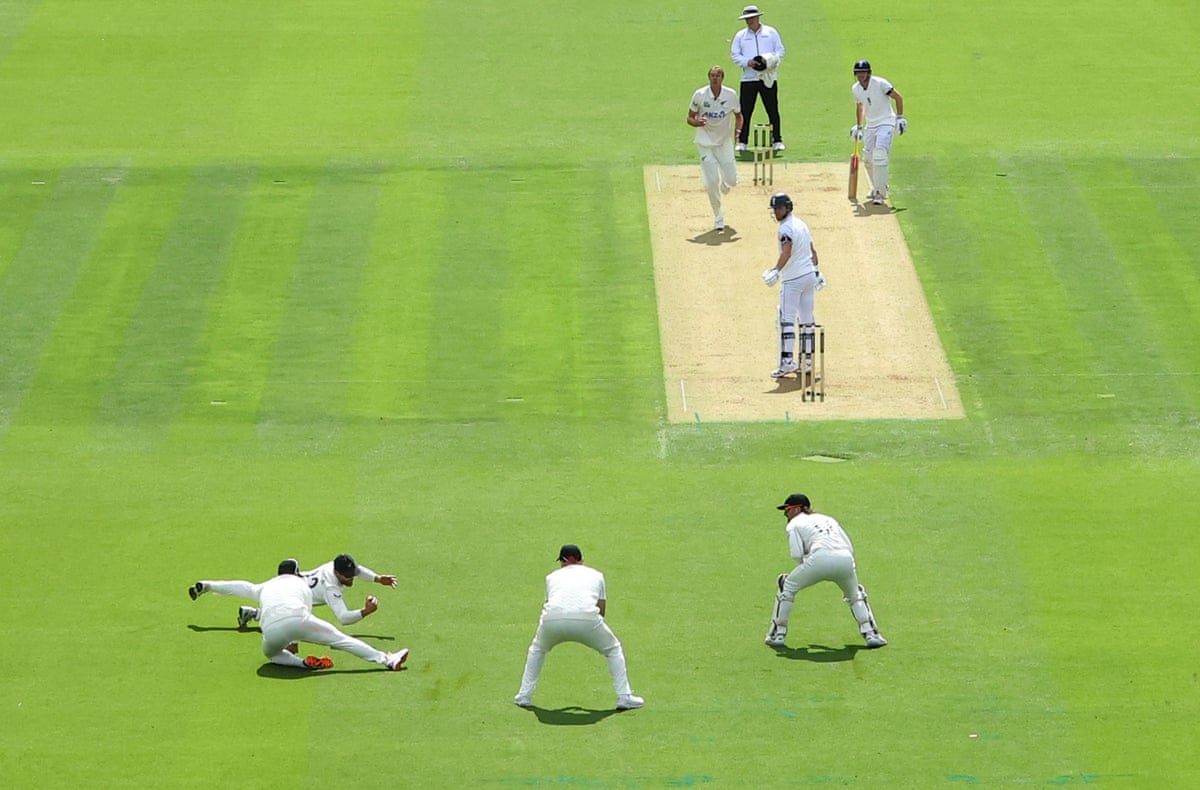
Ben Stokes’ role remains uncertain following his mid-Ashes adjustment to a more defensive approach and a drop to number seven in the batting order. His dismissal to Jamieson on 12 was subdued, but he could take solace in Williamson’s exceptional catch at third slip, which was a remarkable display of athleticism.
Jamieson continued to challenge England’s tailenders. Shoaib Bashir and Josh Tongue added 10 and 14 runs respectively, but Jamieson completed his five-wicket haul by dismissing Gus Atkinson lbw and inducing a light edge from Robinson.
The movement available on the pitch was ideal for a bowler like Robinson. As England left the field at stumps and supporters exited the ground, they appreciated this promising aspect of the team’s reset.


