

Incident on the Elizabeth Line
At approximately 11pm on a Saturday night a few weeks ago, Esme Rice was travelling on the Elizabeth Line across London. She was returning home after dining with friends in Farringdon when two men entered the crowded carriage she was in.
"One of the men tried getting my attention," Esme recounts, "but I ignored him and waited for my stop."
As the train approached Stratford station, one of the men stroked Esme's back. The other man obstructed her path as she attempted to disembark, and as she hurried past, Esme says he groped her.
"It all happened so quickly it took a moment for my brain to catch up," she explains. "I turned towards them and they were grinning, like it was a joke. Then, they were gone.
"I stood on the platform feeling stunned, afraid and violated."
The station was busy with the typical lively Saturday evening crowd, but there were no police officers present.
Words Esme had frequently heard on trains and at stations suddenly came to mind.
She sent a text to the British Transport Police (BTP) using the 61016 number, which is dedicated to reporting non-emergency incidents on the rail network. The BTP states it responds to all crimes within its jurisdiction, which spans over 10,000 miles of track and approximately 3,000 stations.
An automated reply confirmed Esme's report was important and that someone would contact her "shortly." She was then asked via text to provide further details, which she supplied, including descriptions of the incident, timing, and location, before waiting for a response.
Going Public with the Assault
However, 13 hours after the assault on one of the nation's busiest transport systems, Esme had yet to receive any communication. She chose to share her experience on social media.
"I recorded myself with my phone, describing the incident, saying how frustrated I was about the lack of response, and included a screenshot of the message I'd received from police," she says.
Esme posted the videos on her Instagram and TikTok accounts, and within an hour, they had been viewed thousands of times. She received hundreds of comments, including messages from women who expressed understanding of her experience.
"Not long after that I received a call from the BTP," Esme states. "They told me they had opened an investigation and arranged a time to take my statement."
Information about support for sexual abuse or violence is available through BBC Action Line.
The BTP told the BBC that their call was not prompted by Esme's video.
"But I couldn't ignore the timing," she says. "I had reported the assault privately and heard nothing.
"I spoke publicly, and suddenly there was urgency."
The following day, BTP's official social media account commented among the many responses to Esme's video.
"We're sorry you have been subjected to this awful behaviour on the railway. We treat all reports of sexual assault extremely seriously," the comment read, followed by a statement confirming an investigation had been launched.
Assistant Chief Constable Ian Drummond-Smith later called Esme and acknowledged that the 13-hour delay was unacceptable.
"He said I should have been called the same evening I reported the incident," Esme recalls. "I have since been informed there is now an internal investigation into why I was not offered additional support that night."
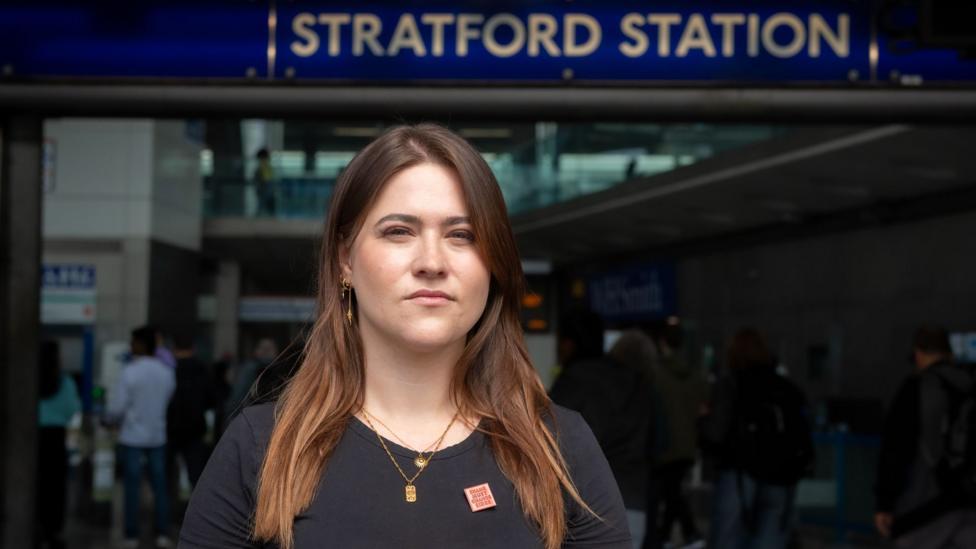
Esme Rice at Stratford station, east London, she is wearing a badge which says 'Shame must change sides' inspired by the story of sexual assault survivor Gisèle Pelicot
BTP's Public Safety Campaign and Esme's Previous Experience
The BTP introduced its well-known public safety slogan a decade ago: "See it. Say it. Sorted." This message is broadcast over public address systems in stations and on trains and is featured prominently on posters throughout the rail network.

Recent awareness campaigns explicitly identify pressing, touching, staring, and upskirting as forms of sexual harassment that are unacceptable on public transport and promise action against offenders.
Despite these efforts, Esme feels the BTP's response time is insufficient to effectively protect individuals reporting incidents or to deter inappropriate behaviour.
"This wasn't the first time I felt like I had received a poor response after reporting an incident to the BTP," she says.
Esme also experienced sexual harassment two years earlier while travelling with a friend on the Jubilee Line at around 6pm one day in March.
"I noticed a man standing close to me, touching himself," she recounts. "I moved away, but then looked down and realised that he had moved closer again and was masturbating against me.
"I remember the shock - I shouted at him, I took pictures, I called him out loudly, so everyone on that packed train could hear. No-one stepped in."
Her friend moved her down the carriage, and upon arrival at Stratford, they approached police officers stationed on the platform.
Esme gave a statement, which was documented the following day, and the BTP reviewed CCTV footage to identify the man.
However, a media appeal seeking public assistance with identifying the individual captured on CCTV was issued weeks later, not immediately after the footage was reviewed. No identification was made, and by mid-April, Esme was informed that no further action could be taken.
'This Could Happen to Anyone'
The videos Esme posted following her second sexual assault went viral. At the time of writing, they have amassed over 500,000 views, with many people sharing similar experiences.
"Some people get it wrong in the comments - they try blaming me for the fact that it happened, or they leave racist comments about the attackers," she says. "But I want to make it clear - this could happen to anyone."
Statistics released at the end of 2025 indicate that reports of sexual offences on the London Underground reached their highest level in five years.
There were 595 sexual offences reported across all Tube lines in 2024-25, the highest since 2019-20, when 776 reports were made.
The data, released by Transport for London (TfL) in response to a Freedom of Information request, did not include figures from the London Overground, Docklands Light Railway (DLR), or Elizabeth Line.
At the time, TfL stated: "Tackling violence against women and girls on public transport has long been a priority for us and our policing partners, and concerted action has been undertaken for a number of years."
Just three days after Esme's assault, on 9 June 2026, a passenger was convicted under new sex-based harassment legislation. He had grabbed a woman's hair and attempted to kiss her on a train heading into London, describing his actions as "banter."
He was sentenced to a 12-month community order, 150 hours of unpaid work, and a 15-day rehabilitation programme.
The BTP told the BBC that addressing sexual offending on the transport network remains a priority, emphasizing its commitment to ensuring safe journeys for all.
"The 61016 number receives more than 250,000 texts every year - and this figure continues to rise as confidence grows among passengers in reporting historically under-reported crimes, such as sexual offending," a spokesperson said.
"This isn't misplaced confidence, as we've shown time and time again that we won't stop until we've caught offenders, put them before the courts, and secured justice for victims."


