Analysis of evidence and expert interviews reveal police failures beyond race issues
As debate continues regarding the police response to the stabbing of Henry Nowak by Vickrum Digwa, rightwing critics have argued that anti-racism policies influenced officers’ inadequate assessment of the incident, leading to Nowak’s appalling treatment as he lay dying.
These criticisms have particularly targeted a document published last year by the National Police Chiefs’ Council (NPCC), the police race action plan. Critics also claim a broader perception exists that police now instinctively side against white individuals when doubt arises.
However, analysis of available evidence and interviews with policing experts suggest this narrative overlooks key factors contributing to the failures in this case.
What does the police chiefs' document say and why is it controversial?
The police anti-racism commitment was developed as part of the police race action plan but remains relatively unknown, even among some who worked closely on it.
The document outlines police chiefs’ commitments to ending racial bias. The contentious passage states:
“It does not mean treating everyone ‘the same’ or being ‘colour blind’ (racial equality).”
The home secretary has described this phrasing as “clumsy.” According to a source familiar with police perspectives, the intention is for officers to consider the context and historical experiences of different groups with policing.
For example, a Jewish person may require reassurance that a claim of criminal damage is taken seriously and that hate is considered a motive. Similarly, a Black person may need assurance that a stop and search is conducted for legitimate reasons rather than racial bias.
Ministers acknowledge the document was not distributed to officers for operational use, but it nonetheless creates a misleading impression.
Policing minister Sarah Jones stated:
“I don’t think it forms the basis of any training or any police activity. We think the language is wrong, it gives the wrong impression. But I don’t think it affects how our training is done.”
The NPCC clarified the document is neither formal policy nor training material. One insider added that few senior officers, and even fewer frontline officers, are aware of its existence or guided by it.
What other policies shape how police treat claims of racially motivated incidents?
Police are required to treat claims of racial motivation seriously, but this does not mean automatically accepting every claim as true, explained Neil Basu, Britain’s former head of counter-terrorism.
Basu, a former Metropolitan police detective and Britain’s most senior ethnic minority officer, said:
“When a victim says something you take it seriously, but that is different to believing it. The policy is supposed to stop police officers ignoring victims without investigating.”
This policy emerged from the 1999 Macpherson report into the murder of Stephen Lawrence, aiming to improve hate crime recording and investigation.
What is the evidence on “two-tier” policing in the UK disadvantaging white people?
No official data exists on anti-white bias in operational policing, but existing statistics demonstrate longstanding racial bias against ethnic minorities, especially Black people.
Use of force, such as Tasers, and coercive powers like stop and search, are disproportionately applied to Black individuals compared to white individuals, with police chiefs unable to explain the disparity.

The , launched following George Floyd’s murder in the US, sought to address persistent racial issues within policing but has yielded little progress.
An independent evaluation of the multi-million-pound initiative concluded it had no “meaningful impact,” with police chiefs showing only lukewarm commitment.
Basu noted that every independent report since the 1980s—including those by Lord Scarman, Macpherson in 1999, and Louise Casey in 2023—has found police failures on race.
He added that despite repeated promises, little improvement occurs. Basu dismissed claims that police overreacted to evidence of bias against Black people by being biased against white people as absurd:
“How can it be an overreaction to something that was barely reacted to in the first place?”
How do police assess competing claims when they arrive at a scene?
Officers are trained using the national decision making model.
The College of Policing explains:
“Police decision making is often complex. Decisions are required in difficult circumstances and are often made based on incomplete or contradictory information.
“In addition … those involved [may] deliberately mislead or try to mislead them.”
This framework helps officers justify decisions but cannot prevent poor choices, which is central to the Henry Nowak case.
A frontline officer with 25 years’ experience said an officer’s “mindset” upon arriving at an incident influences their response and can be difficult to change.
This mindset can be shaped by information received from the control room. The officer explained:
“There’s a danger that this clouds judgment.
“It can fall into: ‘This is the problem I’ve been told to solve, so this is the problem I will solve’.”
If it was not race, what else could explain police actions in dealing with Henry Nowak?
The trial judge noted that police were “in ignorance of the fact that [Nowak] had a serious chest wound” until too late.
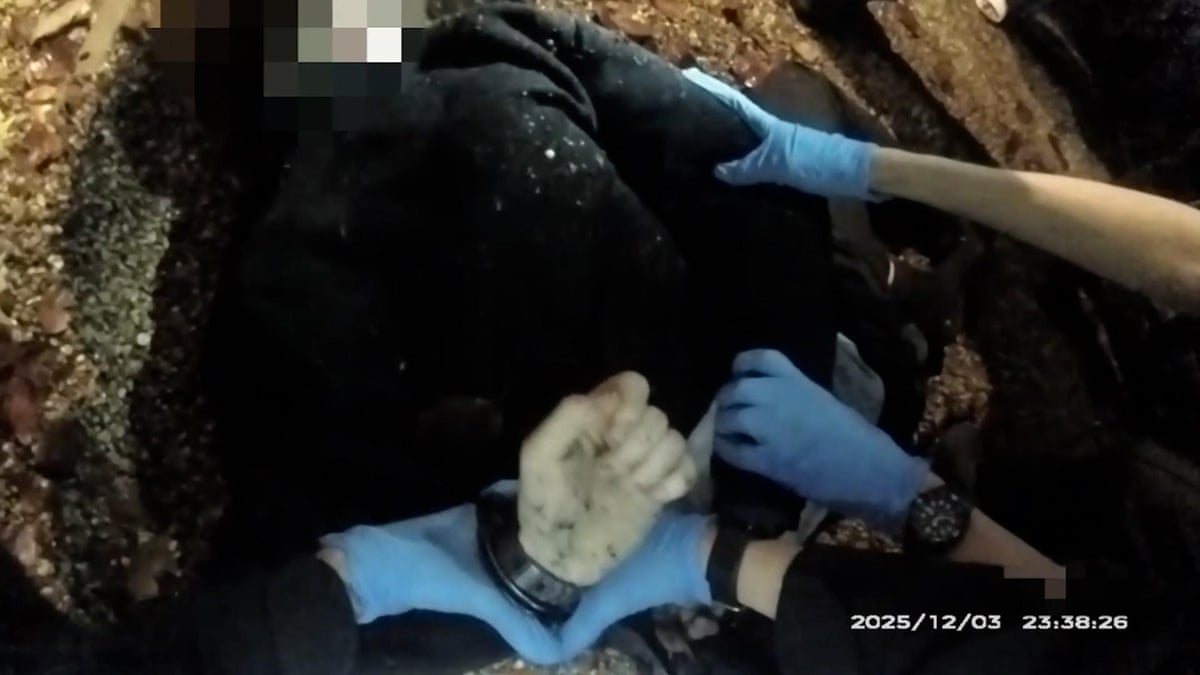
Bodycam footage of Nowak’s arrest shows police did not observe any blood consistent with a stab wound.
As the judge observed in sentencing remarks, Nowak wore dark clothing and the incident occurred at night. The bleeding from his injury flowed internally into his chest cavity.
Donna Jones, Conservative police and crime commissioner for Hampshire, has requested a review by the policing inspectorate into these issues and how officers are trained to triage competing accounts at violent scenes.
Her letter asks the inspectorate to examine officers’ understanding of “the physiological presentation of serious internal bleeding.”
All current and former police sources who spoke to expressed the view that officers lacked “professional curiosity” in the bodycam footage and questioned the decision to handcuff Nowak.