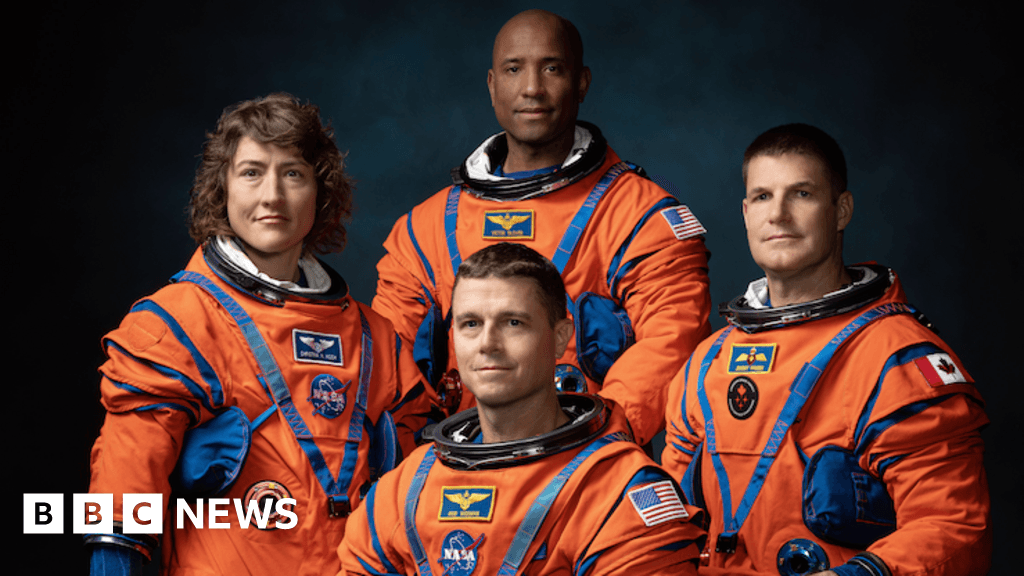
Artemis II: NASA's First Crewed Moon Mission in Over 50 Years
The first crewed Moon mission in more than five decades could be launched by NASA as early as Sunday, 8 February.
The Artemis II mission, expected to last approximately 10 days, aims to take astronauts farther into space than any humans have traveled before. This mission is designed to pave the way for a future human landing on the lunar surface, the first since the Apollo missions of the 1960s and 1970s.
Launch Preparations and Timeline
On 17 January, the crawler-transporter-2 completed a nearly 12-hour journey transporting the rocket four miles to the launch pad. Engineers are currently performing a series of launch pad preparations, which include connecting ground support equipment such as electrical lines, fuel environmental control system ducts, and cryogenic propellant feeds.
NASA is conducting a wet dress rehearsal, a prelaunch test involving fueling the rocket. Should any issues arise, the Space Launch System (SLS) and Orion spacecraft may be rolled back to the Vehicle Assembly Building for additional work before launch.
If all systems are operational, the earliest possible launch date is Sunday, 8 February. The timing also depends on the Moon's position, with launch windows selected accordingly. Typically, there is a one-week launch window at the beginning of each month, followed by three weeks without opportunities.
The potential launch dates are therefore:
Artemis II Crew Composition
The Artemis II crew consists of four astronauts: NASA commander Reid Wiseman, pilot Victor Glover, mission specialist Christina Koch, and Canadian Space Agency mission specialist Jeremy Hansen.
This mission marks the first crewed flight of the SLS and Orion spacecraft.
Mission Objectives and Activities
Once in orbit, the astronauts will test the Orion spacecraft's handling capabilities. This includes manually flying the capsule in Earth orbit to practice steering and aligning the spacecraft for future lunar landings.
Following this, the crew will travel to a point thousands of kilometers beyond the Moon to evaluate Orion's life-support, propulsion, power, and navigation systems.
The astronauts will also serve as medical test subjects, transmitting data and imagery from deep space while working in a small cabin under weightless conditions. Radiation levels will be higher than those experienced on the International Space Station, which orbits in low-Earth orbit, but remain within safe limits.
Upon returning to Earth, the crew will undergo a challenging re-entry through the atmosphere, culminating in a splashdown off the west coast of the United States in the Pacific Ocean.
Future Missions and Lunar Exploration Goals
This mission does not include a lunar landing. Instead, it is intended to prepare for the Artemis III mission, which aims to land astronauts on the Moon by 2028, according to NASA. However, experts consider this timeline ambitious.
The final selection of the lunar lander has yet to be made, with options including SpaceX's Starship or a vehicle developed by Jeff Bezos's Blue Origin. Additionally, new spacesuits manufactured by US company Axiom are not yet ready.
When Artemis III launches, astronauts will target the Moon's south pole. The long-term goal is to establish a sustained human presence on the Moon.
Subsequent missions, Artemis IV and V, will initiate construction of Gateway, a small space station orbiting the Moon. This will be followed by additional lunar landings, expansion of Gateway, and deployment of new robotic rovers on the lunar surface. The program anticipates increased international collaboration to support extended human activity on and around the Moon.
Historical Context and International Ambitions
The last crewed Moon mission was Apollo 17, which landed in December 1972 and returned later that month. In total, 24 astronauts have traveled to the Moon, with 12 having walked on its surface during the Apollo program. Of these 24, only five remain alive.
America's initial Moon missions in the 1960s were driven primarily by geopolitical competition with the Soviet Union, aiming to demonstrate technological and political dominance. After achieving this goal, political enthusiasm, public interest, and funding for Moon missions declined.
The Artemis program emerged from a desire to return humans to the Moon, focusing on establishing a longer-term presence supported by new technologies and commercial partnerships.
Several other countries have expressed ambitions to send humans to the Moon during the 2030s.
European astronauts are expected to participate in later Artemis missions, and Japan has secured seats for its astronauts.
China is developing its own spacecraft, targeting a first lunar landing near the Moon's south pole by 2030.
Russia continues to ...