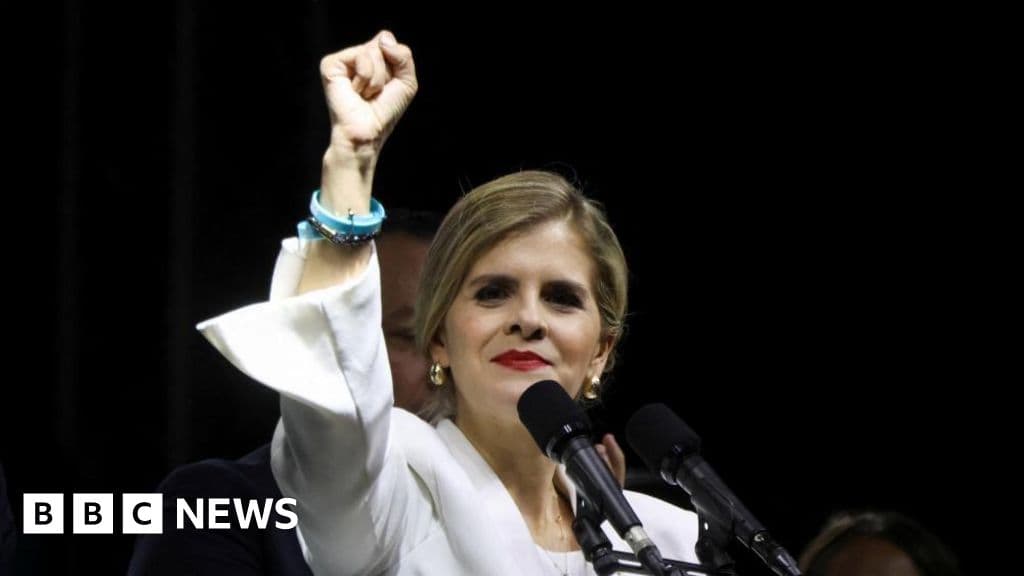
Election Victory
Laura Fernández, the candidate representing the governing conservative Sovereign People's Party, has secured victory in Costa Rica's presidential election.
With over 88% of votes tallied, Fernández garnered more than 48%, significantly leading centrist candidate Álvaro Ramos, who conceded defeat.
Campaign and Policies
Fernández campaigned on a platform to intensify the strict crime policies of outgoing President Rodrigo Chaves, who personally endorsed her as his successor.
Voters expressed concern over increasing drug-related violence in the Central American nation.
Her vote share surpassed the 40% threshold required to win outright in the first round, eliminating the need for a runoff election.
Fernández is scheduled to be sworn in on 8 May.
Victory Speech and Future Plans
In her victory address, the 39-year-old pledged to continue the policies initiated by Chaves, under whom she served as chief of staff.
Due to Costa Rica's constitutional prohibition on consecutive presidential terms, Chaves was ineligible to run for re-election.
Fernández has suggested she might appoint Chaves to a position within her cabinet.
Context of Crime and Regional Influence
Costa Rica, traditionally one of Central America's safest countries and a stable democracy, has experienced a rise in crime in recent years as transnational criminal gangs have expanded their presence in the region.
During her campaign, Fernández indicated she would adopt certain policies similar to those of El Salvador's President Nayib Bukele.
Bukele enjoys exceptionally high approval ratings, with many Salvadorans appreciating his stringent approach to crime, which has led to a significant reduction in the murder rate.
Fernández stated she intends to declare a state of emergency in areas controlled by gangs and to complete the construction of a high-security prison modeled after El Salvador's Cecot facility.
Addressing Criticism and Parliamentary Support
Responding to critics concerned that her policies might infringe on citizens' rights, Fernández declared in her victory speech:
"Our government will be one of dialogue and national harmony, respectful and firmly based in the rule of law."
Nonetheless, she adopted a confrontational tone by criticizing the opposition for what she described as "obstruction and sabotage," referring to the difficulties Chaves encountered in securing parliamentary approval for some policies amid an opposition-dominated legislature.
With her party winning 30 of the 57 parliamentary seats, Fernández is anticipated to have stronger legislative support than her predecessor.
Background and Political Style
Prior to her presidential bid, the 39-year-old held the position of planning minister among other roles.
She is widely regarded as Chaves's political heir, sharing his direct and sometimes confrontational style.
Fernández is also expected to maintain the close relationship with the United States established by Chaves.
US Relations and Migration Agreement
Chaves signed a "safe third-country migrant agreement" with the US, permitting the Trump administration to deport migrants from nations other than Costa Rica to Costa Rica itself.
This agreement enables the US to transfer migrants from countries deemed unsafe to a third country considered safe.
The Trump administration has characterized Costa Rica as a "key global cocaine transshipment point," noting it has "become an increasingly significant waypoint for criminal organisations trafficking cocaine" to the US.
Security Measures and Rights
Fernández has expressed willingness to declare a state of emergency and temporarily suspend certain citizen rights if organized crime gains further control in specific areas.
Historical Significance
She will become Costa Rica's second female president, following Laura Chinchilla, who was elected in 2010.