Introduction to Reporting in Russia
On Russian television, a well-known presenter recently launched a fierce verbal attack on the UK.
"I'm just glad it's not his finger on the nuclear button."
Vladimir Solovyov declared,
"We still haven't destroyed London or Birmingham. We haven't wiped all this British scum from the face of the earth."
He continued,
"We haven't kicked out the goddamned BBC with that Steve Rotten-berg. He walks around looking like a defecating squirrel…he's a conscious enemy of our country!"
This is the reality faced by a BBC correspondent working in Russia.
The documentary Our Man in Moscow for BBC Panorama offers insight into a year in the life of the BBC's Moscow bureau, as the Kremlin continues its war on Ukraine, enforces stricter domestic controls, and manages its relationship with President Trump.
The insult comparing me to a squirrel does not offend me; squirrels are resilient creatures, a trait necessary for foreign correspondents here. However, being called an "enemy of Russia" is painful.
Personal Connection to Russia
I have spent over thirty years living and working in Moscow. Early on, I developed a deep appreciation for Russian language, literature, and music. At Leeds University, I directed a choir performing Russian folk songs and even composed a Russian song about a snowman who melted after wearing too many clothes.
That snowman metaphorically represents the Russia I once knew, which seemed to disappear in February 2022. With its full-scale invasion of Ukraine, Russia embarked on a dark path. President Putin's so-called "special military operation" has become the deadliest conflict in Europe since World War Two.
Looking back, this escalation was not sudden: Russia annexed Crimea in 2014 and was accused of supporting armed uprisings in eastern Ukraine. Relations with the West had been deteriorating.
Nevertheless, the full invasion marked a turning point.
Legal and Operational Challenges
Following the invasion, Russia enacted strict laws to suppress dissent and punish criticism of the government. The BBC's platforms were blocked, and reporting from Russia became akin to walking a legal tightrope. The challenge was to report accurately without risking severe repercussions.
In 2023, the arrest of Wall Street Journal reporter Evan Gershkovich underscored the risks. Despite holding a US passport, he was convicted of espionage and sentenced to sixteen months in prison. His employer and the US government condemned the charges as fabricated.
The BBC's Moscow team has since shrunk. Producer Ben Tavener and I frequently undergo additional scrutiny when entering and leaving Russia. Journalists from countries deemed "unfriendly" by the Kremlin, including the UK, now receive visas and accreditation valid for only three months instead of one year.
Many former sources are reluctant to speak with us, likely due to fears of association with the BBC amid heightened tensions.
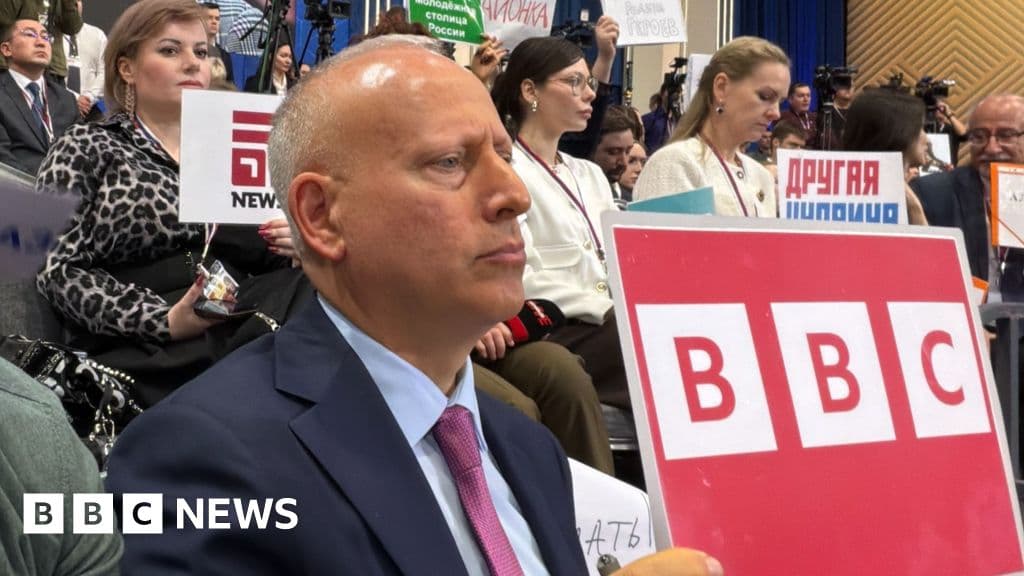
Despite these challenges, Western broadcasters maintaining a presence in Russia still receive invitations to Kremlin events, and I occasionally have the opportunity to question President Putin directly.
Insights from Interactions with Putin
Even brief exchanges at press conferences can reveal aspects of Putin's mindset.
Putin is motivated by resentment toward the West, particularly NATO's eastward expansion and perceived disrespect from Western leaders. Critics accuse him of imperial ambitions aimed at restoring Russia's sphere of influence.
Last December, I asked President Putin, "Will there be new 'special military operations'?" as part of a broader inquiry about his plans.
He responded, "There won't be any operations if you treat us with respect. If you respect our interests…"
This raises concerns about potential future actions if Russia feels its interests are disregarded.
Russia's Relations with the US and the West
With Donald Trump back in the White House, Moscow perceives increased respect from Washington. At the Alaska summit in August, Trump welcomed Putin with a red carpet reception. Although the summit did not end the war in Ukraine, it symbolized a thaw in relations.
However, not all developments favored Moscow. Venezuela's President Nicolás Maduro, an ally of Russia, was recently captured by US forces, and the US seized a Russian-flagged oil tanker in the Atlantic.
Notably, Kremlin criticism of the US has been muted over the past year, reflecting a belief that good relations with the Trump administration may facilitate a favorable resolution to the Ukraine conflict.
Consequently, most anti-Western rhetoric in Russian state media is now directed at the European Union and the UK.