

Social Democrats Lead but Fall Short of Majority
Under the leadership of Prime Minister Mette Frederiksen, Denmark's Social Democrats secured the highest vote share in the recent general election, yet failed to achieve a parliamentary majority, marking the party's weakest performance since 1903.
The Social Democrats, who have governed since 2019, received 21.9% of the vote and won 38 seats, maintaining their position as the largest party in Denmark's parliament, Christiansborg. However, this number is insufficient for an outright victory.
Frederiksen Addresses Supporters Amid Mixed Results
Within Christiansborg, Social Democratic supporters applauded as Frederiksen addressed the crowd, expressing regret over the election outcome but pride in the party's standing.
"I'm sorry that we did not get more votes. I had also hoped for a better result."
"But there is nothing today that can make me sad that the Social Democrats have once again become the Danes' absolute favourite political party," she concluded.
Coalition Talks Loom as No Majority Emerges
Frederiksen retains the possibility of a third term as prime minister, but Denmark's tradition of coalition governments means complex negotiations are anticipated, potentially lasting days or weeks.
The election featured twelve political parties, with the contest closely contested until the end. The left-wing "red bloc" secured 84 seats, narrowly leading the right-wing "blue bloc," which holds 77 seats. Neither bloc reached the 90-seat threshold required for a majority in the 179-seat parliament.
The eventual formation of a majority government remains uncertain.
"I have been responsible for this wonderful country for almost 7 years," Frederiksen said. "I am still ready to take on responsibility as Denmark's prime minister."
Moderates Hold Kingmaker Role
The Moderates, a centrist party with 14 seats, now hold the balance of power. Their leader, former Prime Minister Lars Løkke Rasmussen, is under scrutiny as a potential kingmaker.

Rasmussen, known for his role in managing the Greenland dispute with the United States and for a notable fist-bump with US officials Vice President JD Vance and Secretary of State Marco Rubio in Washington, addressed supporters on election night.
With his signature pipe in hand, Rasmussen expressed openness to forming a government spanning the political center.
"We're standing in the middle," he said. "We're ready."
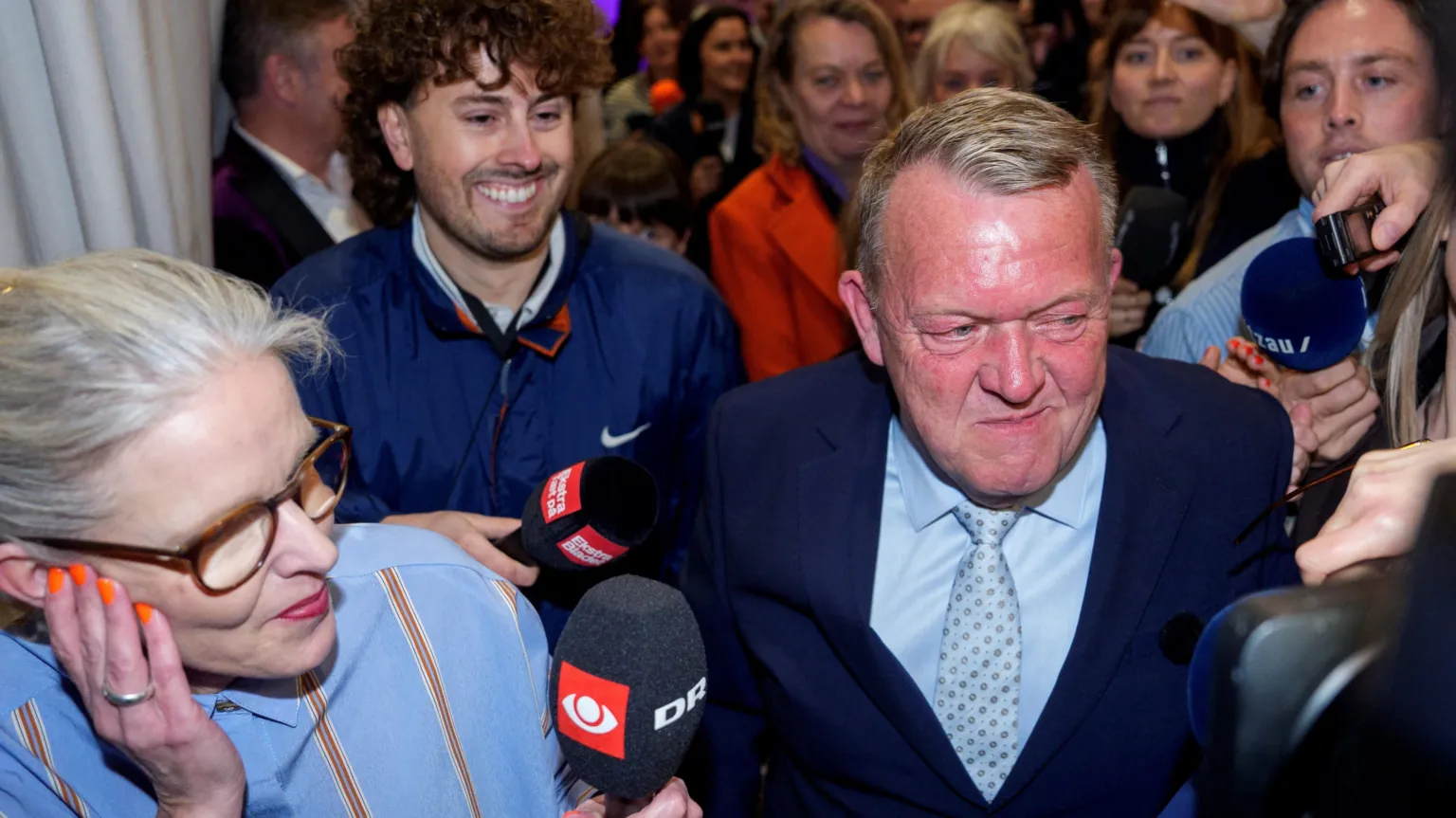
However, Troels Lund Poulsen, leader of the Liberals—the largest party in the blue bloc—has dismissed the possibility of joining a government with the Social Democrats and urged Rasmussen to align with the right-wing bloc.
"It is possible to get a new direction in Denmark," Poulsen stated.
Potential Government Alignments and Election Context
DR's political correspondent Christine Cordsen has indicated that the most probable outcome is a center-left coalition involving the Social Democrats, Red-Greens, the Moderates, and the Danish Social Liberal Party.
This election has been challenging for Frederiksen, whose popularity has declined after six years in office, despite many Danes acknowledging her effective management of international crises.
The election followed US President Donald Trump's repeated attempts to acquire Greenland, a semi-autonomous Danish territory. Frederiksen, aged 48, called the election months earlier than scheduled, hoping that her handling of the Greenland issue would bolster her chances for a third term.
Nonetheless, domestic issues dominated the campaign, including concerns about the cost of living, economic conditions, and welfare. Environmental issues such as pesticide contamination in drinking water linked to pig farming and the agricultural sector's climate impact also influenced voter priorities.


