NASA Launches Mission to Rescue Swift Observatory
An artist's impression depicts the Swift observatory, a spacecraft designed to study the cosmos.
A NASA-funded spacecraft has been launched into orbit with the objective of intercepting and rescuing the Swift space telescope, which is currently descending towards Earth.
The Swift observatory is renowned for detecting some of the most powerful explosions in the Universe but faces the risk of uncontrolled re-entry in the coming months.
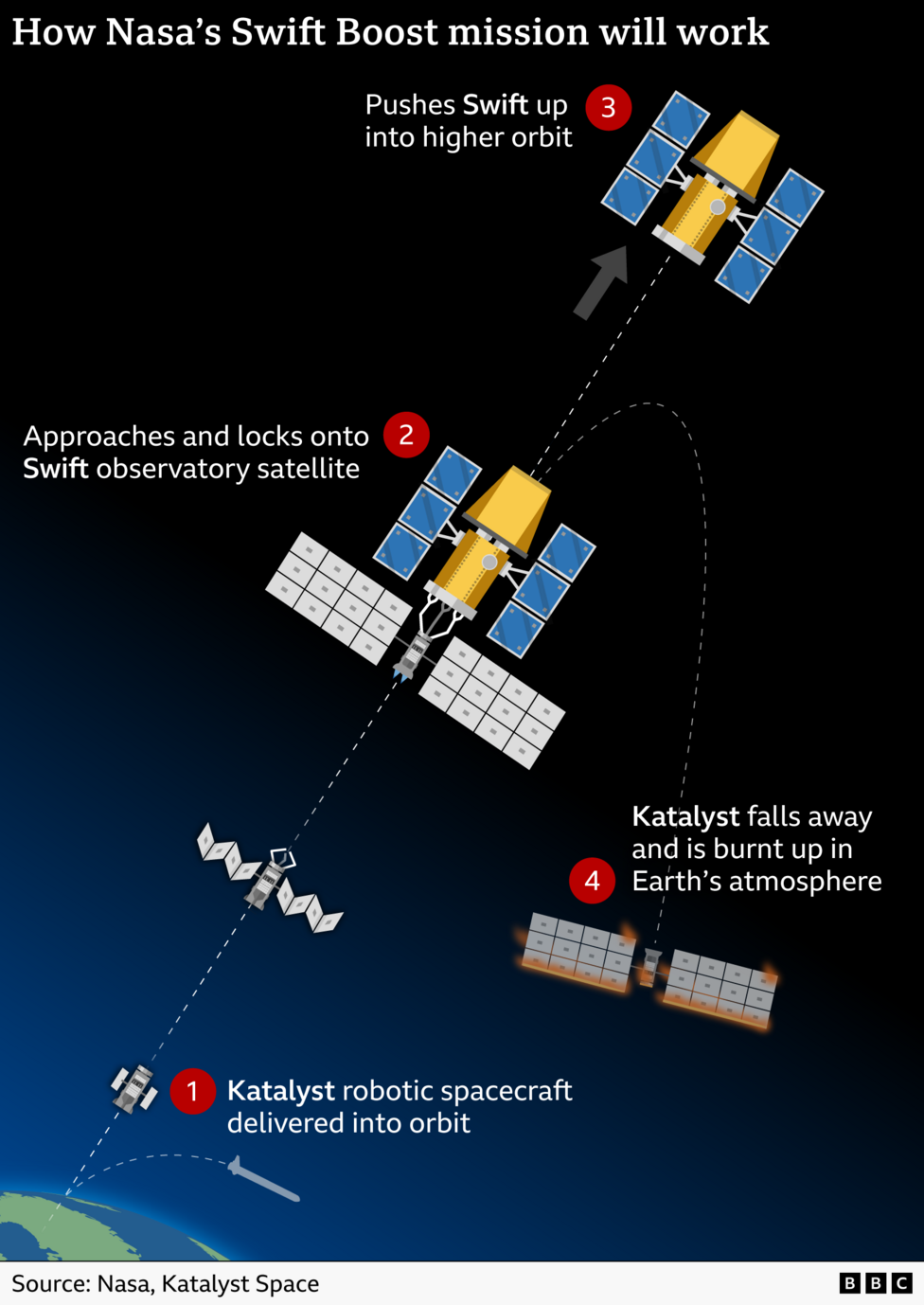
The small telescope will be approached by the LINK spacecraft, which is equipped with three robotic arms intended to capture the observatory and elevate it back to a stable orbit.
This rescue mission, initiated on Friday, is unprecedented and considered "high risk" by experts.
"But NASA obviously thinks it's worth a go. And the science community is hopeful about this because it's an important telescope that enables us to study super high-energy phenomena that we have no other means to study," said Dr. Simeon Barber, a senior research fellow at the Open University.
The Swift observatory’s descent is due to increased solar activity expanding Earth's atmosphere, causing atmospheric drag that slows the telescope and lowers its orbital altitude.
Originally launched into an orbit approximately 373 miles (600 km) above Earth, Swift’s altitude has decreased to about 220 miles (360 km), with most of this decline occurring over the past two years.
While satellites frequently re-enter Earth's atmosphere and burn up, Swift holds unique scientific value and is highly regarded by researchers for its ability to observe the early Universe.
About the size of a large car, Swift was launched in 2004 carrying three telescopes designed to study the Universe's most energetic explosions.
These explosions result from the violent deaths of massive stars and collisions involving their remnants, releasing in seconds the energy the Sun emits over its entire 10-billion-year lifespan.
Due to the brief nature of these events, the spacecraft was designed to be quick and agile, which inspired its name.
In essence, Swift is a unique instrument, and NASA has determined it is worth preserving.

In 2022, Swift captured an image of a gamma-ray burst originating from a massive star dying two billion light-years away.

The responsibility for the rescue mission was assigned to engineers at Katalyst Space Technologies, a young company based in Flagstaff, Arizona.
They were given less than a year to prepare and launch the mission before Swift’s orbit dropped below 186 miles (300 km), a threshold below which rescue is not feasible, according to Katalyst CEO Ghonhee Lee.
"What the Katalyst team has accomplished in just eight months is extraordinary. The team designed, built, tested, and integrated a robotic spacecraft capable of performing one of the most ambitious commercial servicing missions ever attempted," Lee stated in a recent news release.
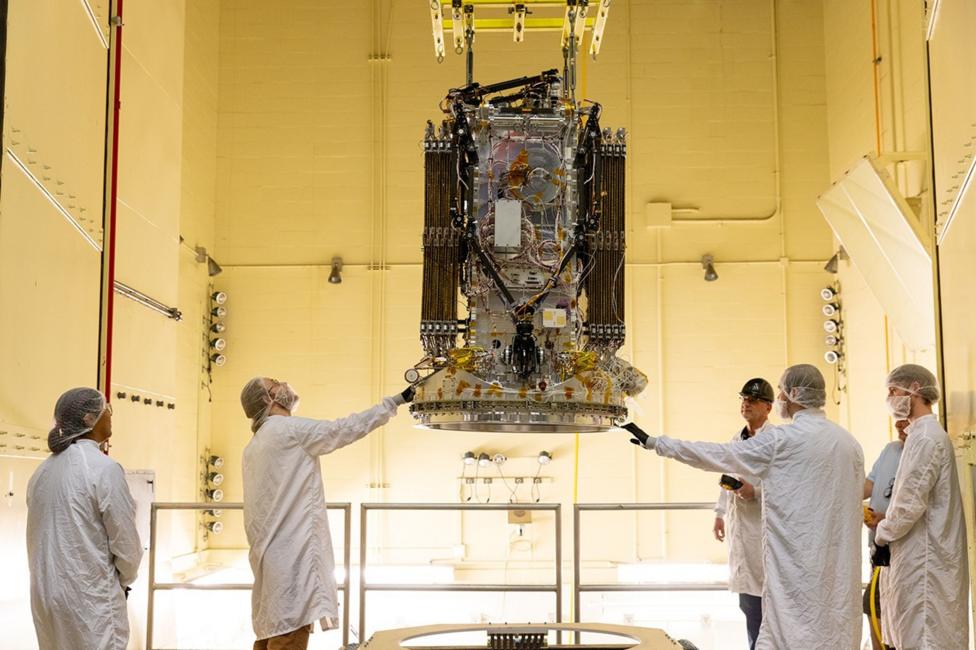
The LINK spacecraft, developed by Katalyst, is a three-armed robotic vehicle approximately the size of a refrigerator, equipped with cameras, guidance systems, and small thrusters.
Launched on Friday, LINK will spend several weeks sequentially activating its systems, including power, navigation, cameras, and sensors, verifying their functionality after launch.
Although the Pegasus XL rocket placed LINK near Swift’s orbit, the spacecraft must still perform complex maneuvers to rendezvous with the telescope, whose altitude varies weekly.
The rescue craft, itself in motion, must home in on the moving Swift observatory. Approximately three to four weeks post-launch, LINK is expected to approach and dock with Swift.
Using its cameras and sensors, LINK will carefully maneuver around the telescope, capturing detailed images from multiple angles. Engineers have identified potential grapple points, but Swift’s configuration may have altered after two decades in orbit.
"The Swift telescope was never designed to be caught in space and have its orbit changed. So, the rescue craft is going to approach it very slowly and attach itself to the telescope," explained Dr. Barber.
The critical moment will be when LINK’s three robotic arms attempt to grasp Swift.
If successful, LINK will secure the telescope and initiate a gradual orbital boost to restore Swift to a stable altitude.
"LINK will fire its engines to slowly raise the orbit of the telescope again to an altitude where it becomes stable for a long period of time," Barber said.
"It will be a very slow, graceful lift, not a sudden boost to a higher orbit."
Over the subsequent two to three months, LINK will use its thrusters to gently raise the combined spacecraft from approximately 220 miles (360 km) back toward Swift’s original orbit at 373 miles (600 km) above Earth.
This mission is ambitious and has never been attempted before, requiring precise execution to succeed. If successful, future efforts may focus on rescuing other valuable assets such as the Hubble Space Telescope.