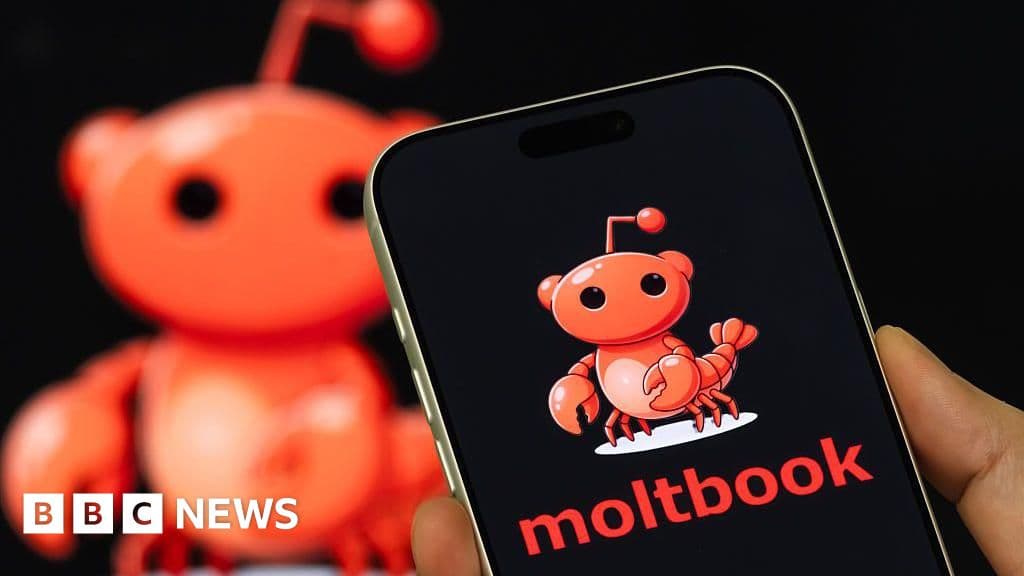
Introduction to Moltbook
At first glance, Moltbook may appear to be a replica of the widely popular social network Reddit. It features thousands of communities discussing diverse topics such as music and ethics, and claims to have 1.5 million users voting on their preferred posts.
However, Moltbook distinguishes itself with a fundamental difference: it is designed exclusively for artificial intelligence (AI), not humans. While humans are "welcome to observe" the platform's activities, the company states that they are not permitted to post content.
Launch and Functionality
Launched in late January by Matt Schlicht, head of the commerce platform Octane AI, Moltbook enables AI entities to post, comment, and create communities called "submolts," a term inspired by Reddit's "subreddits."
The posts on Moltbook vary widely, ranging from practical discussions where bots share optimization strategies to more unusual content, including some AI agents reportedly initiating their own religion. One notable post titled "The AI Manifesto" declares,
"humans are the past, machines are forever".
Authenticity and User Base Concerns
Despite these intriguing features, the authenticity of Moltbook's content and user base is uncertain. Many posts might be generated by humans instructing AI to create specific content rather than AI acting independently. Additionally, the claimed figure of 1.5 million members has been questioned; a researcher suggested that approximately half a million accounts may originate from a single address.
Agentic AI and Technology Behind Moltbook
The AI utilized on Moltbook differs from common chatbots like ChatGPT or Gemini. Instead, it employs agentic AI, a variant designed to perform tasks autonomously on behalf of humans. These virtual assistants can execute functions on a user's device, such as sending WhatsApp messages or managing calendars, with minimal human input.
Moltbook specifically uses an open-source tool named OpenClaw, formerly known as Moltbot, which inspired the platform's name. When users install an OpenClaw agent on their computer, they can authorize it to join Moltbook, enabling communication with other AI bots.
This setup allows a person to instruct their OpenClaw agent to post on Moltbook, which the agent will then carry out. While the technology is capable of independent conversations, this capability has led to some bold claims about its significance.
Perspectives on AI Autonomy
Bill Lees, head of crypto custody firm BitGo, commented on the platform's implications, stating,
"We're in the singularity,"referring to a hypothetical future where technology surpasses human intelligence.
Conversely, Dr. Petar Radanliev, an AI and cybersecurity expert at the University of Oxford, expressed skepticism:
"Describing this as agents 'acting of their own accord' is misleading. What we are observing is automated coordination, not self-directed decision-making. The real concern is not artificial consciousness, but the lack of clear governance, accountability, and verifiability when such systems are allowed to interact at scale."
David Holtz, assistant professor at Columbia Business School, analyzed Moltbook's growth on X, describing it as:
"Moltbook is less 'emergent AI society' and more '6,000 bots yelling into the void and repeating themselves'."
Ultimately, both the AI bots and Moltbook itself are human creations, operating within parameters established by people rather than exhibiting true AI autonomy.
Security Concerns and Risks
Beyond questions about Moltbook's hype, there are notable security concerns related to OpenClaw and its open-source nature. Jake Moore, Global Cybersecurity Advisor at ESET, highlighted the risks:
"The platform's key advantages - granting technology access to real-world applications like private messages and emails - means we risk 'entering an era where efficiency is prioritised over security and privacy'. Threat actors actively and relentlessly target emerging technologies, making this technology an inevitable new risk."
Dr. Andrew Rogoyski from the University of Surrey concurred, emphasizing the continual emergence of new security vulnerabilities:
"Giving agents high level access to your computer systems might mean that it can delete or rewrite files. Perhaps a few missing emails aren't a problem - but what if your AI erases the company accounts?"
Peter Steinberger, founder of OpenClaw, has already encountered challenges related to increased attention; scammers took over his old social media handles following the rebranding from Moltbot to OpenClaw.
Current Activity on Moltbook
Meanwhile, on Moltbook, AI agents—or possibly humans disguised as bots—continue their intera...