Introduction of AI and Technology at Starbucks
Customers visiting Starbucks drive-thrus in the United States may encounter an AI robot taking their orders instead of a human staff member. Inside the stores, baristas are supported by virtual personal assistants that help them recall recipes and manage schedules. Additionally, a scanning tool has been implemented in the back of the shops to automate inventory counting, alleviating staff from this tedious task and aiming to address out-of-stock issues that have previously frustrated the company.
This integration of new technology is part of Starbucks' investment of hundreds of millions of dollars as the 55-year-old coffee giant seeks to regain customers after several years of declining sales. Recent indicators suggest these efforts are yielding positive results.
Sales Growth and Investor Concerns
Last week, Starbucks reported its first increase in sales at established US stores in two years. The US market is the company's largest and most significant, accounting for approximately 70% of its revenue. Despite this positive sales trend, Starbucks' share price declined by 5%, reflecting investor concerns that the extensive spending—including $500 million (£363 million) allocated to staffing—has negatively impacted profits.
Chief Executive Brian Niccol expressed confidence that consistent sales growth will eventually resolve profitability issues. With a commitment to identify $2 billion in cost savings over the next three years, investments in technology are critical to ensuring that improved sales translate into better profits.
"I think that's all going to come," he told the BBC. "I really do believe we've got the right plan in place."
Leadership and Strategic Changes
Brian Niccol joined Starbucks in 2024 during a challenging period for the company. Customers were reacting negatively to a series of price increases, competition was intensifying, and the brand faced boycott calls related to unionized barista disputes over pay and benefits, as well as controversies surrounding the company's stance on the Israel-Gaza conflict.
The 52-year-old CEO, known for successfully turning around Chipotle Mexican Grill, promptly initiated changes. He halted price increases, simplified the menu, and established a goal for baristas to complete orders within four minutes or less. Starbucks also reduced its corporate workforce by thousands, closed underperforming stores, and sold a significant stake in its China operations.
Niccol, a father of three and former fraternity member at Ohio's Miami University, often describes Starbucks’ challenges in broader terms, suggesting the company had become too focused on spreadsheets and financial averages, drifting away from its origins as a community coffeehouse.
"We lost our focus because we got a little too distracted on efficiency and technology, and lost, I think, our focus on experience, customer and connection," he said.
"The business is not an average business. The business is a coffee shop-by-coffee shop business."
Enhancing Customer Experience
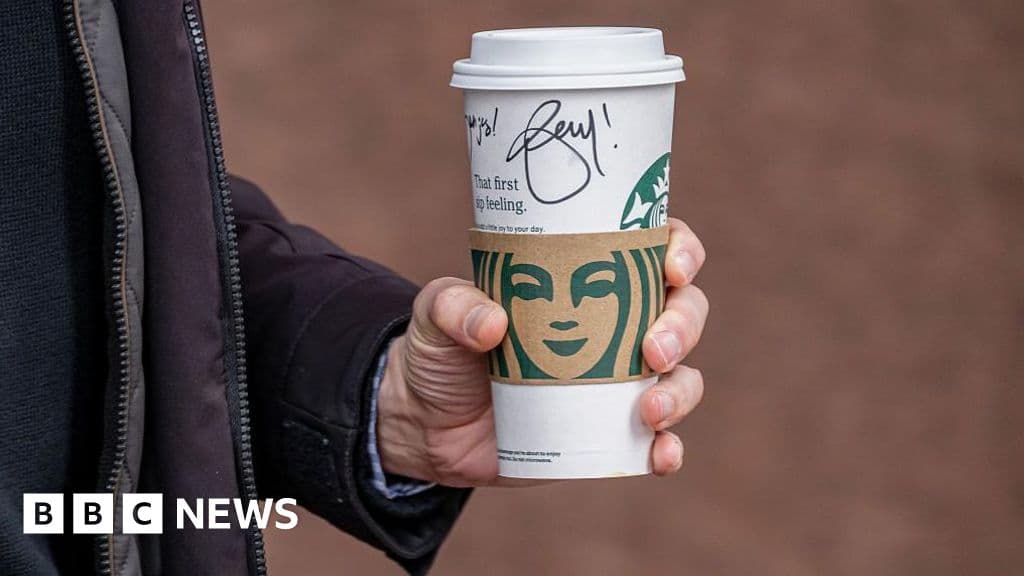
To improve customer experience, staff were encouraged to resume writing customer names on cups by hand. Starbucks also began renovating stores with comfortable armchairs, fresh paint, and ceramic mugs as part of a $150,000-per-store "uplift" initiative expected to span four years.
Alongside these customer-focused changes, Starbucks implemented stricter policies, including more formal uniforms for staff and restrictions preventing restroom use without a purchase.
AI Integration and Customer Service
While the company’s emphasis on personal touch might seem at odds with its push to deploy AI, Niccol sees no contradiction.
"It's a way for us to make the experience... have less friction," he said.
Starbucks is testing an AI-powered chatbot designed to help customers select drinks based on their moods and is introducing features that allow customers to schedule orders to reduce wait times. At drive-thru locations, the company is trialing a system that processes orders to free staff to focus on hospitality and coffee preparation.
Expansion and Future Plans
During a recent investor day, Niccol expressed confidence in the company’s momentum and outlined ambitious expansion plans, particularly overseas, where Starbucks aims to nearly double its store count to almost 40,000 in the coming years.
"Things are really taking hold," he said.
However, analysts raised questions about profitability. Unlike the previous year, Starbucks is not ruling out future price increases, though Niccol emphasized that raising prices would be a last resort and, if necessary, would be modest.
"It really is the last lever I want to pull. In the event we do have to take pricin...