

Scotland Rugby Great Scott Hastings Passes Away
Scott Hastings, a celebrated figure in Scottish rugby, died on Sunday at the age of 61.
In September 2011, during the Rugby World Cup in Invercargill, New Zealand, a city known as the southernmost point of the country and nicknamed the city of water and light, Hastings was present as a television summariser. Despite the heavy rain and the city's often gloomy reputation, Hastings expressed his enthusiasm for Invercargill, contrasting with Mick Jagger's infamous 1965 remark calling it the "arsehole of the world." Hastings was seen leading a lively sing-along of The Proclaimers in a local pub, embodying his characteristic energy and positivity.
His adaptability and infectious enthusiasm were evident throughout his life, both during his rugby career and afterwards, in his family life and charitable endeavors.
Strong Man on the Field and Off It
Hastings was known for his ever-present smile and dedication to charity, notably as a close friend and advocate for Doddie Weir. He was deeply involved in raising awareness and funds for motor neurone disease research, the illness that claimed Weir in 2022.
During this period, Hastings himself battled non-Hodgkin's lymphoma, a cancer affecting white blood cells. He approached his illness with humor and determination.
Beyond his own health challenges, Hastings endured profound personal tragedy. His wife, Jenny, suffered from depression for two decades before taking her own life in autumn 2024. Hastings spoke powerfully about their life together, including the joy of raising children and traveling through rugby, as well as the pain caused by her illness.
Depression would engulf Jenny for extended periods, yet Hastings maintained an upbeat demeanor, confronting her condition head-on. After Jenny, aged 60, disappeared while swimming in Wardie Bay, Edinburgh, Hastings frequently returned to swim there, finding solace and healing in the place where she lost her life.
His strength extended beyond the rugby field, embodying resilience in the face of personal adversity.
His passing on Sunday was met with shock. He had recently contributed to media coverage during the Six Nations and was a passionate supporter of Gregor Townsend and the Scottish team. Cancer ultimately claimed his life.
'A Man of Huge Integrity' - Moore's Tribute to Hastings
Everyone Knew His Importance in a Golden Era
Scott Hastings was a formidable rugby player, known for his strength and fierce determination as a centre. He debuted for Scotland in 1986 alongside his older brother, Gavin Hastings, and earned 65 caps over 11 years. For a time, he held the record as Scotland's most capped player, a fact he occasionally reminded his brother of.
Gavin Hastings was renowned as a goalkicker, captain, and British and Irish Lions leader in 1993. While Scott may not have achieved the same international recognition, his significance to Scotland during a golden era was widely acknowledged.
In 1989, Scott was selected for the British and Irish Lions tour to Australia, playing a key role in Ian McGeechan's team that overcame a 1-0 series deficit to win 2-1. The Lions faced a formidable Wallabies side and endured the infamous Battle of Ballymore, which Hastings often recounted with enthusiasm, noting his unique vantage point away from the violence.

Known for his self-deprecating humor, Hastings transformed on game day, driven by passion. The pinnacle of his career came on 17 March 1990, when he was part of Scotland's Grand Slam-winning team against England at Murrayfield, the last Scottish Grand Slam to date.
Those involved in that historic match have shared vivid and sometimes humorous memories of Hastings' demeanor. Reflecting on the day, he said:
"I was in a trance. I relied on passion. I cried all the way to the ground. I cried in the dressing room beforehand, I cried on the way out to the pitch."
This was during the famous Slow Walk, led by captain David Sole, where the team marched onto the field in numerical order. However, Hastings broke formation:
"Scott jumped the queue and went in third," said Chris Gray. "I was saying, 'Scott, get back'. He ignored me. 'Scott, you're 13th in line'. No response. I looked at him - and he was gone. He was in another world. We were lining up in the corridor, ready to walk, but there was a delay. I was thinking, 'If Scott doesn't get on the move soon he's going to blow a gasket'. He was like a horse down at the starting stalls. He had to be let loose.'"
Hastings enjoyed this depiction and appreciated the recognition of his intense focus, which even some English players noted.
A Tackle for the Ages in Grand Slam Win
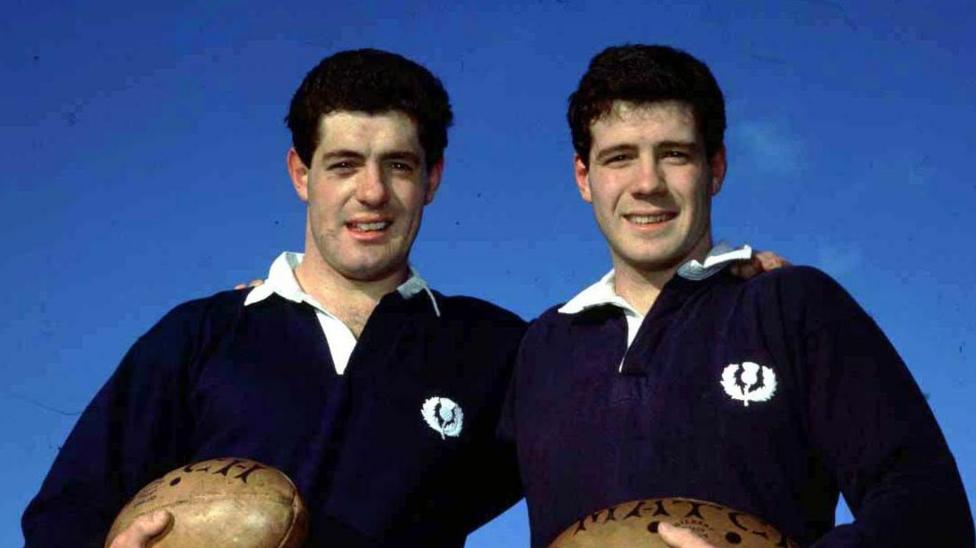
Scott Hastings, right, and brother Gavin both served Scotland with distinction.
Jeremy Guscott, Hastings' midfield partner on the Lions tour the previous summer, recalled the Grand Slam decider:
"Scott was like a zombie. He wasn't there. He was away at the races, gone from the emotion and the history of it all. After they came out I was looking for the players I'd toured with eight months earlier with the Lions - and there was no recognition from any of them."
The match cemented Hastings' place in Scottish rugby lore. Although he blamed himself for a try scored by Guscott, he redeemed himself with a memorable tackle.
Rory Underwood, a ruthless winger, attempted to exploit a gap between Hastings and his winger Iwan Tukalo during a critical moment:
"A lovely big space and through I go. But then I'm down. How the hell am I down? I should be running over the try line now. But I'm down."
Hastings explained:
"I got him at the knees, slid down to his boots and managed to hang on."
For years, Scott and Gavin joked about the incident, with Gavin claiming the tackle did not win the Slam since Underwood still had to get past him, which he never would. Scott retorted that the try would have been inevitable because his brother was ineffective at tackling on his inside.
The Hastings brothers were Scotland men and Lions together, the first siblings to appear on the same Test Lions team since the early 1900s.
Scott Hastings left a lasting impact on rugby, not only through his on-field achievements but also through his friendships and unwavering support of teammates. He will be remembered, mourned, and cherished by many.


