England Fans Embrace 'Wonderwall' as New World Cup Anthem
"Cmon England cmon Wonderwall."
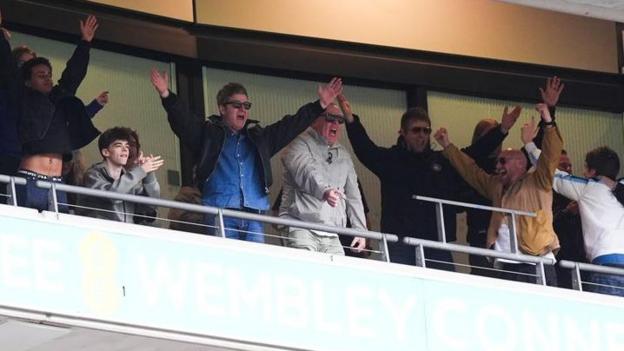
This was the message from Oasis frontman Liam Gallagher on Wednesday, following England's late World Cup knockout victory over DR Congo in Atlanta. England's travelling supporters once again sang the band's iconic song alongside the players at full-time after a tense match.
In recent weeks, this has become a new tradition, with the song being sung after all three of the men's team's wins in the United States.
After England's opening win in Dallas, Noel Gallagher, Liam's brother and fellow Oasis bandmate who wrote the song, told The Sun:
"Wonderwall belongs to the people, and it was a magical moment between the people and the players."
Interestingly, Noel claims he is not an England fan.
England captain Harry Kane described the first spontaneous singalong as one of his "favourite ever moments in an England shirt" during an appearance on the Lions' Den podcast.
Joe Hart, Kane's former teammate and current pundit, said such "phenomenal" moments allow players to "drop the mask, just for a few minutes, of being an elite professional."
Wonderwall: A Song of the Summer
While traditional England anthems like "Three Lions," "Vindaloo," "World in Motion," as well as "Sweet Caroline"—which became an accidental hit during Euro 2020—continue to be heard in pubs across the country, "Wonderwall" has emerged as the song of the summer so far.
The track, which reached number two on the UK singles chart and is from Oasis's 1995 album (What's the Story) Morning Glory, re-entered the charts last week following the viral moment sparked by England fans.
In 2008, shortly before Oasis disbanded, Liam Gallagher expressed his dislike for performing the song, stating he "can't stand singing that song"—the acoustic ballad that has become a staple for buskers worldwide.
However, since then, Liam has performed "Wonderwall" numerous times, delighting fans globally during Oasis's successful reunion tour last year.
"Song for the Moment"
England players have been facing fans behind the goal for shared Oasis singalongs after victories in Dallas, New Jersey, and Atlanta.
Author and broadcaster PJ Harrison, who released the biography Gallagher: The Rise and Fall of Oasis last year, finds the adoption of pop songs by football fans intriguing.
He explained to that in the 1960s, Everton fans had a tradition of singing contemporary pop hits during matches.

Harrison believes the current phenomenon with England and "Wonderwall" could not have been orchestrated.
"You have the long lifespan of Wonderwall, then you have the renewed interest with the tour," he said. "And obviously, if you've got to put one song on from that tour, that fits.
"Then it's just a case of the DJ having the situational awareness to think, 'This is the song for the moment', put it on and everybody just embrace it."
"Once it takes root and it becomes melded to an emotional moment, like winning a first World Cup game, it just takes on this emotional life and quickly gathers an immediate nostalgia."
Following England's win over DR Congo, fans sang "Wonderwall" once more.
Regarding the song's meaning, Noel told Uncut magazine around its release that it was a musical love letter to his then-wife Meg Mathews. Later, he revised this, telling Q Magazine it was about "an imaginary friend who's going to come and save you from yourself."
Harrison believes the ambiguity of the lyrics combined with the familiar, easy melody allows fans to "express an outpouring of love without necessarily specifying what it's towards."
"What is a Wonderwall? I'm not really sure what it is but I can sing about it and it can be whatever I think it is," said Harrison, a former Plymouth Argyle director and co-founder of LA-based City of Angels FC.
"If I think it's Jude Bellingham or if I think it's England winning, it can be that, or it could be my girlfriend or whatever."
Unlike other upbeat and hopeful England songs, Harrison feels the reflective nature of "Wonderwall" means it "would also still work in consolation if the team get knocked out."
"Euphoria and Melancholy"
The term "Wonderwall" originates from the 1968 psychedelic and surreal film of the same name, starring Jane Birkin as the object of obsession for a man who lives next door and makes holes in his wall to watch her.
George Harrison provided the film's soundtrack, which was the first solo album by a Beatle and where Noel Gallagher, an avid record collector, first encountered the term.
The original working title for the song was "Wishing Stone," but a lyrical adjustment led to the creation of Oasis's best-selling track, which has sold millions of records and garnered billions of streams, likely funding Noel's swimming pool.
Louder Than War writer and Membranes musician John Robb, who authored the Oasis biography Live Forever: The Rise, Fall And Resurrection Of Oasis last year, described "Wonderwall" as the perfect football song due to its blend of "euphoria" and "melancholy."
"There's something really melancholic about being a football fan because any second you're about to lose but any second you're about to win," said Robb, a Blackpool supporter.
"The song captures both - it's the perfect football song."
"It has that thing where you can sing along to it but it's got that undertone of sadness, it's also got that lift in the chorus."
Although not originally written as a football anthem, Noel has acknowledged the influence of his time spent on the terraces at the old Maine Road watching Manchester City on his songwriting, Robb noted.
"Football is about community and camaraderie and everybody being together in the moment, and those kinds of songs are perfect for it," he added.
"The ultimate choir is a football terrace, because it's a lot of people who can't really sing, singing together and in harmony.
"That's quite a beautiful thing."
Looking Ahead: England's Journey and the Song's Legacy
England fans hope their team continues to perform well so they can maintain this new tradition through to the final in New York. However, the path is challenging, beginning with a match in Mexico City on Monday morning.
Interestingly, "Wonderwall" lost its own chart battle in November 1995, being kept from the number one spot by Robson and Jerome's double A-side, "I Believe" and "Up On The Roof"—songs not widely sung by England fans.
If England wins the World Cup for the first time in 60 years, "Wonderwall" may finally end its 30-year chart misfortune. If not, supporters may be left heartbroken.
As Liam Gallagher expressed on X (formerly Twitter):
"Let's keep the biblical vibrations going."
- Wonderwall one of favourite England moments - Kane
- How Sweet Caroline became an accidental football anthem