

Heading in Football Under Scrutiny
Heading in football has been a subject of concern and investigation for over two decades, driven by fears and uncertainties.
There is apprehension that frequent heading could cause long-term brain damage in players who regularly perform this action.
At the same time, there remains uncertainty about the reasons behind heading frequency and the actual level of risk involved.
Scientific research has started to shed light on these issues, but a comprehensive understanding of the impact of heading—a fundamental part of football since its inception—remains incomplete.
Existing studies have raised enough concern to prompt rule changes by football governing bodies.
Nevertheless, for many, the risk remains somewhat intangible, often gaining attention only when a prominent former player is diagnosed with dementia or Alzheimer's disease.
Some find reassurance in the belief that modern football has evolved: coaching methods have changed, footballs are lighter, and the game is now played more on the ground.
However, this perception varies significantly depending on the league observed.
Scottish Premiership's High Heading Frequency
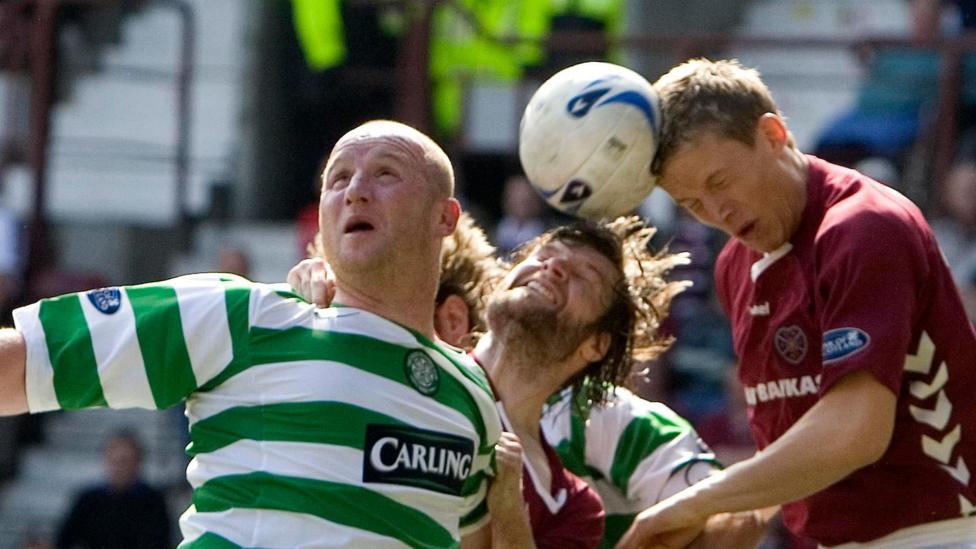
New data reveals that the Scottish Premiership features considerably more headers per match compared to most of Europe's leading leagues.
BBC Scotland analyzed statistics from the beginning of the 2021 season to the present, focusing on aerial duels and headed clearances across the top leagues in Scotland, England, Italy, France, Germany, and Spain.
In the Scottish Premiership, players engage in aerial challenges an average of 42.5 times per match, which is a 71% increase over France's Ligue 1, where the average is 28.5 aerial duels per match.
Fans watching England's Premier League can expect about 28.7 aerial duels per game, nearly 50% fewer than in Scotland.
Similarly, Germany's Bundesliga, Spain's La Liga, and Italy's Serie A all record significantly fewer aerial duels than the Scottish Premiership.
Regarding headed clearances, France again shows the most notable contrast.
Ligue 1 averages 16.8 headed clearances per match, nearly 50% less than Scotland's 24.7 per match.
The Premier League (21.3), Bundesliga (21.2), Serie A (18.2), and La Liga (19.4) also have fewer headed clearances than Scotland.
Additional data indicates this trend continues in comparable leagues.
The Czech First League records almost 60% fewer aerial duels than Scotland.
Top leagues in Denmark, Sweden, and Norway also show over 40% fewer aerial duels than the Scottish Premiership.
These countries also report fewer headed clearances compared to Scotland.
When combining these metrics, Scotland has over 35% more heading actions than ten other top European leagues.
While these figures may not surprise regular viewers of Scottish football, they raise important questions regarding player safety discussions.
Health Concerns Linked to Heading
Since the 2002 death of former England centre-forward Jeff Astle from dementia, scientific studies have increasingly connected repeated head impacts to chronic traumatic encephalopathy (CTE), a condition that can lead to neurodegenerative diseases.
In January, a coroner investigating the death of former Scotland and Manchester United centre-half Gordon McQueen concluded:
"I am satisfied that, on the balance of probability, repeatedly heading footballs contributed to his developing chronic traumatic encephalopathy."
A 2019 field study by Glasgow University found that former professional footballers were three-and-a-half times more likely to develop neurodegenerative diseases, with defenders exhibiting an even higher risk.
Dr Willie Stewart, who led the study, remarked:
"I actually looked, a few years ago, at the heading rates across World Cups, going all the way back to 1966. The stats actually showed that the amounts of headers in games were increasing over that 50-year period, rather than declining, as some people might have thought - so I'm not too surprised."
Scottish FA's Measures to Reduce Risks
In 2022, the Scottish Football Association (SFA) implemented several measures aimed at reducing heading-related risks.
Heading the ball was prohibited for players under 12 years old, and in professional football, heading during training was banned on the day before and after matches.
Clubs were also instructed to limit training exercises involving repeated heading to one session per week.
Dr Jonny Gordon, the SFA's chief medical officer, stated:
"The Scottish FA has led the way in research into head trauma in sport, working in partnership with the University of Glasgow in a landmark 2020 field study and additional research published in 2022. We will continue to monitor guidance based on evolving research as part of the association's commitment to ensuring the national game is a safe and enjoyable environment for all players."
Heading as Part of Scottish Football Culture
There are also significant health benefits associated with playing football.
Dr Stewart's study found that former professional players were less likely to die from illnesses such as cancer and heart disease.
So, why does the football spend more time in the air in Scotland?
Willie Miller, a former defender who played 560 times for Aberdeen and earned 65 caps for Scotland, commented:
"The stats are a little surprising and I don't know what we're doing wrong. One of the refreshing things this year has been watching Motherwell. They are not a tall team and constantly build up from the back and play a lot of good football. Maybe we need to work harder on the coaching side and I know the SFA has been doing some work on it with the youngsters, but clearly we have to turn the product round a bit for the good of the game and the health of the players as well."
Others who have played both north and south of the border believe the difference may be cultural.
Christophe Berra, former Scotland and Hearts defender, suggested:
"Yes, but I don't think it will ever change - it's just the Scottish culture. I've seen it at Tynecastle when new managers come in and want to play the ball on the ground, but when it's not going well, the fans can get on your back and just want it in the box."
Future Considerations
The science regarding heading and its risks continues to develop, and understanding is still evolving.
If increased heading frequency does elevate the risk of brain injury, Scotland, which has been at the forefront of research on this issue, faces important decisions about the future direction of the game.


