

Set-Piece Drama Defines Premier League Season
There is a certain irony that Arsenal, known for their mastery of set-pieces this season, secured a victory over West Ham through a VAR decision that disallowed Pablo's goal for a foul on Arsenal goalkeeper David Raya.
This Premier League season has been marked by intense set-piece incidents, not only in terms of goals scored but also due to persistent grappling, pushing, pulling, and wrestling among players.
The situation escalated notably in February when approximately 15 Manchester United and Everton players crowded inside the six-yard box, with players being thrown to the ground even before the ball was in play, creating chaotic scenes.
"You get the feeling now that referees really don't want to get involved in any of it," Everton manager David Moyes said.
This issue is not confined to the Premier League. recently attended an event with Roberto Rosetti, head of Uefa's referees, who highlighted examples of goalkeepers being pressured during set-pieces.
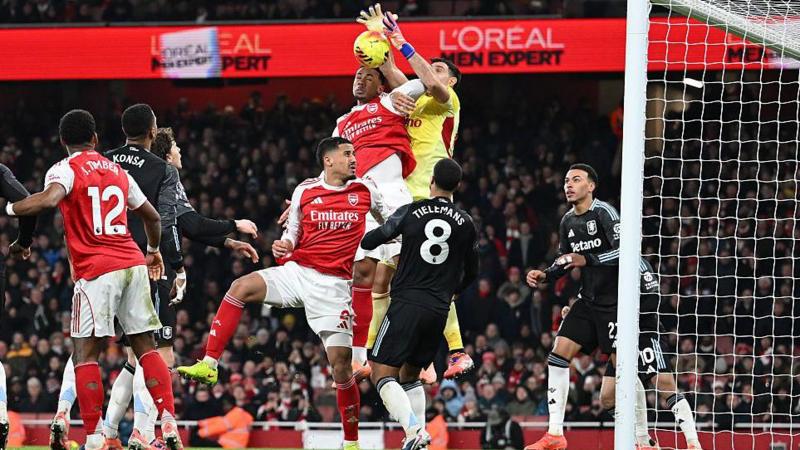
Arsenal have excelled in this tactic, crowding goalkeepers at corners to create space and score.
On Sunday, a significant VAR intervention affected Arsenal's title ambitions and West Ham's Premier League survival hopes. Multiple instances of pushing and pulling occurred, but Pablo was penalized for a foul on Raya. VAR overturned the decision, allowing Arsenal to claim a vital 1-0 win.
Given Arsenal's proficiency in set-pieces—21 of their 68 league goals (31%) have come from them—the irony of the opposition having a goal ruled out in such a manner is notable.
Breaking Down the Disallowed Goal and Five Fouls in the Build-Up
Was this VAR's biggest decision? Jarrod Bowen stood by the corner flag as a melee unfolded in the penalty area when he delivered a cross. Callum Wilson then scored, but VAR official Darren England intervened.
The decision was complex, with five potential fouls amid the players. England's ruling was bound to face scrutiny.
Here is a step-by-step analysis of the fouls and VAR considerations:
The first potential foul involved Kai Havertz and Tomas Soucek at the near post. Soucek climbed over Havertz, who ended on the floor with Soucek on top. However, Havertz was not in the ball's landing area, and Soucek was facing the ball, so VAR likely allowed this to stand.
Next, Martin Odegaard and Jean-Clair Todibo were mutually holding each other. Since both players were equally engaged, no foul was judged.
Leandro Trossard and Pablo's battle began just outside the six-yard box with mutual holding. Pablo attempted a run, and Trossard grabbed him around the waist from behind. This was insufficient for a penalty as Pablo could still move toward the ball.
The most critical incident involved Pablo and goalkeeper David Raya inside the six-yard box. Pablo impeded Raya's ability to claim the ball by placing his arm across the goalkeeper and holding Raya's left arm, restricting Raya's movement. Todibo also pulled Raya's shirt, but Pablo's foul was decisive.
Declan Rice held West Ham's Konstantinos Mavropanos around the waist, potentially a penalty-worthy foul. However, it occurred simultaneously with Pablo's challenge on Raya, and the latter was prioritized.
Other VAR Decisions on Set-Pieces This Season
Despite widespread grappling and pushing, West Ham's disallowed goal is the only one ruled out for such fouls on VAR review this season.
Four goals have been disallowed for fouls, but not for pushing or holding. Seventeen penalties have been awarded for pulling and holding, five via VAR, with three more missed due to VAR errors.
Two Arsenal-related incidents illustrate the VAR's approach:
In Man United 0-1 Arsenal, William Saliba applied pressure on goalkeeper Altay Bayindir by briefly touching his arm during a corner. The key match incidents panel found no pushing or holding offence.
During Arsenal 4-1 Aston Villa, Gabriel scored while jumping near Emiliano Martinez with his elbow raised. Minor contact was noted but deemed non-impactful, and no foul was called.
In Man City 3-1 Bournemouth, David Brooks held Gianluigi Donnarumma's arm but released it before the goalkeeper attempted to play the ball, and the goal was allowed.
Biggest VAR Call Ever? Four Chaotic Minutes That May Define the Season
West Ham plans to contact the referees' body regarding the disallowed goal, while Arsenal manager Mikel Arteta praised officials' courage in overturning the West Ham equalizer.
Origins and Wider Context of Set-Piece Tactics
Early proponents of set-piece focus included Tony Pulis and Sam Allardyce, with Sean Dyche later refining the approach. Arsenal's tactics have shaped how corners dominate the Premier League this season.
Allardyce's data-driven positioning targeted zones with the highest ball landing probability but lacked the innovations introduced by Nicolas Jover, ex-Brentford and current Arsenal set-piece coach.
Corners have become most effective as in-swingers are played into a crowded six-yard box, a tactic neither Pulis nor Allardyce employed to the same extent as Arsenal and others now do.
Dyche's Burnley side (2019-2020) advanced this by delivering crosses close to goal and preventing keepers from claiming the ball, though their goal tally was limited by player quality.
Arsenal's success is attributed to the quality of crossers like Declan Rice and Bukayo Saka and the aerial threat of Gabriel.
Their approach has influenced other teams, including Manchester United, Chelsea, and Tottenham.
Potential Solutions to Set-Piece Fouling
Much grappling occurs before the ball is in play, with referees limited to stopping the game and ordering retakes, which does not prevent recurrence.
This issue affects all players, not just defenders holding attackers, and has been an unsightly trend throughout the campaign.
At season's end, the Professional Game Match Officials Limited (PGMO) surveys stakeholders on refereeing issues, which has previously led to rule tweaks such as handball adjustments.
This summer, hair-pulling and grappling in the box may be addressed, potentially with referees issuing more yellow cards before the ball is played.
Currently, there are often five or six potential fouls on every corner.
Former Premier League assistant referee Darren Cann told Match of the Day:
"I feel that the time has come now for a law change whereby no attackers are allowed in the six-yard box before the corner is taken. Lots of teams grapple at corners, sometimes before the ball has come into play, and then obviously the referee can't give a penalty, can't give an indirect free-kick, if the ball is not in play. So this would create that natural separation and eradicate these kind of situations."
Another suggestion is to make the play live as soon as the ball is placed in the corner quadrant, allowing fouls before the corner is taken to be penalized.
This would create a buffer between the set-up and delivery, forcing players to disengage briefly and potentially reducing fouls.
Alternatively, teams might change tactics and avoid exploiting minor rule limits, though this is considered optimistic.
- Get news, insight and fan views on your Premier League team
- All your football quizzes in one place


