Football Fever at Wimbledon
“Pssst!” The security staff at Wimbledon do not engage in much conversation. Their role guarding Centre Court is taken almost as seriously as standing sentry on Whitehall. However, one guard, standing at attention outside the media centre in his blue peaked cap and freshly pressed jacket, whispered to his colleague three feet away,
“Pssst! Rashford’s starting.”His colleague glanced to the right without turning his head.
“Rashford? Not Gordon?”
Wimbledon is arguably the one place in England where access to football on screens is limited. The All England Club’s chief executive, Sally Bolton, stated at the start of the week that football would not be shown on any of the hundreds of televisions around the grounds, including the large screens on the hill and in the South Village. This decision requires no further explanation, as it has become a tradition during football tournaments to inquire whether Wimbledon will broadcast matches.
Balancing Tennis and Football
While much of England might have been watching the World Cup semi-finals on 11 June 2018, Wimbledon attendees were focused on the quarterfinals of the tennis tournament. This year, matches such as Felix Auger-Aliassime versus Dino Prizmic on No 1 Court, and Jessica Pegula against Sara Sorribes Tormo on No 2 Court, were the main attractions. It was an opportune time for those seeking entry to the show courts, as the club releases tickets when attendees leave for the day, resulting in a surplus of available seats around four o’clock. The reason for this surge in availability was apparent.
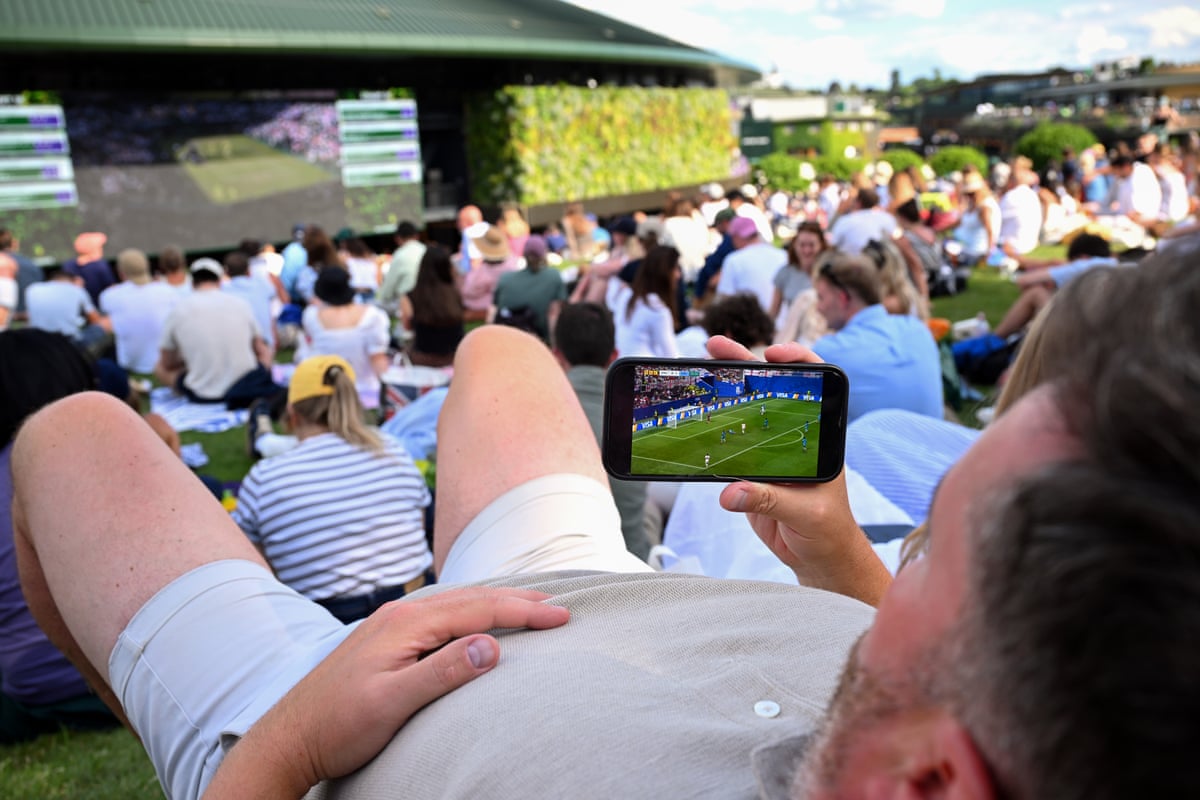
Despite this, many seats on Centre Court remained empty. Among those occupied, some spectators discreetly followed the football match via earpieces or secondary screens. Tim Henman even mentioned he would have the football on in the commentary booth. Bolton acknowledged,
“Clearly, if people have got their phones, then we’re not going to prevent people from watching the football.”However, this leniency did not extend to staff during working hours. One steward was reprimanded after being caught watching the pre-game on his mobile phone while off shift.

Viewing Challenges and Adaptations
Veteran staff members are well aware of the best spots to watch the football discreetly. The media room is a favored location due to its televisions that can be switched to different channels, and the presence of sports journalists who occasionally change the broadcast. Previously, it was possible to position a television to face the concourse outside Centre Court, allowing passersby to watch moments of the match. However, this year the All England Club installed frosted windows to prevent peeking, citing health and safety concerns.
Consequently, most attendees resorted to watching the match on their phones. There was a noticeable surge in people signing up for the venue’s Wi-Fi as phone reception became overloaded just before kick-off. While it is not advisable to generalize, a significant number of young men were observed facing away from the tennis on Henman Hill, engrossed in the football, while their partners followed the women’s tennis matches. The tension of the game was audible when someone exclaimed,
“Oh fuck! You are shitting me!”upon England conceding a goal in the seventh minute. It was unclear whether he noticed the disapproving look from the woman beside him, or if he cared.
Players’ Perspective on the Football Distraction
The tennis players have become accustomed to the divided attention of the crowd. During a match between Novak Djokovic and England’s Andy Murray, play was paused as fans celebrated Trent Alexander-Arnold’s winning penalty kick. Djokovic responded by miming an imaginary spot-kick himself.
Djokovic commented on the atmosphere,
“You can sense there’s a buzz going on. People are kind of simultaneously looking at your match and also following their national team. It’s normal. It’s the football fever right now in these four to six weeks. We are also part of it. I like football. I follow everything that is going on. Obviously it’s nicer when you’re by the TV than when you’re playing, not everyone is focused on your match. But that’s OK. That’s what it is.”
Wimbledon’s Place in English Sporting Priorities
Wimbledon is a £500 million championship and one of the largest annual sporting events globally. However, the World Cup serves as a reminder of the hierarchy of English sporting passions, with football commanding unparalleled attention during its tournament period.