

Teenager Sooryavanshi from ‘a different planet’ but superstardom not guaranteed
Fifteen-year-old sensation Vaibhav Sooryavanshi has sent Jasprit Bumrah over the ropes, but how he manages inevitable challenges will determine his future success.
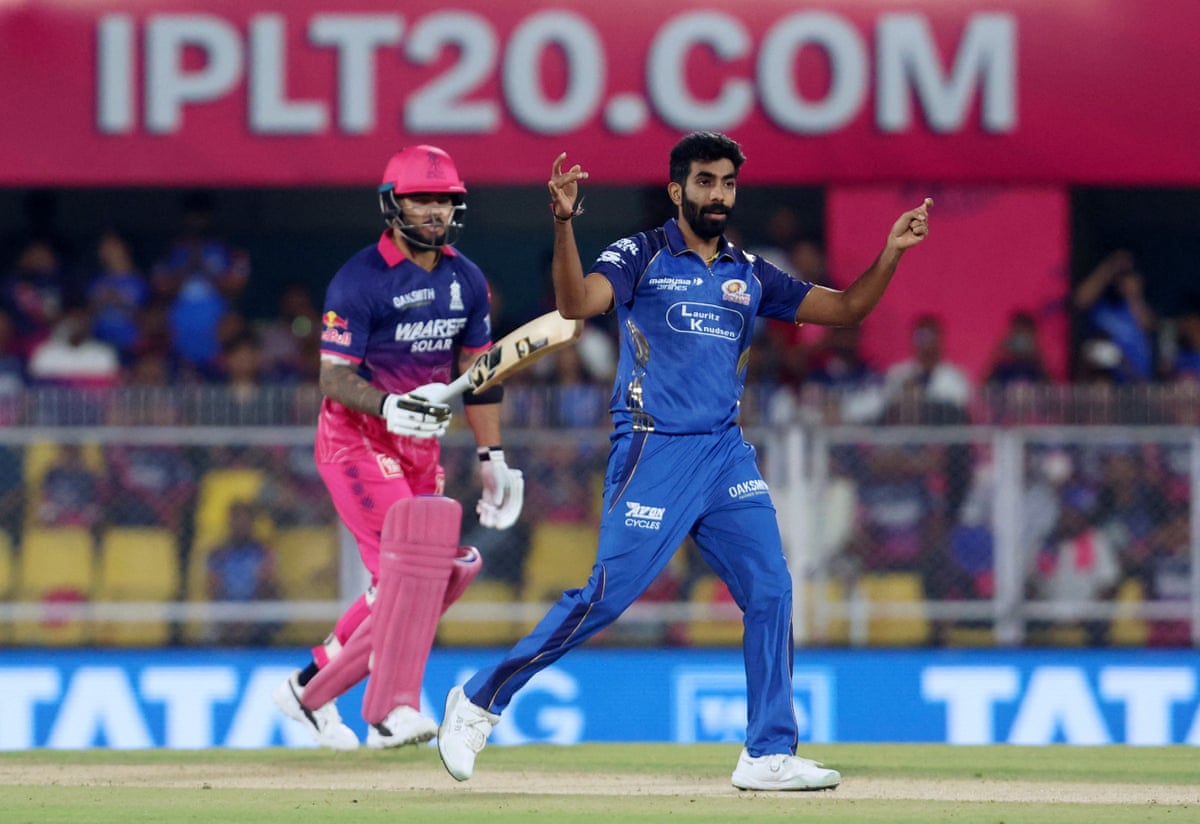
When Jasprit Bumrah stood at the top of his mark for the Mumbai Indians against Rajasthan Royals in this year’s Indian Premier League, he was regarded as the most complete all-format bowler in history. With a whiplash action that explodes from a staccato run-up like a stick of dynamite unraveling silk, he fires searing yorkers and steepling bouncers at will. Three balls later, he was the setup for the story’s real protagonist.
Before this moment, Bumrah, winner of five IPL titles and two World Cups, had delivered 5,445 balls in T20 cricket for Mumbai and his country. Only 180 of those deliveries were sent sailing over the rope for six. That equates to a maximum every five overs. Since 2013, he has been a walking cheat code, the point of difference in almost every game. None of that seemed to matter to Sooryavanshi.
Bumrah’s first ball to the kid not old enough to drive was spanked over wide long-on. His third was hoiked over deep-backward square. In half an over, Sooryavanshi had outperformed all the world’s batters by nearly 1,900%. Once the initial disbelief subsided, the question arose whether we were witnessing the nascent steps of cricket’s next superstar?
“The short answer is we can’t know for sure, and anyone who tells you differently is lying,” says David Court, head of player identification at the England and Wales Cricket Board. “It’s a multitude of factors and the interplay between them. If you’re searching for one golden nugget, you’re selling yourself short.”
Court’s role is essentially to try to predict potential anyway. He oversees the identification and development of England’s best young players while managing a network of scouts tasked with finding the next Joe Root or Jimmy Anderson. This is an exercise in informed guesswork, complicated by the fact that teenage excellence is both common and misleading.
“There are things we can look for,” Court says. “Talent is one thing, but what we’re really after is mental toughness. That sounds vague and manifests in multiple ways, but essentially it boils down to finding a way through adversity.”
A 2012 paper published by Sports Medicine, titled “The Rocky Road to the Top: Why Talent Needs Trauma,” shows that talent benefits from obstacles on the path to success. These aren’t necessarily dramatic. In cricket terms, this could be a run of poor scores or opposition batters figuring you out as a bowler. What separates those who endure from those who don’t is not the absence of these moments, but their response to them over time and under pressure. Court namechecks two of England’s rising stars.
“I remember watching Jacob Bethell and James Rew batting against Australia in a youth Test,” Court says, recounting the third innings of the game in Brisbane in 2023. “It was so hostile. The Aussies really gave it to them. But they were calm. Jacob scored a ton [123] and James got a high score [62]. I remember thinking: ‘These guys have got it.’”

Court is particularly interested to see how Sooryavanshi adjusts when the inevitable lean patch arrives. So too is Paul Adams, the former South African wrist-spinner turned coach who observed the young Indian starlet up close during the recent Under-19 World Cup, where Sooryavanshi scored 439 runs – including 163 against England in the final – with a strike-rate of 169.49.
“He’s from a different planet,” says Adams, who was a young sensation himself, making his Test debut at 18 against England in 1995. “I’m interested if he has a plan other than just smacking it when top bowlers start figuring him out, because they will.”
Adams stood at this crossroads himself. With an action that Mike Gatting likened to a “frog in a blender,” he delivered the ball with flailing limbs, releasing it while looking towards the sky. In his first three series, “Gogga” as he was known (Afrikaans for insect), claimed 31 wickets at an average of 25.
“My strength was that I was unique,” Adams says. “I think it’s important for all youngsters who make the step up to have something unique about them. But you can’t rest on that. Once batters started to pick my googly, and they started playing me off the pitch a bit more, I had to develop different plans. It’s not easy. I’ve seen a lot of top youngsters fall away because they couldn’t adapt.”
Much of this has to do with their environment.
“We try to create scenarios that are competitive, relentless, hard-working, but also supportive,” Court adds. The balance is delicate. Too little pressure and a player never develops the tools to cope. Too much, too early, and they risk being overwhelmed.
Adams came through a different, more Spartan era.
“It was sink or swim,” he says. “There wasn’t much care for young players. It was on you to prove that you belonged. I see the love that Vaibhav gets and it looks totally alien to what my generation had.”

Court concurs:
“It’s so different. Yes there’s more appreciation for soft skills, but there are other variables at play. Lads get a few runs at a World Cup and suddenly they’ve got thousands more followers. They hit one boundary in a game and that’s instantly posted on their socials. They’re dealing with that while they’re still playing.”
Sooryavanshi has 3.8 million followers on Instagram. His fame has outpaced the glut of runs that cannon off his bat. His challenge from here will be far more complex than simply spanking the world’s best bowler.
Wisden shines light on India’s control
The 163rd edition of the Wisden Cricketers’ Almanack was released on Thursday, with editor Lawrence Booth addressing the “increasingly Orwellian” control India exerts on the game.
Booth provides evidence, noting that the Indian Premier League now functions less as a tournament and more as a gravitational force, warping the global calendar around it. Bilateral tours are squeezed into its margins, International Cricket Council events tiptoe around it, and boards fall into line. When the Board of Control for Cricket in India declined to send a team to Pakistan for the 2025 ICC Champions Trophy, the solution was not negotiation but accommodation with a “hybrid model” ensuring India played elsewhere. There was also the case of a Bangladesh player quietly dropped from IPL consideration after political sensitivities flared. Presiding over it all is Jay Shah, moving from BCCI secretary to ICC chair with seamless inevitability. Adding to this is India’s swollen share of ICC revenues and the unspoken rule that global tournaments must suit Indian broadcast primetime, sharpening the picture.
However, this is not a new phenomenon. Despite concerns about overreach, there is a risk of mistaking discomfort for injustice. Cricket has always followed power, historically English and privileged. India’s version arrives louder and brasher, wrapped in hyper-nationalism that can feel jarring, but it is rooted in a vast, invested public for whom cricket is far more than a pastime.
This is not to excuse the ugliness on social media or the bombast of politicians and Bollywood stars. But before pointing fingers at Ahmedabad, one should be conscious of three other fingers pointing back.
For players, supporters, and journalists from South Africa, New Zealand, or the West Indies, the inequities of the game remain the same. There is just a different ruler sitting on the throne.
Quote of the week
“This County Championship sub rule is complete nonsense” – Ian Ward, commentating on Sky, expressed his disapproval of a new trial law allowing domestic teams to make substitutions for players who are injured, unwell, or attending significant life events such as the birth of a child.
Memory lane
11 April 2000: Hansie Cronje, the South Africa captain and a symbol of a post-racial democracy after apartheid, sits next to South Africa’s sports minister, Ngconde Balfour (second left), at a press conference on the day he was sacked as captain after admitting to receiving between $10,000 and $15,000 from an Indian bookmaker during a limited-over series with Zimbabwe and England.

Still want more?
Former England cricketer has labelled England’s Ashes campaign as “feckless, reckless and legless.”
Ben Stokes has moved to downplay suggestions of a disagreement between himself and Brendon McCullum.
Gary Naylor reflects on the County Championship, highlighting Jimmy Anderson’s inspiring performance leading Lancashire to a thrilling win against Derbyshire.
Contact The Spin
Contact The Spin by writing to daniel.gallan.casual@the.com.
To to The Spin, just follow the instructions provided.


