

STV Staff to Strike on Election Results Day
Journalists and some technical staff at broadcaster STV are set to stage a 24-hour strike on Friday in protest against a pay freeze.
The company has stated that this industrial action will result in no Scottish news bulletins or programmes being broadcast on the day the results of the 2026 Scottish Parliament elections are announced.
The National Union of Journalists (NUJ) and the television union Bectu contend that the pay freeze effectively constitutes a reduction in wages.
STV acknowledged the difficulties faced by its staff but maintained that the pay freeze is necessary to place the company on a strong financial footing.
While Scottish news and election coverage will be unavailable, ITV network programmes and advertisements will continue to be broadcast as usual.
The scheduled STV election programme at 17:00 will be replaced by an episode of the quiz show The Chase airing on the network.
Paul McManus, Bectu negotiations officer for Scotland, said: "Staff at STV have been left with no choice but to take this action. They are being asked to take a real terms pay cut against the backdrop of rocketing prices and when they are already overworked. As usual, it is workers being asked to take the financial hit while STV seems able to find money to invest in other areas of the business."
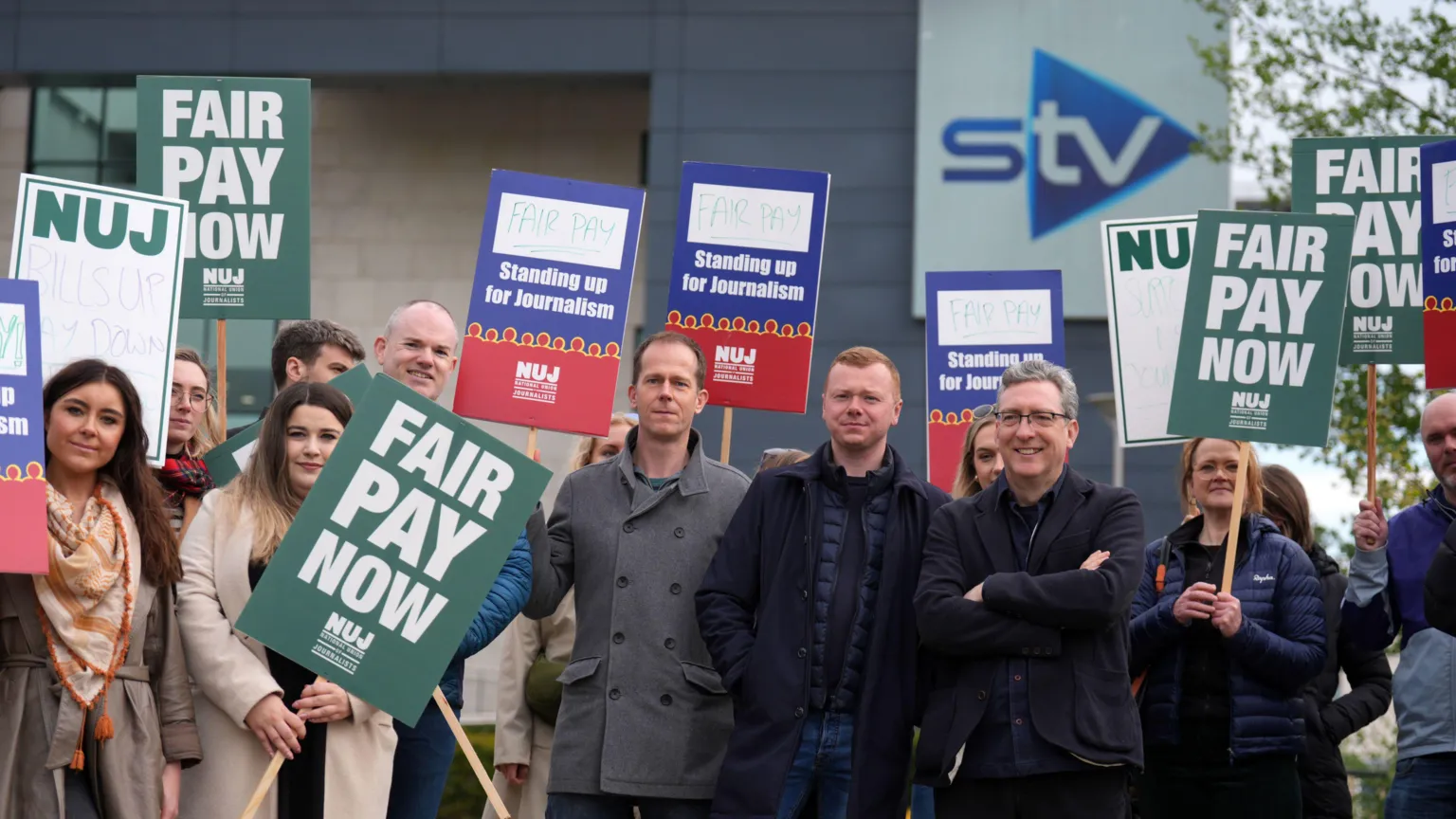
STV's original schedule for Friday included a special programme at 17:00 presenting details and analysis of the Scottish election results. This would have been followed by the main 18:00 news programme.
At 19:30, the current affairs programme Scotland Tonight was planned to reflect on the election outcome.
Instead of the STV News at Six, an episode of the Scottish travel series Sean's Scotland will be broadcast.
Some Scottish election coverage will still be included within the ITV network news, which is produced by ITN.
A spokesperson for STV explained that the company must respond to challenging market conditions affecting the media sector.
They added: "We recognise a temporary salary freeze is challenging for colleagues. Returning the business to a strong financial footing is our priority and will protect the long-term interests of our colleagues. We are disappointed that the unions' chosen day of action will impact our on-air audiences and we remain committed to continuing the dialogue with the joint unions."
'Failure' to End Dispute
STV provides the Channel 3 service in most of Scotland and owns a production business that creates programmes for other broadcasters.
The company has faced financial difficulties due to a decline in traditional television advertising, which has contributed to a drop in its share price and a headline loss.
Broadcast regulator Ofcom has informed BBC Scotland News that STV will not breach its broadcasting licence requirements as a result of the strike.
This is because there is no specific obligation to provide a news service every single day, and Ofcom permits licence commitments to be missed in exceptional circumstances such as industrial disputes.
The current pay dispute is separate from a controversy regarding STV's plans to discontinue the distinct news service for the north of Scotland, a legacy of the former Grampian Television.
Ofcom is expected to announce within the next few weeks whether it will approve this change.
Nick McGowan-Lowe, the NUJ's Scottish organiser, said it would be "embarrassing" for STV to broadcast reruns instead of election coverage. He added: "Our members would much rather be reporting the election results than standing on picket lines, but they have been driven to this action by management indifference as to how underworked and underpaid they are. Chief executive Rufus Radcliffe has once again failed to grasp the opportunity to end this dispute."
Analysis: Hard Times for Commercial Broadcasters
Beyond the specifics of the STV dispute, there are broader challenges affecting commercial broadcasters with public service commitments.
STV, like other commercial channels, has been impacted by declining television advertising revenue. Audience ratings have been in long-term decline, and some viewers no longer watch linear TV at all.
STV's licence to broadcast on Channel 3 carries legal obligations not imposed on other broadcasters.
The primary obligation is to provide Scottish news and current affairs programming. While this enhances the company's reputation, relatively little advertising revenue is generated around news programmes.
Effectively, the news service is subsidised by the remainder of the broadcast schedule.
STV argues that its legal commitments related to news need to be revised to ensure the service's sustainability. This is the rationale behind its proposal to cut the separate news service for the north of Scotland. A regulatory decision on this matter is expected shortly.
Controlling costs across the business is also a factor behind the pay freeze.
It has become increasingly difficult for commercial broadcasters to finance loss-making public service obligations.
Questions arise as to whether there are mechanisms to support the sustainability of these commitments if they are deemed important to society as a whole.
Is it still reasonable to require commercial broadcasters to air programmes that do not generate profit, or should regulatory requirements be enforced more rigorously?



