

Douglas Alexander Supports Starmer Leading Labour but Acknowledges Uncertainty
Douglas Alexander, the Scottish secretary, appeared on the airwaves this morning as part of a trusted group of ministers including Pat McFadden and Darren Jones, known for handling media during challenging government moments.
Alexander stated that appointing Peter Mandelson as ambassador to the US was a mistake. He noted that Keir Starmer has admitted and apologised for this error but maintained that Starmer did not lie because he was not informed about Mandelson effectively failing the security vetting process. Alexander emphasized that Starmer should have been informed, saying:
"I think most people watching this programme would think if there was material information, that the UK vetting agencies had come up with concerns and made a recommendation in relation to what’s a highly intrusive vetting process, that rightly and reasonably, that would be flagged to the ministers concerned."
When asked if he expected Starmer to lead Labour into the next election, Alexander replied:
"I expect so, yes … I think he will."
He added that while there are no certainties, he believes Starmer should lead because, on the most significant decision in parliament, he exercised sound judgment by keeping the UK out of another nation's war.
Alexander also remarked on Starmer’s fallibility:
"As a Scottish Presbyterian I don’t believe in papal infallibility, nor do I believe in prime ministerial infallibility."
Olly Robbins to Testify on Mandelson Vetting Dismissal
The Commons Foreign Affairs Committee confirmed that Olly Robbins will provide evidence at 9am tomorrow regarding his dismissal related to Peter Mandelson’s security vetting.
Reform UK's Malcolm Offord Claims Poll Shows Him as Only Alternative to Swinney
Severin Carrell, ’s editor, reported on a new poll indicating a near tie between pro-independence and pro-UK parties ahead of the Holyrood election on 7 May. The Scottish National Party (SNP) and Scottish Greens are projected to be one seat short of a pro-independence majority.
The poll, conducted by More in Common using multilevel regression and poststratification (MRP), forecasts the SNP winning 56 of 129 seats but falling short of an overall majority. This outcome would deny SNP leader Nicola Sturgeon the mandate for a second independence referendum, which she believes a majority would provide. The Scottish Greens argue that a combined majority with the SNP would suffice, a position rejected by Deputy First Minister John Swinney.
The MRP predicts the Scottish Greens will secure eight seats, fewer than their own expectations of 12 or more, leaving pro-independence parties at 64 seats—one short of a majority.
Among unionist parties, Reform UK is projected to be the largest with 22 seats, Labour 17, and the Liberal Democrats 14. Labour and the Liberal Democrats have ruled out any coalition with Reform.
More in Common noted that over half of Holyrood’s 73 constituency seats are highly marginal, contributing to uncertainty. The poll suggests the Scottish Greens would gain two SNP constituency seats in Edinburgh and Glasgow for the first time, while the Liberal Democrats would triple their 2021 results to 14 seats, gaining control over the Highlands.
Reform UK’s Scottish leader Malcolm Offord used these results to challenge Sturgeon, the Liberal Democrats, and the Conservatives to support a Reform-led government.
Last week, Offord sparked controversy by alleging that Scottish Labour leader Anas Sarwar privately approached him last year to discuss a deal to exclude the SNP, a claim Sarwar denies and has condemned.
"It is abundantly clear now that Anas Sarwar will not be first minister. The only way that would happen is if all unionist parties backed him in a coalition and we at Reform categorically rule out supporting a Labour party that no longer supports workers and doesn’t share our ambition to make Scotland the most prosperous part of the United Kingdom. So, we ask Mr Sarwar, will you back a Reform government or will you let this country suffer another 5 years of the SNP?"
Farage Accuses Starmer of Lying About Mandelson Vetting; Predicts Possible Labour Leadership Challenge
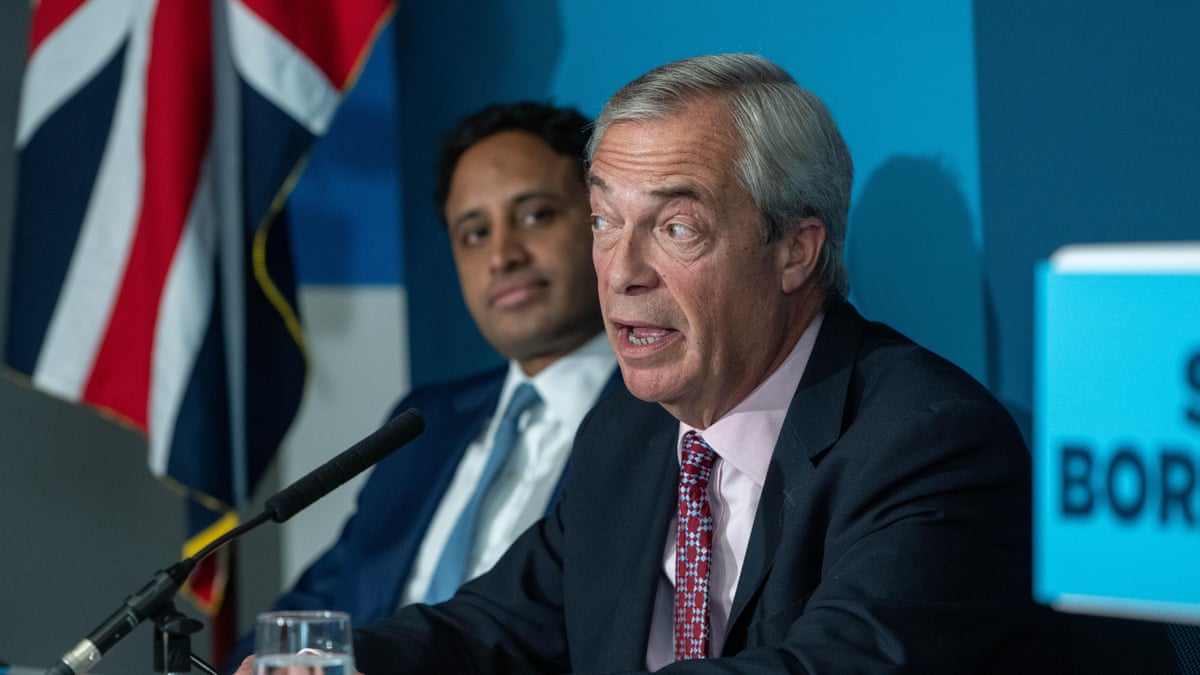
At a press conference, Nigel Farage addressed reports suggesting Keir Starmer was aware of security concerns that led to Peter Mandelson failing his vetting interview. The reports referenced sources indicating Starmer had been warned about major risks but dismissed them.
Farage insisted there was no way Starmer was unaware of these concerns, citing a September report by The Independent highlighting MI6’s failure to clear Mandelson due to business links with China and associations with Jeffrey Epstein. The Independent later clarified that UK Security Vetting, not MI6, was responsible for the vetting failure.
Farage said:
"It’s impossible for the prime minister to say the warning lights weren’t flashing. And if you were prime minister and there were news reports last September that your ambassadorial choice had failed vetting, you would have thought perhaps he might have had some curiosity to try to find out whether this had really happened or not. I just find the whole thing totally incredible. Incredible. There is no way the prime minister couldn’t have known. Are you telling me that everyone around him knew and he didn’t know what? It’s possible he’s just a puppet and never consulted on anything, but frankly, it isn’t believable. And I do believe strongly that he misled the House of Commons, that he lied to the country especially. He was so definitive in that Hastings speech that all the necessary channels had been gone that vetting had been assured."
Asked if Reform UK would support a no-confidence motion against Starmer, Farage said they would, but he doubted Labour MPs would do so, though he suggested their mood might change after 7 May.
Former MI6 Chief Questions Lammy’s Claim of Being Uninformed on Mandelson Vetting
David Lammy, deputy prime minister and justice secretary, who was foreign secretary when Mandelson was appointed ambassador, stated he was never informed that Mandelson failed the vetting interview. Mandelson’s appointment was technically approved because Olly Robbins, head of the Foreign Office, exercised discretion to override the vetting recommendation.
In an interview with Pippa Crerar, Lammy gave his account.
Sir Richard Dearlove, former MI6 head, expressed skepticism about Lammy’s claim on GB News:
"The problem ultimately is caused by the prime minister choosing an ambassador with a known integrity problem. Everybody understood that about Peter Mandelson, if you look at his past record. I’m not criticising his abilities, but as the talisman for New Labour, he had a very dodgy series of relationships. We won’t go into that. So there should have been, the prime minister should have thought through before announcing the appointment how he was going to manage that aspect of choosing Mandelson. But let me just move on now to the whole process of the DV [direct vetting]. I cannot believe that a permanent under secretary, when he got the results of the DV, didn’t ring up his minister, who he talks to every day, and say to him, ‘Look, Mr Lammy, minister, we have a problem, and we have to work out now how we’re going to manage that problem’. Did Olly Robbins really take it on himself to not tell anybody and decide, as the permanent under secretary of the Foreign Office, that the risk was manageable? I mean, whichever way you look at it, it’s a mess. It was a bad choice in the first place. It was an appalling choice in the first place."
Reform UK Plans to Deport Hundreds of Thousands Granted Asylum in UK
Nigel Farage, Reform UK leader, held a press conference outlining the party’s plan to deport people who have been granted asylum in the UK but entered illegally or overstayed visas. The party intends to review all successful asylum claims over the past five years, revoking status and deporting those found to have entered unlawfully.
The Press Association reported:
"Reform UK has pledged to deport ‘hundreds of thousands’ of small boat migrants who have successfully claimed asylum if the party wins the next general election. It plans to review all successful asylum claims over the past five years, with anyone who is found to have entered illegally or overstayed their visa and subsequently claimed asylum to ‘have their status revoked and be deported’, Reform’s home affairs spokesman Zia Yusuf said."
The Times reported that approximately 400,000 people would be subject to this review, with the majority expected to be deported.
On X, Yusuf stated:
"Reform will reverse the invasion of Britain. Anyone who broke into the country illegally, or came in on a visa and overstayed to claim asylum (which is almost all of them) will have their status revoked and be deported. This is an addition to all those currently in Britain illegally."
This announcement follows a recent surge in Channel crossings, with 602 people arriving on small boats on Saturday, making it the second busiest day this year and bringing the total arrivals in 2026 to over 6,000.
Reform UK has already pledged to deport all illegal migrants and to withdraw from the European Convention on Human Rights, which is often cited in asylum claims. The party aims to deport 188,000 illegal migrants annually via five removal flights daily.
Alexander Accuses Kemi Badenoch of Spreading False Conspiracy About Starmer
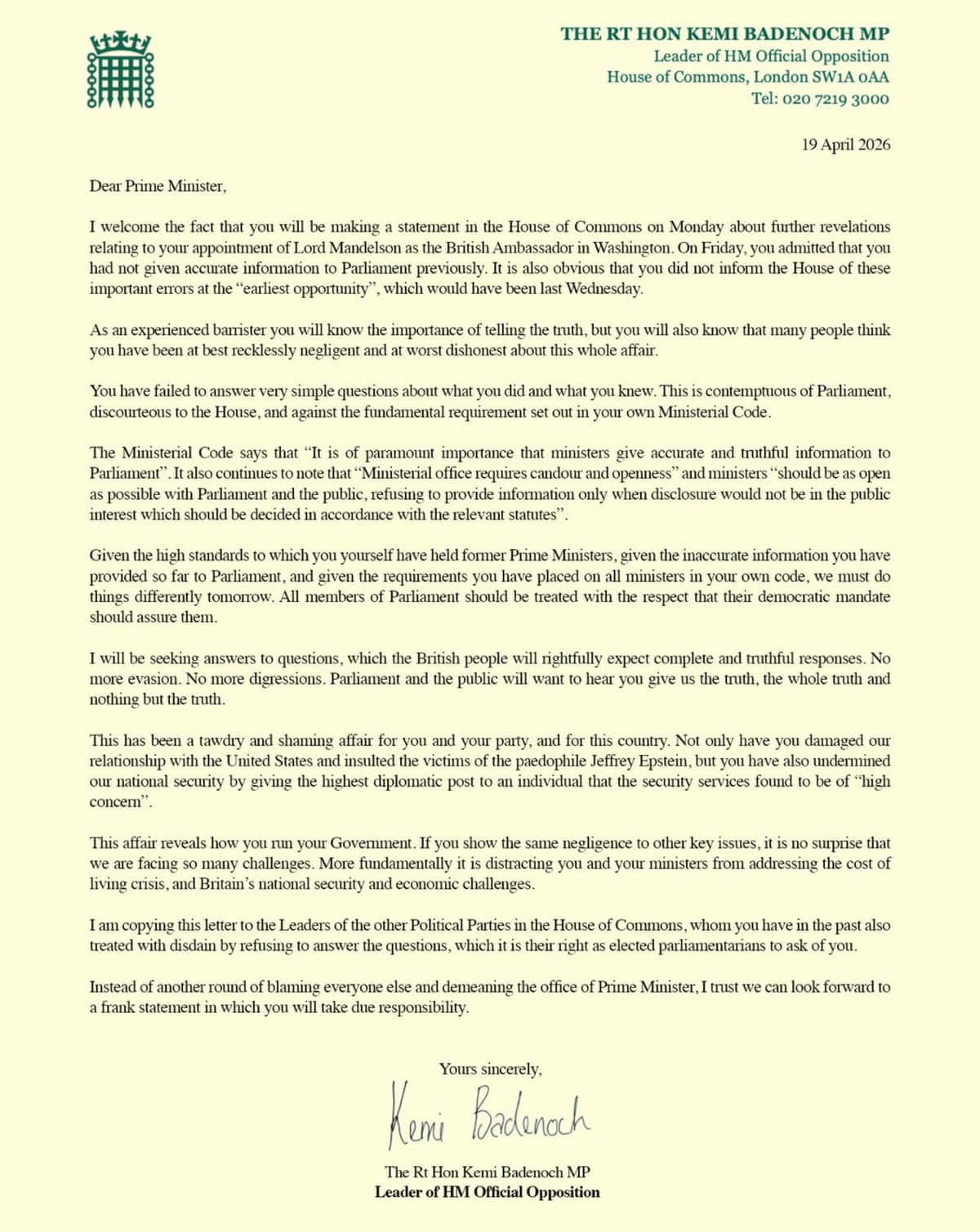
During an interview on the Today programme, Douglas Alexander accused Conservative minister Kemi Badenoch of promoting a conspiracy theory alleging deliberate dishonesty by Keir Starmer regarding Mandelson’s vetting. Despite Badenoch softening her stance since last week, Alexander said:
"The central charge that has been run by the opposition since Kemi Badenoch appeared on this programme on Friday – and I quote her directly, she said ‘there is deliberate dishonesty, I know he is lying’ – is that the prime minister has been deliberately dishonest. That is simply not true. Indeed, there is a growing body of evidence disproving that charge, not least friends and allies of Olly Robbins himself, who maintained that he didn’t tell the prime minister and claim he couldn’t tell the prime minister the recommendation of the vetting agency about Peter Mandelson. So, of course, rightly and reasonably, there will be important questions asked from all sides of the House of Commons today and the prime minister will account for the decisions he’s taken where he should at the despatch box. But the central charge made by the opposition, that somehow he knowingly misled parliament or the public is simply untrue. And to believe that requires a conspiracy not only involving Olly Robbins and his friends, but senior officials like the cabinet secretary, and indeed the permanent secretary of the Cabinet Office and every minister involved in this appointment."
Former No 10 Adviser Praises Olly Robbins’ Integrity
Tom Fletcher, UN Under-Secretary-General for Humanitarian Affairs and former Downing Street foreign policy adviser, spoke on the Today programme about the humanitarian impact of the Iran war and defended Olly Robbins, recently dismissed as head of the Foreign Office for not informing Starmer about Mandelson’s vetting recommendation.
Fletcher stated that Robbins has “public service and integrity stitched into his DNA” and described him as a strong character who has had a difficult few days and is heartbroken.
When asked about comments from former officials Gus O’Donnell and Simon McDonald suggesting Robbins was treated unfairly, Fletcher indicated he believed their points were serious and valid.
Badenoch Calls for Starmer’s Resignation, Softens Claim of Knowing Lie
On Friday, Conservative leader Kemi Badenoch asserted that she knew Starmer was lying about Mandelson’s vetting, stating:
"It’s completely preposterous for us to believe that when the prime minister said on the floor of the house [of Commons] the full due process was followed that officials who knew that was not the case would not have told him. He knew. It is preposterous for us to believe that on 5 February, [after] him giving press conference saying that Mandelson was cleared by the security services, nobody told him that actually this was not the case. It’s completely preposterous, the prime minister, the former chief prosecutor, did not ask basic questions, did not ask to look at the security vetting himself. It’s also completely preposterous that civil servants would have cleared a political appointee who had failed security vetting. Mandelson was not a mandarin he was a Labour party grandee appointed to be our most senior diplomat and ambassador … It doesn’t matter what story the prime minister is telling, at some point there is deliberate dishonesty – whether it’s the cover-up story or the original story – one of these is deliberate dishonesty, they can’t all be true, and that’s why I know he is lying."
However, Badenoch has since moderated her accusation, no longer claiming to know Starmer is lying but stating that he has been “at best recklessly negligent and at worse dishonest.” She reiterated her call for his resignation, telling LBC:
"I do think, certainly, in terms of his authority, he has reached the end of the road. He should resign."
Alexander: Announcing Mandelson Before Vetting Was a Mistake
Douglas Alexander stated in interviews this morning that announcing Peter Mandelson as the UK’s ambassador to the US before completing security vetting was a mistake. Peter Walker reported on this.
Former Cabinet Secretary Gus O'Donnell Defends Robbins’ Vetting Disclosure Decision
Downing Street claims that under the Constitutional Reform and Governance Act 2010 (CRAG), Olly Robbins could have informed Keir Starmer about Mandelson’s vetting failure. The government’s briefing states:
"Prerogative powers emanate from the crown but are exercisable by ministers and, when (and only when) delegated or otherwise authorised by ministers or as decided by statute, are exercisable by civil servants. In the context of vetting and clearance, this means civil servants run the process and make the decisions on whether clearance should be granted. There are legal obligations in carrying out vetting processes to ensure the appropriate protection and management of sensitive personal information, in accordance with data protection law. However, no law prevents civil servants – while continuing to protect such sensitive personal information – from sensibly flagging UK Security Vetting recommendations or high level risks and mitigations. This allows Ministers to make informed decisions, including on appointments or when accounting for government business in parliament."
In an article in The Times, Gus O’Donnell, former cabinet secretary, defended Robbins’ choice not to share the information with Starmer, explaining that Robbins had the authority as the ultimate decision-maker to approve the vetting. O’Donnell wrote:
"For a government often accused of being overly focused on law, legalism and process, they do not seem to have convinced the many sceptics that they have a clear understanding of their own vetting laws and processes. Their explanation of how the express exclusion of ministers, set out clearly in legislation, from the process of national security vetting for officials relates to how ministers are informed has been, to put it charitably, confusing so far. Moreover, the prime minister might feel that this exclusion of ministers didn’t serve him well in this case. But if so, he should change the system. Instead, he appears to have taken a very rapid decision to dismiss someone for applying what seems on the face of it to be an entirely standard, reasonable and perfectly obvious interpretation of the law and rules as they stand."
Downing Street Claims Starmer Could Have Been Told About Mandelson’s Vetting Failure
Good morning. Prime ministers rarely face Commons days that determine their political survival. Margaret Thatcher’s Westland debate and Boris Johnson’s Partygate hearings are notable examples. For Keir Starmer, the Commons session today is unlikely to end his leadership despite the controversy over Peter Mandelson’s security vetting failure, which Starmer repeatedly denied.
Labour MPs have not called for Starmer’s resignation, though many doubt he is the right leader for the next general election. The recent scandal has reinforced that view.
’s political editor, Pippa Crerar, outlines today’s developments. She notes that Labour MPs are aware of public disillusionment with politics, and the Mandelson scandal accelerates this sentiment, potentially prompting leadership change opportunities.
Last week, Starmer dismissed Olly Robbins for not informing him about Mandelson’s vetting failure. Robbins’ friends say he believed he was not authorized to disclose details of the secretive process. Allies also argue Robbins was implementing the prime minister’s decision to appoint Mandelson despite known risks.
Last night, Downing Street published a briefing on vetting disclosure rules, stating:
"The Constitutional Reform and Governance Act 2010 (CRAG) does not prevent civil servants from informing ministers of UK Security Vetting recommendations. What CRAG says is that civil servants make decisions on vetting and clearance. But no law stops civil servants sensibly flagging UK security vetting recommendations, while rightly protecting detailed sensitive vetting information, to allow ministers to make judgments on appointments or on explaining matters to parliament."
Today’s agenda includes:
- 11am: Reform UK leader Nigel Farage and home affairs spokesperson Zia Yusuf hold a press conference on deportation plans.
- 11.30am: Downing Street lobby briefing.
- After 3.30pm: Prime Minister’s statement to MPs regarding allegations of misleading Parliament and the public about Mandelson’s vetting.
For correspondence, please post comments between 10am and 3pm or contact via social media. maintains a presence on Bluesky and X for updates and corrections.


