Scottish Parliament Election 2026: Results Overview
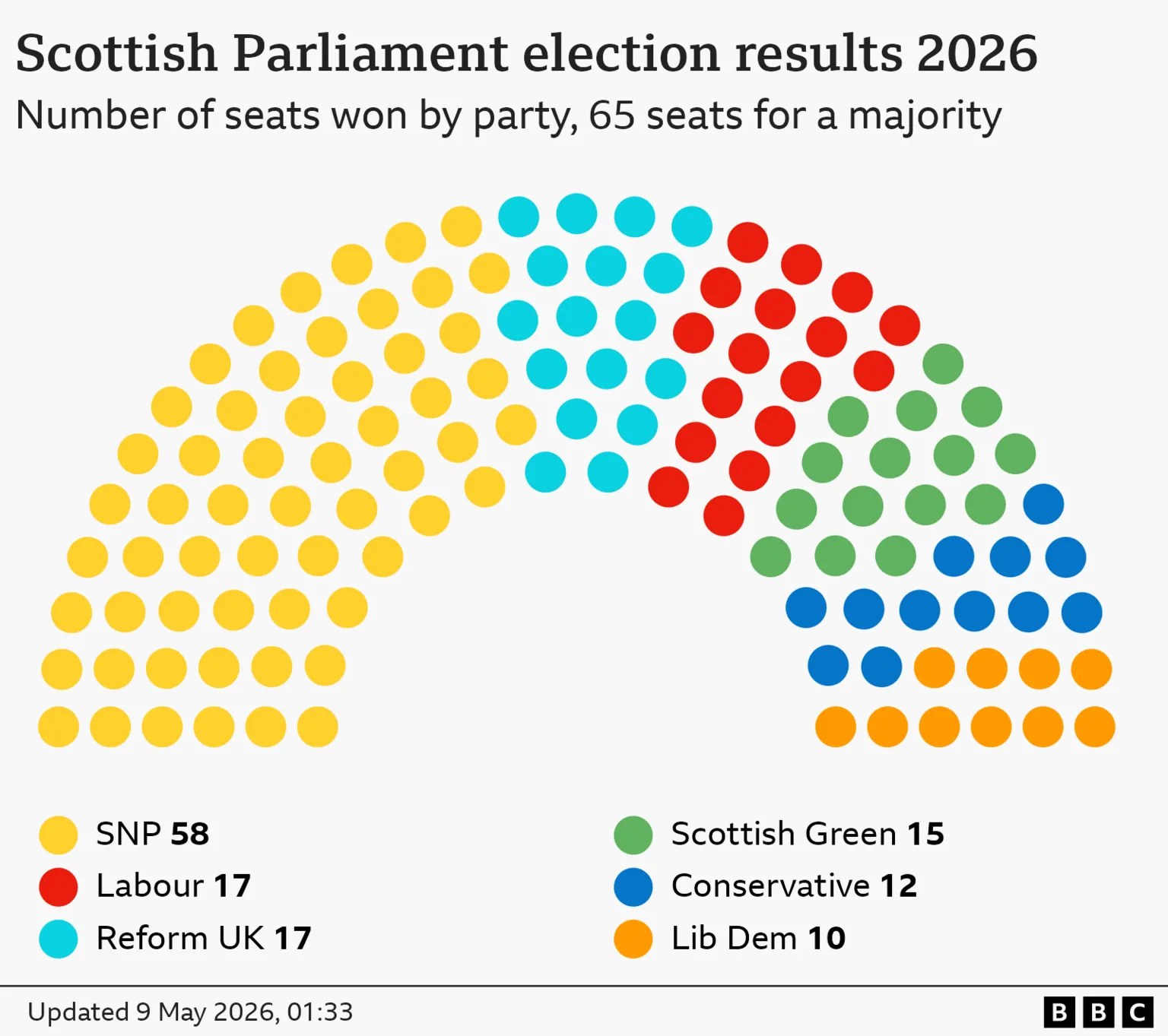
The Scottish National Party (SNP) emerged as the largest party in the 2026 Scottish Parliament election, securing 58 seats. However, this total falls short of the 65 seats required for an outright majority.
Party leader John Swinney stated that the SNP had won the Holyrood election "hands down" and the party is anticipated to form the next government.
Labour and Reform UK finished tied for second place, while the Scottish Greens achieved a milestone by winning their first constituency seats.
The election results illustrate the political landscape across Scotland and the composition of the new Scottish Parliament.
The SNP won decisively, benefiting from a fragmented opposition vote. Labour continued its trend of losing seats in every Scottish Parliament election since 1999, ending in a tie for second place with the rapidly growing Reform UK party.
The Conservatives experienced a significant decline, dropping from second place in 2016 and 2021 to their worst Holyrood result to date, with only 12 seats won.
Meanwhile, the Scottish Greens made substantial gains, achieving a record 15 seats, and the Liberal Democrats increased their representation to 10 seats.
The constituency map remains predominantly yellow, representing the SNP, with a notable change in Shetland, which the SNP won for the first time in a national election since 1945, breaking the Liberal dominance there.
There were also notable results in Liberal Democrat orange and Scottish Green green.
The Greens secured their first-ever constituency seats in Glasgow Southside and Edinburgh Central, marking a significant achievement for the party.
The Liberal Democrats made gains in the northern mainland, winning in the large constituencies of Caithness, Sutherland and Ross, and Skye, Ross and Lochaber. They also captured urban seats in Edinburgh Northern and Strathkelvin and Bearsden.
Labour managed to gain one seat in Na h-Eileanan an Iar (Western Isles).
Despite the SNP making some gains, such as taking Eastwood from the Conservatives, they did not reach the majority that John Swinney had aimed for.
Constituency Vote Share Across Scotland for Main Parties
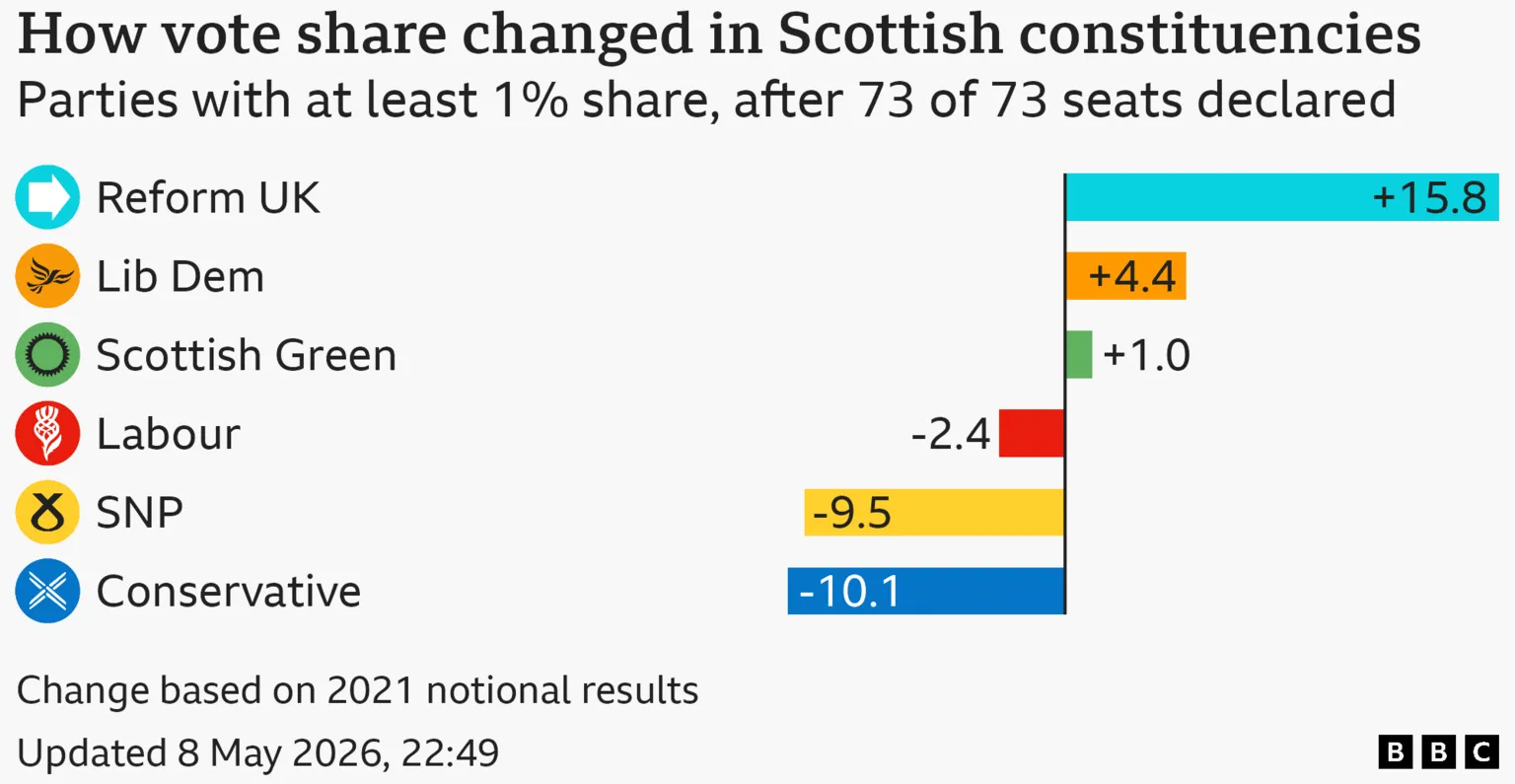
The distribution of party support across Scotland reveals several trends.
The SNP maintains strong support in most areas but finished third in a constituency for the first time since 2011, with Angus Robertson placing behind the Greens and Labour.
The Liberal Democrats have established strongholds in various parts of the country but remain uncompetitive in many seats, losing their deposit (receiving under 5% of the vote) in 27 constituencies.
The Greens contested only six constituencies but finished first or second in four of them, raising questions about whether they will expand their contesting efforts in future elections.
Reform UK developed a broad base of support, notably not losing a single deposit, in contrast to the Conservatives, who lost deposits in 22 constituencies.
Labour's support appears concentrated in central belt heartlands, aside from their Western Isles gain, facing a shortage of viable target seats as leader Anas Sarwar considers rebuilding strategies.
Regional Results and Their Impact
While constituency results secured the SNP's position, the regional vote was crucial in determining the overall parliamentary composition.
Reform UK was a notable beneficiary, gaining all its seats from the regional list despite narrowly missing a constituency win in Banffshire and Buchan Coast.
Following a campaign marked by intense exchanges between party leaders, Reform UK may have a significant and potentially disruptive role in the upcoming Holyrood term.
The Scottish Greens also made gains, now holding at least one Member of the Scottish Parliament (MSP) in every region of Scotland for the first time.
With Labour and the Conservatives losing seats, questions arise regarding the effectiveness and strategies of the opposition in Holyrood.
The Liberal Democrats, with increased influence, may find themselves competing with the Greens to negotiate budget agreements with the SNP.
Voter Turnout Trends
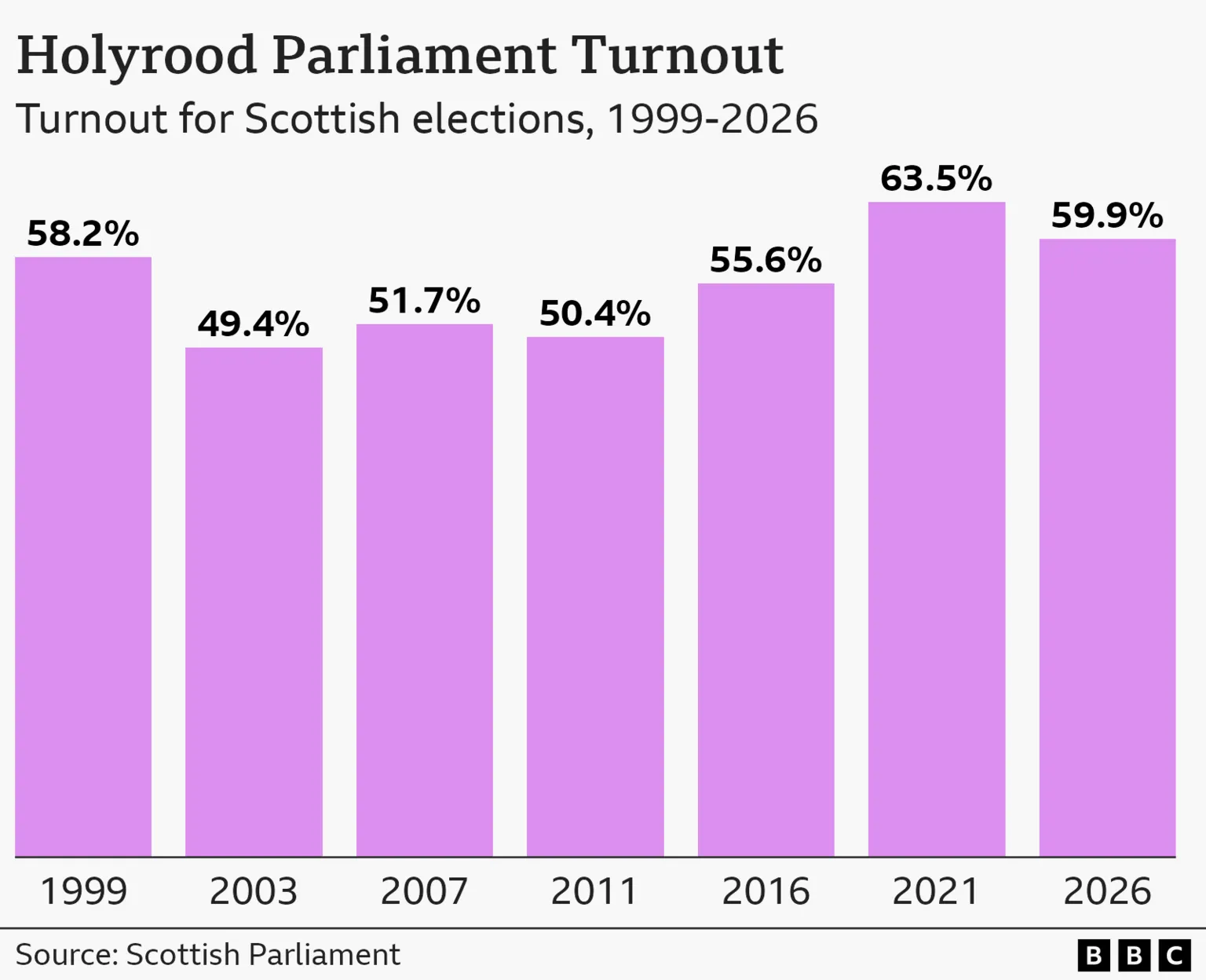
Voter turnout declined slightly from the record high of 63% in 2021 to 59.9% in the 2026 election, though it remains higher than many previous elections.
Only one constituency, Glasgow Kelvin and Maryhill, saw an increase in turnout, rising by 0.4%.
In 18 constituencies, fewer than half of eligible voters participated in the election.