

South Western Railway is reducing services on the West of England line after dry weather affected the route, with timetable changes and reduced speeds due to clay soil shrinkage on rail embankments. From 10 August, South Western Railway (SWR) will halve the number of trains between Yeovil Junction and Exeter St Davids as part of alterations on the line to London Waterloo.
The issue is clay soil shrinkage on rail embankments, which causes the tracks on top to buckle. The same problem reduced services on the line from August to November 2025.
The new timetable maintains trains every 30 minutes from London Waterloo to Salisbury and an hourly service to Yeovil Junction. However, trains will only be extended to Exeter St Davids every other hour.
Journeys will take slightly longer due to reduced speeds between Honiton and Tisbury, SWR said.
Train driver Peter Cook says it is noticeable from the cab when the rails are moving.
“you can tell when rails are moving”

Lawrence Bowman, managing director of SWR and Network Rail Wessex, apologised for the disruption and said the second year of prolonged hot, dry weather had affected the network.
“This is the second year in a row that prolonged hot, dry weather has affected our network.
“Since last summer's intervention, we've invested in strengthening the route, carried out extensive work to the track and embankments, and developed a plan that customers can rely on.
“As a result of that careful planning, we've managed to reduce journey times in our amended timetable by around 30 minutes compared to last year.”
The shrinkage - known as Soil Moisture Deficit (SMD), external - is already running at a higher level than in 2025, according to SWR data.
SWR train driver Peter Cook said it was noticeable from his cab.
“You can tell when rails are moving and you can see that from a long line away. And at greater speeds it's more exaggerated.”
Anne Browne, from SWR and Network Rail, said SMD problems were a sign of climate change.
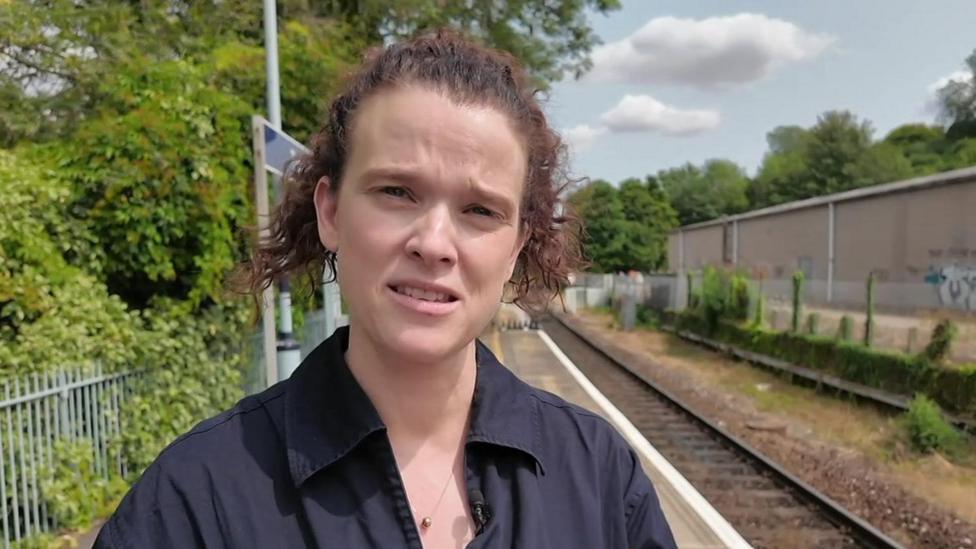

“This is the second year in a row that prolonged hot, dry weather has affected our network.
“Since last summer's intervention, we've invested in strengthening the route, carried out extensive work to the track and embankments, and developed a plan that customers can rely on.
“As a result of that careful planning, we've managed to reduce journey times in our amended timetable by around 30 minutes compared to last year.”
She said SWR was working with the University of Southampton on potential long-term solutions, which could involve changes to track materials or embankment vegetation.
The West of England line, which connects London with parts of Devon, Dorset, Hampshire, Somerset and Wiltshire, includes single-track sections with passing loops, making it prone to delays.
The section between Honiton and Tisbury is particularly vulnerable to drought-like conditions, SWR said. It can take weeks or even months for soil moisture levels to return to normal, the operator added.
Timetable changes due to SMD have already been announced on routes through part of East Anglia from Monday.
How will the timetable change?
SWR will keep trains running every 30 minutes from London Waterloo to Salisbury and hourly to Yeovil Junction, but services onwards to Exeter St Davids will run every other hour from 10 August. The operator said this is part of a reduced timetable caused by the effects of dry weather on the route.
Why is dry weather affecting the line?
Clay soil shrinkage on rail embankments can make the tracks buckle, creating safety and reliability problems. SWR said the issue, known as Soil Moisture Deficit (SMD), is already at a higher level than in 2025, and the Honiton to Tisbury section is particularly vulnerable.
What are rail staff seeing?
Train driver Peter Cook said the effect is visible from the cab and becomes more obvious at speed. He said:
“You can tell when rails are moving and you can see that from a long line away. And at greater speeds it's more exaggerated.”
What has SWR said about the disruption?
Lawrence Bowman, managing director of SWR and Network Rail Wessex, apologised for the disruption and said the company had invested in strengthening the route since last summer's intervention. He said the amended timetable should reduce journey times by around 30 minutes compared with last year.
Is climate change being linked to the problem?
Anne Browne, from SWR and Network Rail, said SMD problems were a sign of climate change. She said the organisations were working with the University of Southampton on long-term solutions, including possible changes to track materials or embankment vegetation.
Why is this route especially vulnerable?
The West of England line connects London with parts of Devon, Dorset, Hampshire, Somerset and Wiltshire. SWR said its single-track sections with passing loops make it more prone to delays, and that soil moisture levels can take weeks or even months to return to normal after dry periods.
Are similar changes being made elsewhere?
Yes. Timetable changes due to SMD have already been announced on routes through part of East Anglia from Monday.
Key Facts
- From 10 August, SWR will halve trains between Yeovil Junction and Exeter St Davids.
- Services from London Waterloo to Salisbury will remain every 30 minutes.
- Hourly services will continue between London Waterloo and Yeovil Junction, with Exeter St Davids reached every other hour.
- The problem is clay soil shrinkage on embankments, known as Soil Moisture Deficit (SMD).
- SWR said the issue has also affected the line from August to November 2025.


