

Cooler Saturday Offers Temporary Relief
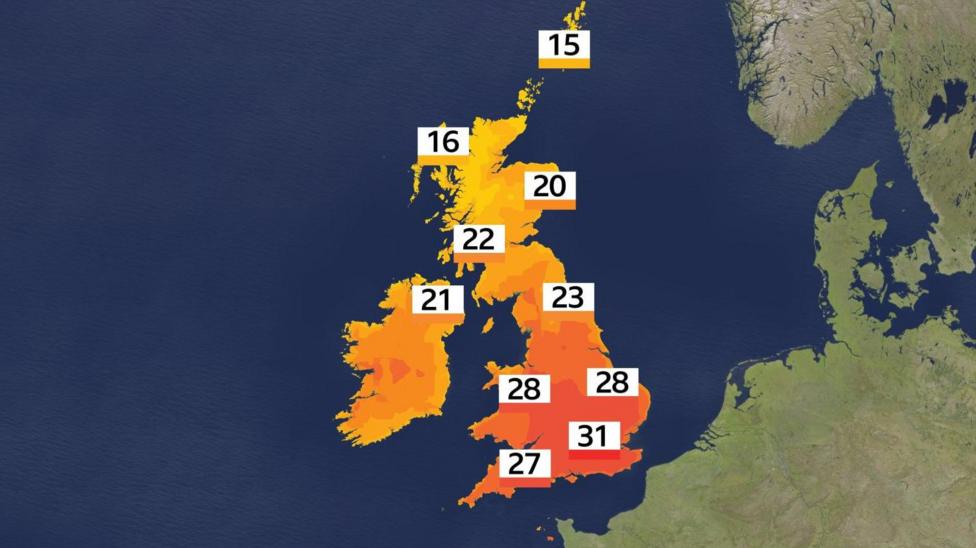
Saturday is expected to provide a brief respite from the recent heat as fresher air moves in from the west. On Friday, sunshine pushed temperatures above 30C (86F) in parts of the UK. However, this cooler air will likely suppress temperatures on Saturday, though highs of 27 or 28C (81-82F) are still anticipated in south-east England.
Most regions should experience dry conditions with sunny spells, accompanied by only a slight chance of an isolated shower.
Despite this temporary cooldown, temperatures are forecast to rise again on Sunday, continuing to climb on Monday and Tuesday as a Met Office amber warning for extreme heat comes into effect.
Will a Heatwave Be Declared on Saturday?
For a hot spell to be officially classified as a heatwave, temperatures must exceed a regional threshold—ranging from 25-28C (77-82F)—for three consecutive days.
Several areas in south-east England have already recorded two consecutive days above this threshold. Should temperatures remain sufficiently high on Saturday, a heatwave declaration would follow. However, it is possible that maximum temperatures may fall slightly short of these levels.
Meanwhile, Scotland, Northern Ireland, Wales, and northern and western England will experience significantly cooler conditions, with afternoon highs expected between 16-24C (61-75F).
You can check forecast temperatures for your area on the BBC Weather website and app.
Sunday Brings Return of Hot Weather
Temperatures are set to increase again on Sunday, regardless of whether an official heatwave is declared.
Sunny spells are expected across most areas, with peak temperatures reaching 27-31C (81-88F) in parts of the Midlands, Wales, and southern England.
Some northern England locations will see highs of 23 or 24C (73-75F), while much of Scotland and Northern Ireland will experience temperatures between 20-22C (68-72F), excluding the far north.
High levels of UV radiation and pollen are anticipated in many regions.
Staying Safe in Hot Weather
- Staying safe in water when the weather's hot
- Hay fever: Did you know your pets can suffer too?
- How to get a good night's sleep during hot weather
Extreme Heat Expected on Monday and Tuesday
The Met Office has issued an amber warning for extreme heat, effective across much of southern and eastern England and parts of south Wales from 01:00 BST on Monday until 23:59 on Tuesday.
Temperatures are forecast to peak at 34 or 35C (93-95F) in south-east England during this period.
It is highly likely that a heatwave will be officially declared in some areas.

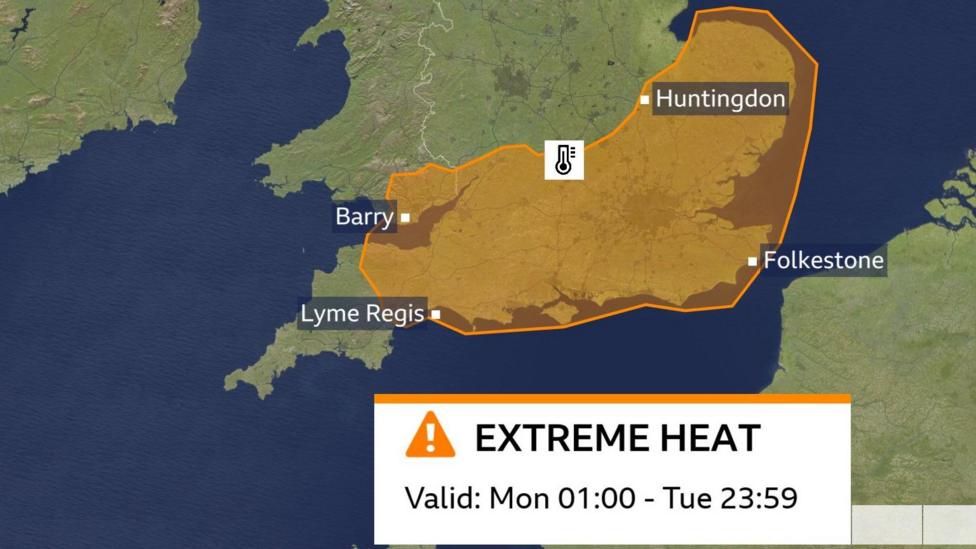
This marks only the sixth amber extreme heat warning issued by the Met Office since their introduction in 2021.
Some locations are expected to experience tropical nights, with overnight temperatures remaining above 20C (68F).
The combination of hot days and warm nights is likely to have various impacts on people and infrastructure.
There is a health risk, particularly for elderly and vulnerable individuals.
The UK Health Security Agency has already issued amber and yellow heat health alerts covering large parts of England.
Even younger and healthier individuals face risks of conditions such as sunstroke and heat exhaustion.
Delays and disruptions to travel networks and power supplies are possible.
Additionally, scattered intense thunderstorms may occur, especially in parts of England and Wales, posing further hazards.
When Will the Heatwave End?
Some forecasts indicate that temperatures could remain around 30C for at least seven consecutive days in certain locations, with possible rises into the mid-30s at times, although uncertainty remains.
This current hot spell follows a record-breaking May, during which the UK recorded its warmest May day.
The Met Office notes that heatwaves are becoming more frequent and intense globally due to human-induced climate change.
Scientists project that hot spells will become more common in the changing climate, particularly in south-east UK, stating it is
"virtually certain that human influence has increased the occurrence and severity of extreme heat events".
The developing El Niño is not responsible for this current hot spell, with its peak effects expected later this year and into 2027.
What is the summer solstice and why is it the longest day of the year?


