

Nicola Bannon, one of four women abused as schoolchildren by former teacher William Lloyd-Lavery in the 1970s, has called on the chief executive of the Law Society of Northern Ireland, David Lavery, to resign after he provided a character reference for her abuser. Lavery was sacked on Tuesday from his role as a human rights commissioner, but he remains in post as chief executive of the Law Society of Northern Ireland.
Bannon said she accepted that Lavery had apologised for what she described as his severe lack of judgement, but said the incident raised doubts about whether he should continue to lead such an important institution. Speaking on BBC's Good Morning Ulster programme, she said that if she were in a similar situation, she would resign.
“I do appreciate that he [David Lavery] has apologised for his severe lack of judgement,” Nicola said.
“But honestly that questions whether or not he is the right person to be leading an institution of such importance as the Law Society of Northern Ireland.”
“If I was in a similar situation, I would resign.”
How has David Lavery responded?
In a statement, Lavery apologised for a serious error in judgement in providing a character reference for his cousin and for any hurt and distress caused to the victims in the case. He said he profoundly regretted the decision and was committed to doing all he could to address it in the time ahead.
“In a statement, Lavery apologised for a ‘serious error in judgement on my part in providing a character reference for my cousin and particularly for any hurt and distress that I caused the victims in this case’.”
“I profoundly regret that and I am committed to doing all I can to address it in the time ahead,” he said.
The Law Society also said it had undertaken an internal process in relation to the matter. It said the process had now concluded and that, respecting its confidential nature, it would make no further comment on the outcome.
“This has now concluded and respecting the confidential nature of that process, we will be making no further comment on the outcome.”
The Law Society’s statement added that it acknowledged the concern caused by the case and that it was committed to facilitating appropriate consideration of the use of character references following conviction, acknowledging that there will be a broad range of views.
“We are committed to facilitating appropriate consideration of the use of character references following conviction, acknowledging that there will be a broad range of views.”
Bannon said she was surprised and disappointed by that response and called for greater transparency from the Law Society and more reassurance for victims. She contrasted that with what she described as the very firm and decisive action taken by Lavery’s other employers at the Northern Ireland Human Rights Commission, or NIHRC.
On Tuesday, Northern Ireland Secretary of State Chris Bryant removed Lavery from his post as a human rights commissioner. A Northern Ireland Office spokesperson said the NIHRC found Lavery had breached its code of governance and was capable of bringing the commission into disrepute.
“The public rightly expects the highest standards of integrity and professionalism from those in public appointments.”
“The public rightly expects the highest standards of integrity and professionalism from those in public appointments.”
“The secretary of state had ‘considered the findings of this independent review’ and then ‘terminated Mr Lavery's appointment with immediate effect’.”
Bannon said she was very grateful to Bryant and to the NIHRC, and said the open and transparent way they had dealt with the issue was a mark of the institution. She said it sent a very strong message to victims everywhere that they can have complete trust and confidence in the Human Rights Commission and that it will support them, protect them and champion their rights.
“I think it sends a very strong message to victims everywhere that you can have complete trust and confidence in the Human Rights Commission and that they will support you and protect you and champion your rights,” she added.
What happened in the trial?
Earlier this year, Lloyd-Lavery, of Richmond Avenue in Lisburn, was found guilty of six counts of indecent assault against four of his former pupils. The pensioner previously taught history at Richmond Lodge School in Belfast and was later a press officer for the Ulster Unionist Party, or UUP.
The women, who were aged between 13 and 14 at the time of the assaults, were praised by the trial judge for coming forward to expose a paedophile.

“for coming forward to expose a paedophile”
Lloyd-Lavery was sentenced to two years in prison in April.
After that hearing, two of the victims waived their right to anonymity to speak publicly about their experiences. Nicola Bannon and Lynne Darcy, who helped bring their former teacher to justice earlier this year, later said they found it difficult to deal with the character references that had been given to the court before their attacker was sentenced.

During that interview, Bannon and Darcy said the references were painful to hear in the context of their case. The following month, the Northern Ireland Human Rights Commission launched a formal process into the actions of Lavery, who was then its commissioner.
The Northern Ireland secretary of state is the appointing minister of the NIHRC. In its statement, the Northern Ireland Office said the public rightly expects the highest standards of integrity and professionalism from those in public appointments.
“The public rightly expects the highest standards of integrity and professionalism from those in public appointments.”
It said the secretary of state had considered the findings of the independent review and terminated Lavery’s appointment with immediate effect. The NIHRC said the protection of victims of sexual violence and abuse is of the utmost importance.
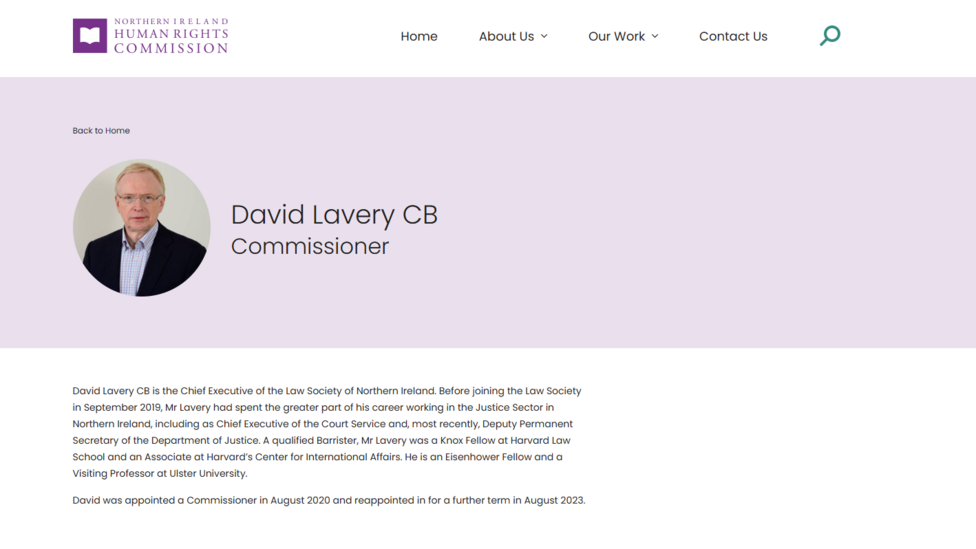
David Lavery’s profile on the NIHRC, pictured last month, has since been removed.
What did the character references say?
In Lavery’s character reference, Lloyd-Lavery was described as someone who had a Christian faith, was a family man, and wanted to contribute to society. The reference said: “I know that he was well respected in these circles and was viewed as a person of sound judgement and good character.”
“I know that he was well respected in these circles and was viewed as a person of sound judgement and good character,” it said.
David Campbell, chair of the Loyalist Communities Council and former UUP chair, also provided Lloyd-Lavery with a reference. In May, Campbell said: “It was never my intention to add to their [the victims] hurt.”
“It was never my intention to add to their [the victims] hurt.”
Earlier this year, Lloyd-Lavery, of Richmond Avenue in Lisburn, was jailed after being convicted of the assaults against four former pupils. The case prompted public discussion about the use of character references after conviction, and Bannon has continued to speak about the impact on victims.
The Law Society said it had already completed its internal process and would not comment further, while Bannon said victims deserved greater openness. She said the contrast between the Law Society’s response and the action taken by the NIHRC showed why transparency mattered in cases involving abuse survivors.
“If I was in a similar situation, I would resign.”
“I think it sends a very strong message to victims everywhere that you can have complete trust and confidence in the Human Rights Commission and that they will support you and protect you and champion your rights,” she added.
Key Facts
- Nicola Bannon and three other women were abused by former teacher William Lloyd-Lavery at a Belfast school in the 1970s.
- David Lavery provided a character reference for Lloyd-Lavery before his sentencing.
- Lavery was sacked on Tuesday from his role as a human rights commissioner, but remains chief executive of the Law Society of Northern Ireland.
- Lloyd-Lavery was convicted earlier this year of six counts of indecent assault and jailed for two years in April.
- Two victims waived anonymity to speak publicly after the sentence.


