

Scottish Parliament Election and Financial Promises
The Scottish Parliament election has been marked by numerous promises to increase spending on new policy initiatives. Concurrently, discussions have also focused on cutbacks, with several parties pledging to reduce the number of "quangos" and to limit the size of the public sector.
Holyrood's annual budget reached £68 billion this year and is expected to grow in the coming years, with increases anticipated both from the "block grant" provided by Westminster and from tax revenues managed by Holyrood. However, the budget faces significant pressures, including rising demands for services and benefits, substantial public sector pay agreements, and an ageing population.
Economic experts have warned that the budget to be established at the end of the year will present a "horror show" for whoever assumes the role of Scotland's new finance secretary. This raises the question: are any political parties being realistic about the magnitude of the financial challenges ahead?
What are the pressures?
The Scottish government's medium-term financial strategy projects that spending will exceed available funding by £4.8 billion in 2029-30. This shortfall is often described in media reports as a "black hole" in the budget that must be addressed.
The social security budget is a significant contributor to this pressure. It was £7.4 billion this year and is forecast to rise to £9.2 billion by 2030-31. More than half of this expenditure is allocated to the Adult Disability Payment (ADP), with the Scottish Fiscal Commission (SFC) estimating that by 2031, one million Scots will be receiving some form of disability payment.
Health and social care sectors are also under particular strain. The Accounts Commission, a public sector watchdog, has warned that "radical change" is necessary due to the growing gap between demand and available funding.
Public sector pay accounted for 55% of the Scottish budget last year. While the workforce size has increased since the pandemic, pay levels present a greater challenge. The SFC notes that Scotland's public sector workforce is "relatively larger and better paid than in the rest of the UK," with median pay approximately £1,500 higher than elsewhere in the country.
Pay levels continue to rise. The Scottish government budgeted for a total of 9% in public sector pay increases over three years starting in 2025-26, with employers having flexibility in how to distribute these rises. However, two years of substantial pay settlements have already occurred.
Resident doctors agreed to an 8% pay increase over two years, leaving only 1% available within the current budget for the following year. This trend aligns with national patterns; the SFC calculated that pay deals for 2027-28 will need to average 1.1%, significantly below the inflation rate.

What does this mean for the next government?
Various watchdogs and think tanks have cautioned that the next finance secretary will face multiple challenges. The Institute for Fiscal Studies (IFS) and the Fraser of Allander Institute (FAI) have suggested that an emergency mid-year budget may be necessary due to recent pay agreements.
Additional funding from Westminster, particularly Holyrood's share of new money allocated to schools in England, may temporarily alleviate the need to make cuts to support the health budget. However, this would likely defer the problem to the 2027-28 Scottish budget, scheduled for December.
Professor Mairi Spowage of the FAI described the upcoming budget as a "horror show," citing existing pressures and global factors such as the conflict in Iran, which contribute to inflation and increased debt costs.
Pay negotiations remain challenging, with current policies only allowing for below-inflation settlements. The question remains whether a newly elected government would be willing to engage in confrontations with unions.
There is potential for significant savings in public sector pay. David Phillips of the IFS suggested that aligning Scotland's public sector pay with levels in the rest of the UK could save nearly £2 billion annually.
How would parties raise revenues?
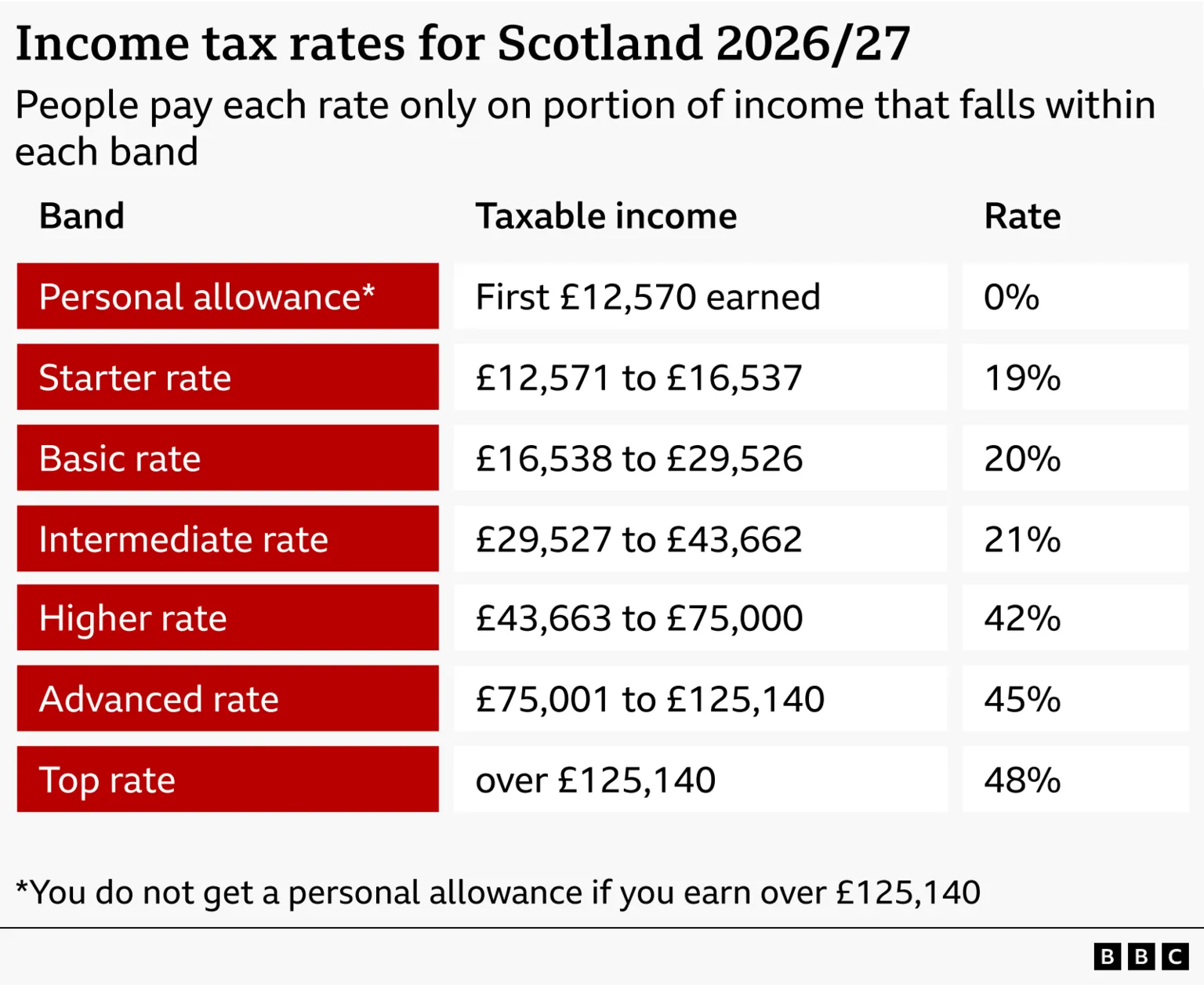
The Scottish National Party (SNP) has continued its policy of increasing revenue from higher earners since implementing a distinct income tax structure in 2016. The party has also utilized "fiscal drag" by freezing the income thresholds at which higher tax rates apply, meaning that as wages increase, more income is taxed at higher rates.
The SFC estimates that the number of individuals paying at least the higher rate of income tax has doubled over the past decade—from approximately 300,000 in 2016-17 to 600,000 currently—and could exceed one million by 2030-31.
John Swinney, the SNP leader, has pledged not to raise tax rates or introduce new tax bands in the next term, although he has not ruled out further fiscal drag since this promise does not extend to threshold levels.
Other parties have proposed raising or reforming different taxes or introducing new ones. The Scottish Greens, for example, included a broad range of tax proposals in their manifesto, such as increases to the land and buildings transaction tax (Scotland's equivalent of stamp duty), business rates targeting large companies, and levies on frequent fliers and domestic flights.

The IFS acknowledged the Greens' recognition of the need for increased revenues but stated that their plans are "unlikely" to generate sufficient funds to cover the scale of proposed spending.
Is anyone planning to cut services?
Most parties concur that the size of the state in Scotland should be reduced. The Scottish government's spending review implied real-terms cuts to local government, education, and justice sectors through to 2028-29.
Ministers have also identified £1.5 billion in "efficiencies" expected over this period, primarily from "back office" functions within public bodies. The savings proposed by parties in their manifestos would add to these measures.
Several parties, including the SNP, have proposed reducing the number of "quangos"—arm's length public bodies. The Scottish Conservatives have pledged to cut their number by 25%, while Labour aims for a 33% reduction. Reform UK has suggested suspending all 132 quangos until they can justify their spending, which the party estimates at approximately £6.5 billion.
The FAI noted that such a suspension would include bodies like the Scottish Funding Council, which administers £2 billion in state support for colleges and universities, the Scottish Prison Service, and Scottish Rail Holdings, which operates ScotRail.
Some parties have proposed cuts to specific services. For example, the Scottish Conservatives have suggested restricting eligibility for Adult Disability Payments for claims related to mental health without a formal medical diagnosis. The party estimates this could save £1.8 billion annually by 2030-31, given that about 40% of ADP claims fall under mental or behavioural disorders.
However, the FAI cautioned that this approach might lead to an increase in formal diagnoses, making any savings "inherently uncertain" in practice.

Do the spending plans stack up?
All parties included spending proposals in their manifestos. The SNP proposed expanding funded childcare at a cost of £540 million. The IFS warned that this figure could increase if uptake exceeds estimates.
Reform UK Scotland proposed tax cuts amounting to £2.3 billion by the end of the next Holyrood term. However, the IFS pointed out that the party claimed these cuts would be "paid for four times over" by £8 billion in potential economic growth over the coming decade, apparently overlooking that £2 billion annually over ten years equals £20 billion in spending.
The Scottish Conservatives acknowledged that "tax rises or spending cuts will be required to balance the books" in the next parliament and outlined plans for £6 billion in cuts by 2031-32. However, the party allocated nearly all these savings to new spending, primarily tax cuts, and pledged to return any budget underspends to taxpayers.
Scottish Labour presented a relatively modest manifesto focused on improving existing services rather than introducing new ones. Nonetheless, the IFS stated that even this "relatively restrained" approach would "still probably require some combination of cuts to other services, increases in taxes or improvements in public sector productivity."
For other parties, manifestos are not necessarily intended to be fully implemented. The Liberal Democrats proposed several smaller spending initiatives, such as £100 million for an emergency insulation program and £50 million to hire an additional 2,000 pupil support assistants for schools. The party appears to be positioning itself for negotiations with larger parties over budget agreements.
The Scottish Greens also seem to be preparing for coalition negotiations, although their policy proposals are potentially more costly, including free bus travel for all, a significant increase in GP numbers, smaller school class sizes, and a four-day working week.

The six parties have offered a variety of responses to the financial challenges facing Scotland. However, experts agree that none have directly addressed the "black hole" forecast for the coming years.
David Phillips commented on this, stating:
"When you're in an election you want to be saying new stuff. But voters obviously care about the quality of existing stuff. How do you move from a debate about new things to making sure that the things you currently get are up to scratch?"
Similarly, Mairi Spowage remarked:
"Absolutely nobody is dealing with the fact that what we spend now on services is not sustainable."
Additional reporting by Aimee Stanton.


