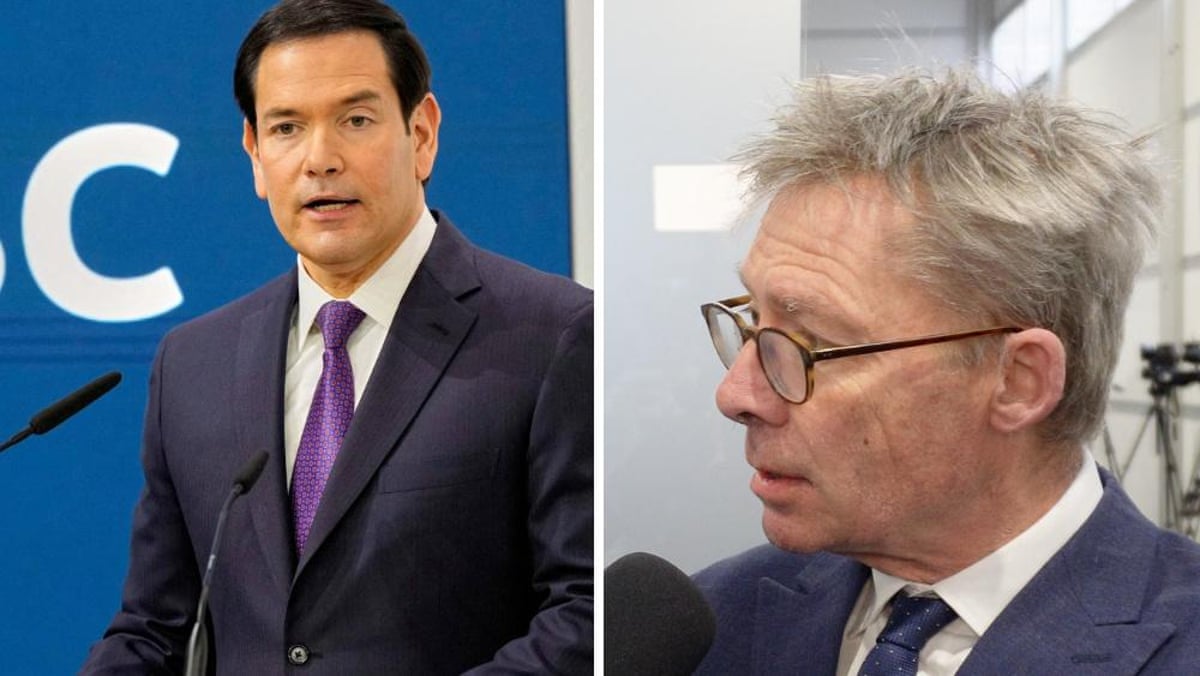
'Contrary to what some say, woke decadent Europe is not facing civilisational erasure,' EU's Kallas says
EU’s Kaja Kallas is currently speaking on the main stage at the Munich Security Conference. In her initial response to US Senator Marco Rubio’s speech from the previous day, Kallas somewhat wryly remarked that
“contrary to what some may say woke decadent Europe is not facing civilizational erasure,”and highlighted that many countries continue to seek membership in the EU, citing Canada as an example of a non-European nation interested in joining the bloc.
She emphasized that Russia remains a significant challenge for Europe.
“This starts in Ukraine, but we know that Russia’s endgame is not Donbas,”Kallas said, referring to ongoing efforts by Russia to destabilize or undermine EU member states.
She continued with a clear assessment of Russia’s current position:
“But let’s be clear-eyed about Russia: Russia is no superpower. After more than a decade of conflict, including 4 years of full-scale war in Ukraine, Russia has barely advanced beyond the 2014 lines, and the cost? 1.2 million casualties.
Today, Russia is broken, its economy is in shreds. It is disconnected from the European energy markets and its own citizens are fleeing.
In fact, the greatest threat Russia presents right now is that it gains more at the negotiation table, then it has achieved on the battlefield.”
EU should define its key asks from Russia before peace talks, Kallas says
Kallas expressed some scepticism regarding the proposal to appoint an EU envoy for negotiations aimed at ending the Russian invasion of Ukraine. She reiterated her earlier point that
“what matters more than having a seat at the table is knowing what to ask [for] when you are sitting there.”
She stressed the importance of establishing clear European demands before entering negotiations.
“That’s why I proposed to the member states [a] concrete mandate [of] the asks that we would have to Russia. So whoever goes to that table, whether it’s individually or bilaterally, they should ask [for] these things from the Russians.
We have a saying in Estonian that if you demand a lot, you get little; if you demand little, you get nothing, and if you demand nothing, you pay on top.”
As the conference nears its conclusion, two of the four panellists have already departed to catch flights home. However, coverage will continue with key statements from remaining speakers.
Latvian Foreign Minister Edgars Rinkēvičs was asked about the potential impact of Hungary’s upcoming election on Ukraine’s EU accession prospects, given that Viktor Orbán, who opposes Kyiv’s EU membership, might be replaced after 16 years in power. Rinkēvičs cautioned:
“I would caution that both Olympic Games … and elections sometimes produce very unexpected results. Let’s not jump ahead of the curve. Let’s not assume something that only voters in each of our countries can decide. … So let’s wait till things happen and let’s see how that happen.”He also noted that elections in France and Poland next year could shift the political dynamics in the opposite direction.
EU 'not ready' to offer Ukraine date for accession to bloc at this stage, Latvia's president and EU top diplomat say
Latvian President Edgars Rinkēvičs shared his perspective on Ukraine’s President Volodymyr Zelenskyy’s push for a specific EU accession date as part of any future peace agreement. He stated:
“We understand that we need Ukraine in the European Union,”but added that discussions with other EU leaders suggest
“at this point, as we speak today here in Munich in February, there is no readiness to [agree on] a date.”
Rinkēvičs explained that while the EU desires Ukraine’s accession as soon as possible, two other issues must be addressed first. He highlighted the western Balkans, noting the EU’s credibility in the region has suffered due to stalled accession progress.
“We have been promising so many things in return for reforms, for name change of North Macedonia, for instance. We have been promising [them the] membership for so long.”
He also stressed that Moldova cannot be overlooked.
“Yes, that’s a small country, but if Ukraine comes in, we can’t leave out Moldova out of this, so it’s not only about Ukraine any more,”adding that this would require
“a very serious discussion”on managing the process.
Rinkēvičs stated that Ukraine’s EU membership is closely linked to the peace deal but expressed skepticism about Russia’s willingness to engage meaningfully.
“If Russia is not moving, then we are not going to have a deal,”he said.
EU foreign policy chief Kaja Kallas concurred:
“My feeling is that the member states are not ready to give a concrete date. There’s a lot of work to be done, but I think the [sense of] priority … to move and to show that Ukraine is part of Europe is there.”

'We need to produce more, everywhere,' Nato deputy secretary general says
Nato Deputy Secretary General Radmila Šekerinska echoed points made by France’s Benjamin Haddad regarding defence production. She recalled that the last Nato summit in The Hague agreed not only on increased defence spending but also on boosting production capacity.
“This will be repeated in Ankara now: we need to produce more, and we need to produce more everywhere.
We need more European production, we also need more production on the US side.
If you look at the numbers, and especially if you look at the numbers on key capabilities, which are urgent in Ukraine, like air defence, we don’t have enough, period.”
Šekerinska explained that many stockpiles are insufficient for current needs and that the US stockpiles have been the primary source for capabilities. She described a recent visit to a Norwegian company that exports mainly to the US, which then supplies additional production to European countries.
“These are the links that defence companies have developed. If we try to dismantle them, we end up weaker and not stronger, so the call in the Ankara summit will be very much we need to produce more and for this, we need better regulation, we need speedier processes, and this is very much where Nato focuses on how do we make interoperability standards.”
Increasing defence spending to buy overseas 'makes no sense,' French minister says
France’s Benjamin Haddad advocated for prioritizing European defence industry in procurement decisions, calling it
“common sense.”He argued that increasing defence budgets, often at the expense of other spending, should not result in subsidizing factories abroad, such as those in Kentucky, USA.
“This makes no sense,”Haddad said.
He also highlighted the importance of control over usage, export, and technological knowledge associated with defence acquisitions.
“We know that when you buy a weapon from another area, it comes with strings attached. It comes with [some] fine print on how and when you can use it. So all of this is absolutely critical.”
Don't cling to some love words from US, but focus on ourselves, France's Haddad says
Haddad offered a nuanced view on Rubio’s speech, noting that four Europeans were expected to respond a day later. He cautioned against complacency or overreliance on positive remarks from the US.
“We should not either be relieved or shocked by this or that speech. I think the worst lesson we could draw from this weekend is to say, well, I can cling to some love words that I heard in part of his speech and push the snooze button,”he said.
Instead, Haddad urged the EU to focus on its own priorities, including rearmament and enhancing competitiveness.
“This is also the best way in the long run to reshape and maybe salvage the transatlantic relationship: to make it more balanced, more mature, with two pillars that are equal rather than looking for love or thinking about how the Americans are going to talk about us.”
We don't see eye to eye on all issues, but we can work from here, EU's Kallas says after Rubio's speech
Kallas, who previously served as Estonia’s prime minister, reflected further on Rubio’s speech, noting that it contained messages directed both at Europe and the American public.
“For me, every time I hear this European bashing – it’s very in fashion right now – I’m thinking of what is the alternative and, and really, I mean, all the best or good things that we got from Europe, and all the good things that Europe actually represents.”
She found reassurance in Rubio’s affirmation of the transatlantic relationship:
“The message that we heard from there is that America and Europe are intertwined; have been in the past and will be in the future. I think this is important. It is also clear that we don’t see eye to eye in all the issues and that this will remain the case as well, but I think we can work from there.”
Kallas also took a pointed jab at the US regarding press freedom:
“Coming from a country that is #2 in the Press Freedom Index hearing criticism regarding press freedom coming from a country that is #58 on this list is interesting.”
Morning opening: What do we make of all of this?
Guten Tag, as the third and final day of the Munich Security Conference commences. The day’s programme is relatively brief, focusing on European reactions to US Secretary of State Marco Rubio’s speech from the previous day, alongside discussions on further reforms to the EU’s economy and competitiveness.
Speakers scheduled include EU foreign policy chief Kaja Kallas, European Central Bank President Christine Lagarde, and former Nato Secretary General Jens Stoltenberg, among others.
It is Sunday, 15 February 2026. Jakub Krupa reporting for Europe Live.