Solar Panels Stir Controversy in Denmark's Rural Areas
In Denmark, the expansion of solar panels has become a contentious topic among voters, particularly in rural communities.
One narrative portrays the golden fields of this proud agricultural nation as being threatened by an industrial spread of solar panels, imposed by an urban elite. While this perspective has not gained traction in conservative regions like Texas and Hungary, where solar power is embraced despite criticism of environmental regulations, it has found resonance in Denmark, known as the world’s most climate-ambitious country.
“We say yes to fields of wheat,”stated Inger Støjberg, leader of the right-wing populist Denmark Democrats, during a 2024 speech.
“And we say no to fields of iron!”
The term jernmarker, meaning iron fields, was selected as the Danish word of the year in December following a solar backlash that influenced municipal elections and led several councils to halt projects. This imagery of barren metal landscapes has reemerged in the national election campaign as Danes prepare to vote on Tuesday. In the first televised debate between party leaders last month, Støjberg emphasized,
“We need more common sense in the green transition.”
Growing Resistance to Clean Energy in Europe
Across Europe, pockets of resistance to clean energy have solidified, with far-right parties targeting climate action as a secondary political issue after migration. Until recently, solar panels had largely avoided the opposition that has hindered the deployment of wind farms, biomass, and other renewable technologies.
Denmark, which produces 90% of its electricity from renewable sources and aims to accelerate this transition faster than any other wealthy nation, has seen solar power’s rapid growth alarm some regions where installations are concentrated. Solar energy’s share of Danish power production increased from 4% in 2021 to 13% in 2025, resulting in some villages becoming encircled by solar panels.
Concerns Over Solar Farms in Rural Communities
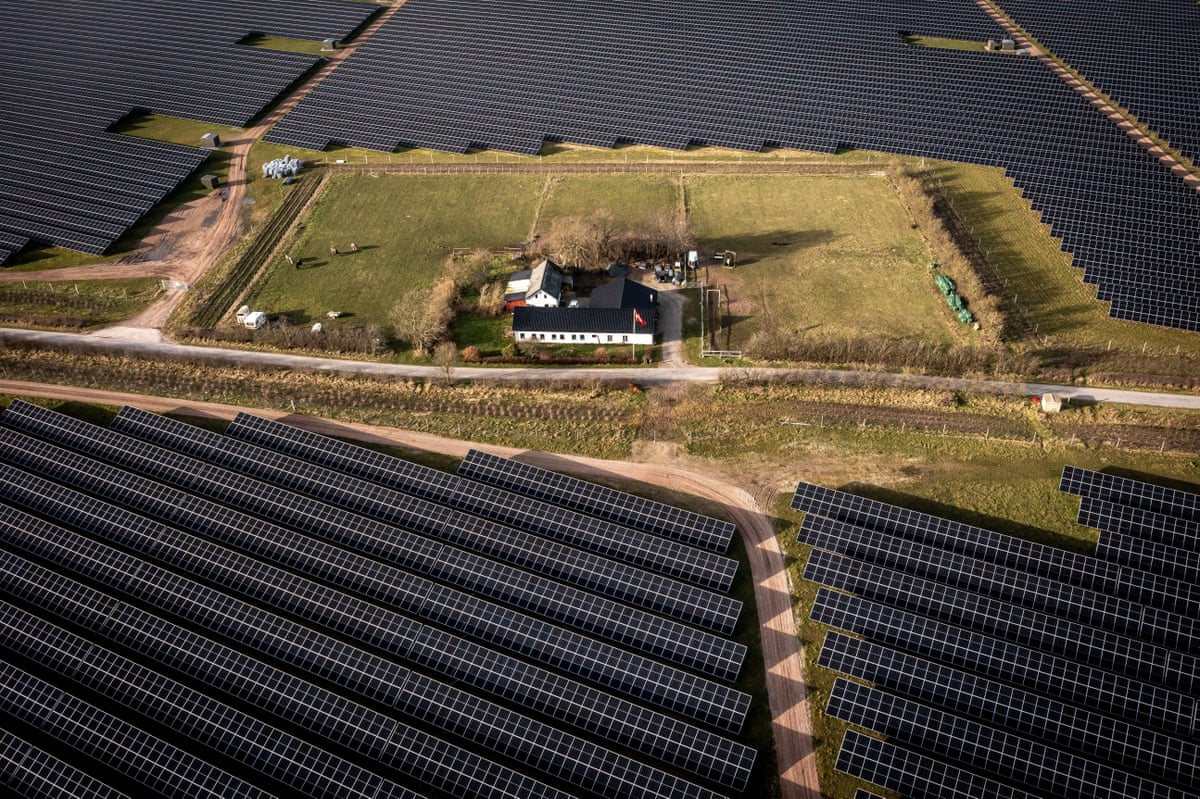
Opponents argue that photovoltaic panels are visually unappealing, harm natural landscapes, and reduce property values in already neglected rural areas. Drone images showing farmhouses surrounded by solar arrays have become symbols of perceived urban overreach, prompting even some established political parties to moderate their support for solar energy.
Lukas Slothuus, a climate politics researcher at the University of Sussex who grew up near the Danish-German border, noted that the Denmark Democrats have provided a clear political platform for this discontent nationwide.
“The far right have realised – and decided – that climate is a potent electoral battleground,”he said.
“It’s just about finding one issue to centre it around.”
Project Cancellations and Political Shifts
The resistance has resulted in project cancellations. In January, the municipality of Køge voted to cancel a renewable energy park in Vallø. Similarly, Viborg’s council recently halted a planned solar farm in Iglsø while approving only the wind and biogas elements of another project in Vinge. On Samsø, the first island globally to be powered entirely by renewables, councillors from multiple political parties voted last year to reject a solar park proposal.
In Ringkøbing-Skjern, Denmark’s solar heartland, enthusiasm for new projects has diminished. Mads Fuglede, a Denmark Democrats politician elected to the council in November, remarked,
“Solar panels have become a symbol of the political elite that wants a green transition and doesn’t care about what happens to the countryside. Because that’s not where they live or where their voters live.”

Denmark Democrats’ Position on Solar Energy
Unlike some right-wing counterparts in other countries who deny climate science and oppose pollution reduction, the Denmark Democrats affirm their support for transitioning to a clean economy. Fuglede clarified the party’s stance:
“You can get your solar panels, but put them up where you live in the cities. There’s no need to cover farmland.”
Public Support and Opposition to Green Energy
Denmark has historically enjoyed strong public backing for its clean economy initiatives and ambitious environmental policies, including the world’s first climate law. A recent survey found that 77% of voters influenced by green energy projects supported them. However, among the two largest right-wing populist parties, whose supporters are primarily rural, over 80% opposed such projects.
Scale of Solar Power and Municipal Responses
Some analysts suggest that the political debate over solar power may be disproportionate to its actual scale. According to the Danish Solar Association, solar panels occupy only about 0.2% of Danish farmland, with roughly one-third of solar capacity installed on rooftops.
In response to opposition, some municipalities have quietly advanced projects. Camilla Holbech, vice-president of renewable energy at Green Power Denmark, explained,
“Municipal politicians that are in favour have been green hushing: not being too vocal about it, they’ve just gone out and done it.”
Challenges in Community Engagement and Market Dynamics
The backlash has raised broader questions about how clean energy developers can engage local communities effectively as renewable energy expands.
Henrik Stiesdal, an inventor who constructed one of Denmark’s first wind turbines in the 1970s and developed its first offshore wind farm in 1991, observed,
“The thing that has changed since the first decades is Facebook. Even though the greater population feels things are good, you can get enough local people and enough not-local-but-angry people to provide opinions.”
Moreover, solar power’s own success may pose challenges. Denmark experiences relatively few sunny days suitable for profitable solar generation. As solar capacity has increased, the frequency of negative electricity prices has risen, leading to profit cannibalization. Slow electrification rates and grid congestion have further frustrated developers.
Torsten Hasforth, chief economist at Concito, a Danish climate think tank, stated,
“Over the next 10 years, the official expectation is a very large rise in the amount of solar produced. But that kind of clashes with the reality on the ground – they can’t make money.”
He added that some developers have inadequately engaged local communities but considered the backlash manageable.
“Opponents of solar cells are always happy to show drone images,”he said.
“But no one watches the world through a drone. We’re a flat country. It’s fairly easy to hide them.”