Artemis II Mission Encounters Toilet Challenges
NASA is preparing to send humans farther into space than ever before, but one piece of technology aboard the Orion space capsule has experienced some difficulties — the onboard toilet system.
Since the launch from Earth on Wednesday, the four astronauts aboard the Artemis II mission's Orion capsule have encountered intermittent problems with their toilet.
On Saturday, the toilet was unable to expel waste overboard, which NASA attributed to a possible frozen vent line. As a result, the crew has been using an alternative method involving collapsible plastic containers to collect urine.
Despite these challenges, Artemis II has successfully progressed into the fifth day of its historic 10-day mission orbiting the Moon.
The crew consists of NASA astronauts Reid Wiseman, Victor Glover, Christina Koch, and Canadian Space Agency astronaut Jeremy Hansen. They are confined within a compact cabin roughly the size of a camper van, measuring approximately 5 meters (15 feet) wide and 3 meters (9 feet) high.
During a video communication with Earth on Thursday, mission specialist Christina Koch mentioned a minor "priming" issue with the toilet.
"I'm proud to call myself the space plumber, I like to say that it is probably the most important piece of equipment on board," she said.
NASA later reported in a press release on Saturday that a wastewater vent line had become clogged.
The flight crew adjusted the spacecraft’s orientation to point the vent toward the Sun in an effort to clear the clog. NASA confirmed that this maneuver did not alter the spacecraft’s trajectory.
While they managed to free some space in the waste management system tank, the issue was not fully resolved.
"Engineers have been using the vent heaters to melt any potential ice that may be clogging the line," NASA stated, adding that they continue to orient the vent toward the Sun.
"The wastewater tank is not full and the toilet is operational; however, the crew was instructed to use backup collection devices overnight if needed," the agency added.
John Honeycutt, chair of the Artemis II Mission Management Team, addressed public interest in the space toilet during a news conference on Saturday evening.
"I think the fixation on the toilet is kind of human nature," he said. "Everybody knows how important that is to us here on Earth. And it's harder to manage in space."
In a Sunday interview on CNN's State of the Union, NASA Administrator Jared Isaacman acknowledged the waste management issue, stating that while many extraordinary capabilities exist in space, perfecting this particular system remains a challenge.
"We can do a lot of extraordinary things in space right now, but nailing this capability is one that we need to certainly work on," he said.
Mission Trajectory and Objectives
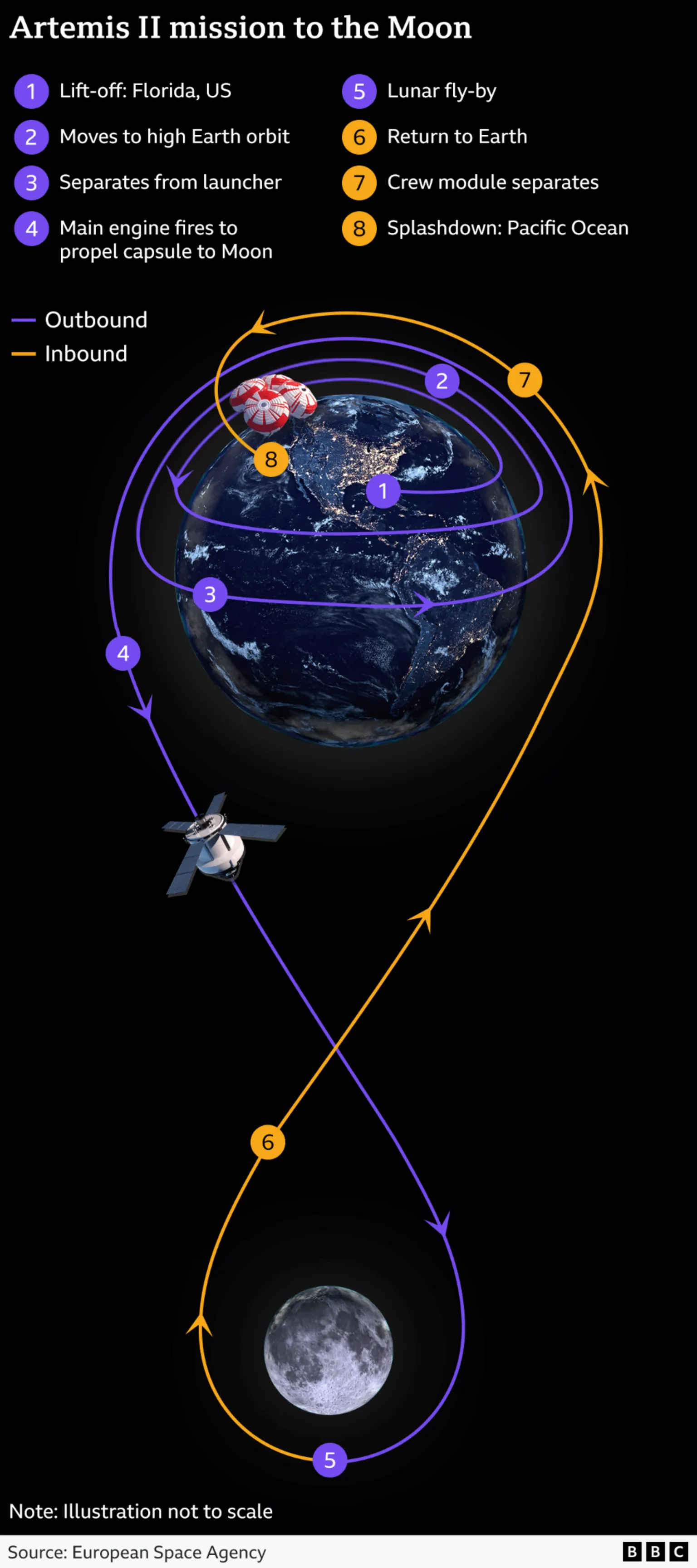
Artemis II is currently on a looping trajectory that will carry the crew around the far side of the Moon and back to Earth. This marks the first time since 1972 that humans have traveled beyond Earth's orbit.
The four astronauts will not land on the Moon but will orbit it, aiming to prepare for a future human lunar landing, the first since the Apollo missions of the 1960s and 70s.
During the mission, the crew will test the Orion capsule’s handling capabilities. This includes manually piloting the spacecraft in Earth orbit to evaluate steering functions and to practice aligning the spacecraft for upcoming Moon landings.