

Strike Commences
Resident doctors in England have initiated a six-day strike, marking their 15th walkout in an ongoing dispute concerning pay. The strike started at 07:00 BST on Tuesday and is expected to cause considerable disruption to NHS services, as resident doctors, previously known as junior doctors, constitute nearly half of the NHS medical workforce.
Senior medical professionals are being deployed to cover emergency services; however, this has necessitated the cancellation of some pre-planned treatments and appointments.
The strike action, organized by members of the British Medical Association (BMA), follows the breakdown of negotiations between the government and the doctors' union last month.
The NHS has advised patients not to delay seeking medical assistance if necessary, emphasizing that those with emergency or urgent needs should continue to use 999 and 111 services as usual. Patients with scheduled appointments and treatments are encouraged to attend unless otherwise informed. General Practitioner (GP) services remain largely unaffected.
Patient Concerns
Adrian Emery, aged 55 from Nottinghamshire, is among those impacted by the strike. He was scheduled for a telephone appointment on Tuesday following several transient ischemic attacks (TIAs), or mini strokes, in January, which have resulted in hearing difficulties.
This appointment was intended as his first follow-up to assess his medication and consult a specialist. Initially rescheduled for mid-June, this appointment has now also been cancelled, leaving him uncertain about when he will be seen.
"I'm very worried, because my grandfather actually had a very serious stroke. I hope I don't have a full stroke before I am seen," he told .
Pay Dispute and Union Position
Despite receiving pay increases totaling 33% over the past four years, the BMA contends that doctors are still earning approximately 20% less in real terms compared to 2008 when inflation is considered.
Dr Jack Fletcher, chair of the BMA's resident doctor committee, expressed regret over the impact of the strike on patients.
"It's very regrettable and I am very sorry to any patients who are affected by this industrial action."
He added that it was neither unreasonable nor unfair for doctors to request higher pay given the real-terms reductions they have already experienced and the likelihood of further declines due to anticipated inflation increases linked to the Iran war.
Dr Fletcher described the strike action as "wholly avoidable" if the government were willing to engage in negotiations.
"We are not asking for pay restoration overnight," he added.
Dr Emma Runswick, deputy chair of the BMA Council, told BBC Breakfast that negotiations had nearly reached an agreement, but the government altered its position at the last minute by reducing the level of investment it was prepared to make.

"That meant that the offer that they made was not one that we could put to members, we know that it will be rejected - and therefore we've had to call strike action once again."
A Department of Health and Social Care spokesperson stated that the government had presented a "generous deal" to resident doctors and expressed disappointment that the BMA proceeded with strike action.
"Our attention and that of leaders across the NHS is now on protecting patients, staff and our NHS by minimising disruption to the health service."
Recent YouGov polling indicates that 53% of the public oppose the strikes, while 38% support them.
Background of the Dispute
Last month, the government proposed a package of measures aimed at resolving the dispute, although the BMA asserts that aspects of the offer were diluted at the last moment.
The package included reimbursement of out-of-pocket expenses such as exam fees, accelerated pay progression through the five salary bands covering resident doctor training, and additional specialty training posts available after the second year following graduation.
The initial 1,000 specialty training posts were scheduled to be created this summer but have been withdrawn following the BMA's announcement of strike action. This development follows a previous recruitment cycle in which 30,000 applicants competed for 10,000 posts, including some foreign-trained doctors.
The government maintains it will not negotiate pay further after awarding resident doctors the most substantial pay rises in the public sector.
Resident doctors recently received a 3.5% pay increase, consistent with the annual pay review process applied to all doctors.
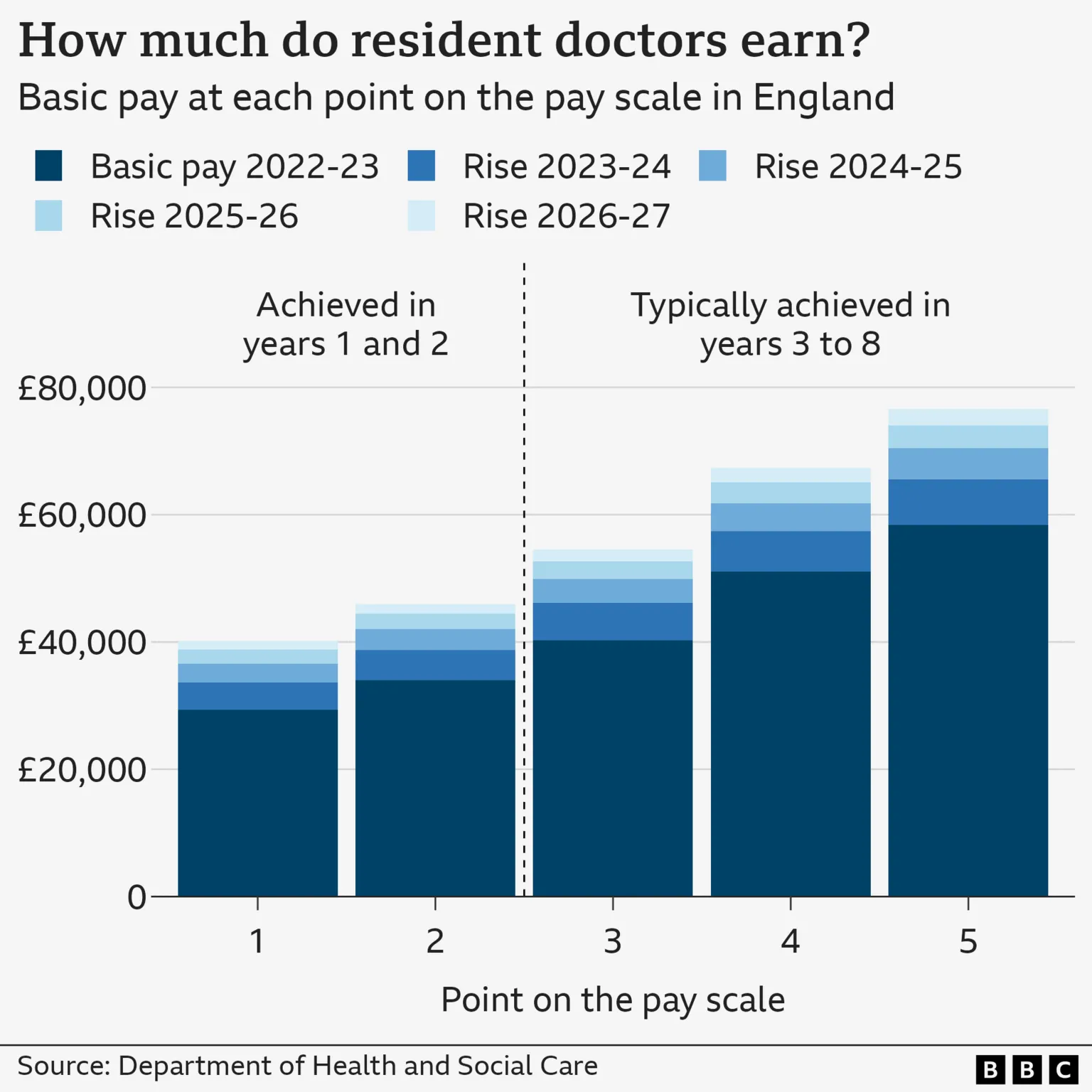
Starting salaries now exceed £40,000, with the most senior resident doctors earning a basic pay of £76,500. Additional compensation is available for unsocial hours and extra work.
The government disputes the BMA's claim that pay is 20% lower than in 2008, noting that this calculation is based on the Retail Price Index (RPI), an inflation measure typically higher than others. The BMA justifies using RPI because it is the metric the government employs for student loan interest calculations.
Related Staff Strike Action
Meanwhile, BMA staff members are also engaging in strike action.
Members of the GMB union, which includes administrative staff, press officers, and negotiators, are currently undertaking a two-day strike over pay disputes.
They have been offered a 2.75% pay increase for this year but report that pay has decreased by 17% since 2012 when adjusted for inflation.


