

Health Secretary Advises Against Private Purchase of Meningitis Vaccine Amid Kent Outbreak
The health secretary has stated that it is unnecessary for individuals to privately purchase a meningitis vaccine despite an ongoing and described as "unprecedented" outbreak in Kent.
Wes Streeting, speaking on BBC Breakfast, acknowledged public concern and the desire for vaccination but emphasized that the risk to the general population remains "low."
A targeted vaccination programme is being implemented for students residing in halls of residence at the University of Kent in Canterbury, the location of the outbreak. Additionally, antibiotics are being distributed as part of the response.
On Wednesday, five additional cases were confirmed in Kent, increasing the total number of confirmed and suspected cases to 20. The outbreak has been linked to a nightclub.
Two fatalities have been reported: a 21-year-old university student and a sixth form pupil named Juliette.
Babies in the UK have routinely been offered the MenB vaccine since 2015; however, older teenagers and university students currently affected were not vaccinated at birth as the vaccine was not available then.
The UK government opted not to conduct a widespread catch-up vaccination campaign for teenagers, leading some parents to seek the vaccine privately.
"It is not a surprise to me people seeing the headlines and thinking 'I will go out and buy myself a vaccination' but just to be clear that is not necessary," Streeting said.
He noted that some pharmacies have experienced vaccine shortages but reassured that there is no supply concern for children and young people covered by the national vaccination programme or the current vaccination efforts in Kent.
Approximately 5,000 students living in university halls in Kent began being offered the MenB vaccine from Wednesday afternoon to provide longer-term protection should the strain continue to circulate.
Separately, Streeting reported that 2,500 doses of antibiotics have been distributed through sites in Canterbury and Broadstairs, with an effectiveness rate of 90% in cases.
Across the country, parents and students have sought the vaccine privately; however, pharmacists informed the BBC that stocks have been depleted or are nearly exhausted.
Oliver Picard, chair of the National Pharmacy Association, told BBC Radio 5 Live that pharmacies were receiving bookings for vaccinations every two to three minutes, totaling over 100 overnight. He described the situation as "unsustainable," noting that their usual small stock was quickly used up.
Clarifying the Nature of the Outbreak
Professor Anjan Ghosh, director of public health at Kent County Council, explained that the vaccine requires two doses and approximately four weeks to become fully effective, meaning it would not prevent the current outbreak.

He also stated that wearing masks is unnecessary given the transmission mode, cautioning that masks could send the wrong message and cause panic by evoking memories of Covid-19. He emphasized that meningitis is a specific infection with a distinct transmission method.
"They can actually create the wrong message as well, because it can actually spread panic and again, revive the memories of Covid when not this is not Covid, it is a very specific infection which has a specific way of spreading," Professor Ghosh said.
Streeting added that from the first case, contact tracing has been conducted, and antibiotics have been offered to those who may have been exposed.
"This disease, whilst very serious, is spread through close personal contact," he said.
He specified that transmission occurs through activities such as kissing, sharing drinks or vapes, and living in shared accommodation. Consequently, the government is particularly focused on individuals who attended Club Chemistry between 5-7 March and those residing in halls of residence.
"So I hope people are reassured that we are managing it, antibiotic provision is there, we're standing up vaccination and general risk is low even if the disease itself is very serious," Streeting stated.
He expressed no concern about students returning home from Kent spreading the bacteria and affirmed that it is appropriate for students in the area to attend exams and for pupils at schools and colleges to continue attending as normal.
Five schools in Kent have confirmed or suspected cases, with hundreds of individuals being offered antibiotics as immediate treatment.
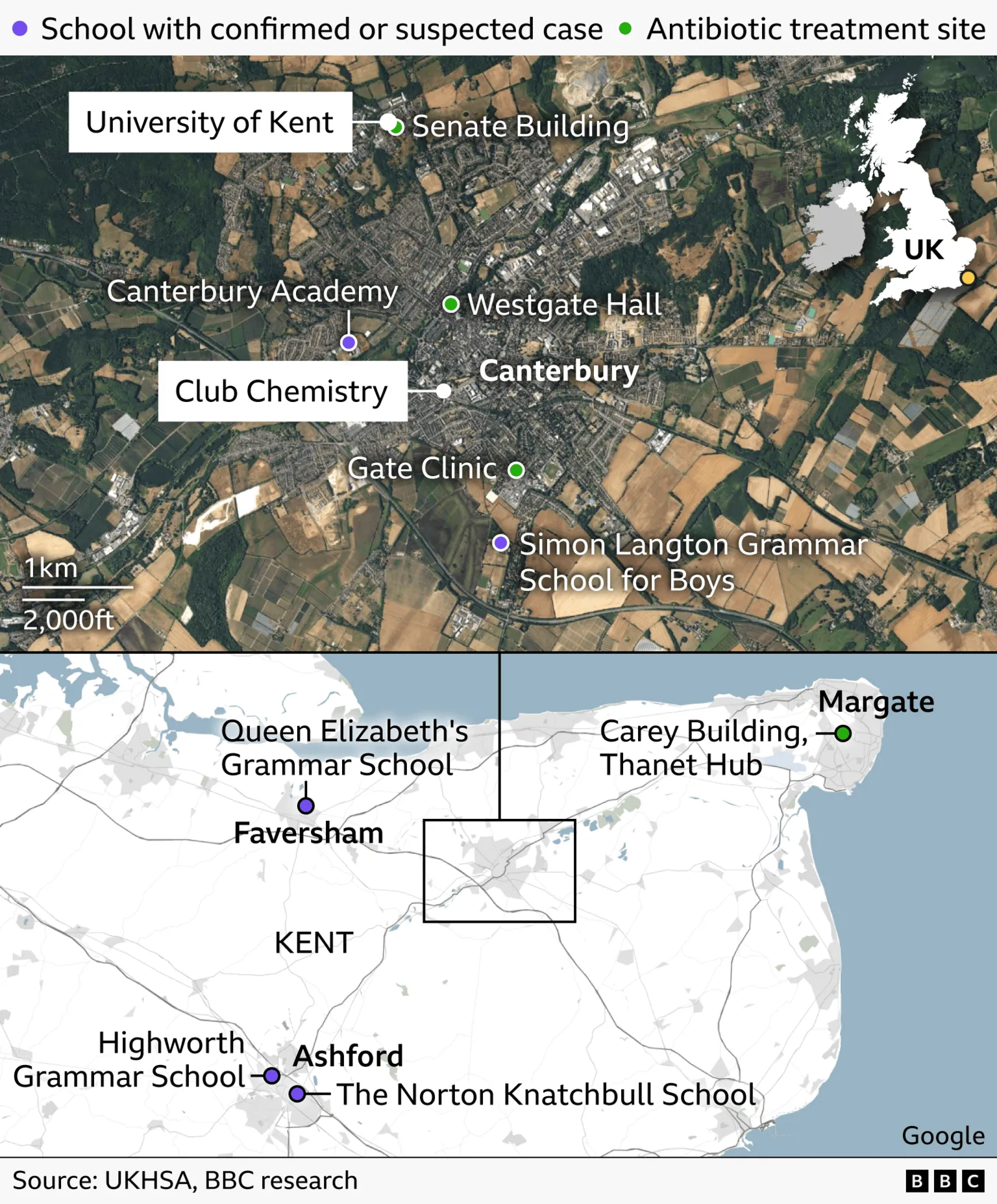
Streeting added that casual contact such as sitting on trains or traveling home is not considered a risk factor.
It is estimated that 10 to 20% of people carry the meningitis bacteria in the back of their throat without developing illness.
However, in a small number of cases, exposure can lead to invasive meningitis, which causes blood poisoning and brain inflammation.
England records approximately 300 to 400 cases of invasive meningitis annually, with 80% attributed to meningitis B, the strain responsible for this outbreak.
The vaccine does not protect against all meningitis B strains, as it comprises various types.
Teenagers aged 14 are offered the MenACWY vaccine, which protects against four meningococcal groups: A, C, W, and Y.
Since 2015, babies have been offered meningitis B vaccines. Streeting has requested that the independent vaccine advisory body, the Joint Committee on Vaccination and Immunisation (JCVI), review its guidance on a broader catch-up programme in light of the Canterbury outbreak.
He emphasized that he is making "no judgement at this stage" and will follow data, evidence, and expert advice.
Adam Finn, a former JCVI member, stated that the risk of any young person contracting meningitis B is "fantastically small" and that even within Canterbury, those without a connection to the outbreak do not need to seek vaccination.
"This is not an infection which would 'shoot through the population', it was 'not Covid', and I expected the outbreak to die out in the coming days," Finn said.


