Introduction to a Bee Enthusiast
Martin Dohrn has a profound affection for bees of all kinds—large, small, aggressive, amorous, and those with distinctive features reminiscent of historical figures. Few bees escape his admiration, though the exact nature of this appreciation is complex.
“It’s hard to explain,” says the veteran wildlife photographer, peering at us through his red-framed glasses while perched at his gadget-strewn kitchen table. “But I really feel for bees. They’re really … I mean, I could say they’re my friends.”
The documentary My Garden of a Thousand Bees explores this unique bond, emphasizing that companionship can flourish in unexpected places. In this case, it is a small urban garden in Bristol where, during the spring and summer of 2020, Dohrn focused his specially adapted bumblebee cameras on over 60 species visiting his backyard.
Exploring the Diversity of Bees
The film introduces viewers to a variety of bees: the wool carder bee, notable for its bald back and aggressive aerial battles; the ashy mining bee, characterized by its tired gait and faded appearance, reminiscent of a grumpy older bumblebee; and the red-tailed mason bee, which constructs its nest inside empty snail shells topped with a delicate dried-grass structure. The scenes unfold under the soft Bristol sunshine, with Dohrn observing intently through his advanced magnifying lens, expressing amazement with exclamations like “wow,” “yes,” and “oh man, will you look at that!”
A Unique Filmmaking Approach
Dohrn describes bees as inhabiting “a completely different dimension,” which inspired a filmmaking style that stretches time to capture intricate details. The resulting visuals are striking, accompanied by a soundtrack blending the sounds of a busy heliport and distant, indistinct mechanical noises.
The film itself mirrors the nature of bees: it moves leisurely through Dohrn’s garden, gathering information much like bees collect pollen. However, it avoids overwhelming viewers with statistics or heavy data. The narrative is informal and reflective, with Dohrn sharing observations and occasional uncertainties rather than detailed scientific analysis. For example, the film briefly notes, “All over the world, bees are declining,” without delving deeply into environmental crises.

Dohrn, described as an affable and contemplative individual who often addresses the audience as “mate,” frequently appears as fascinated and puzzled by the bees as the viewers themselves.
The Story of Nicky the Leafcutter Bee
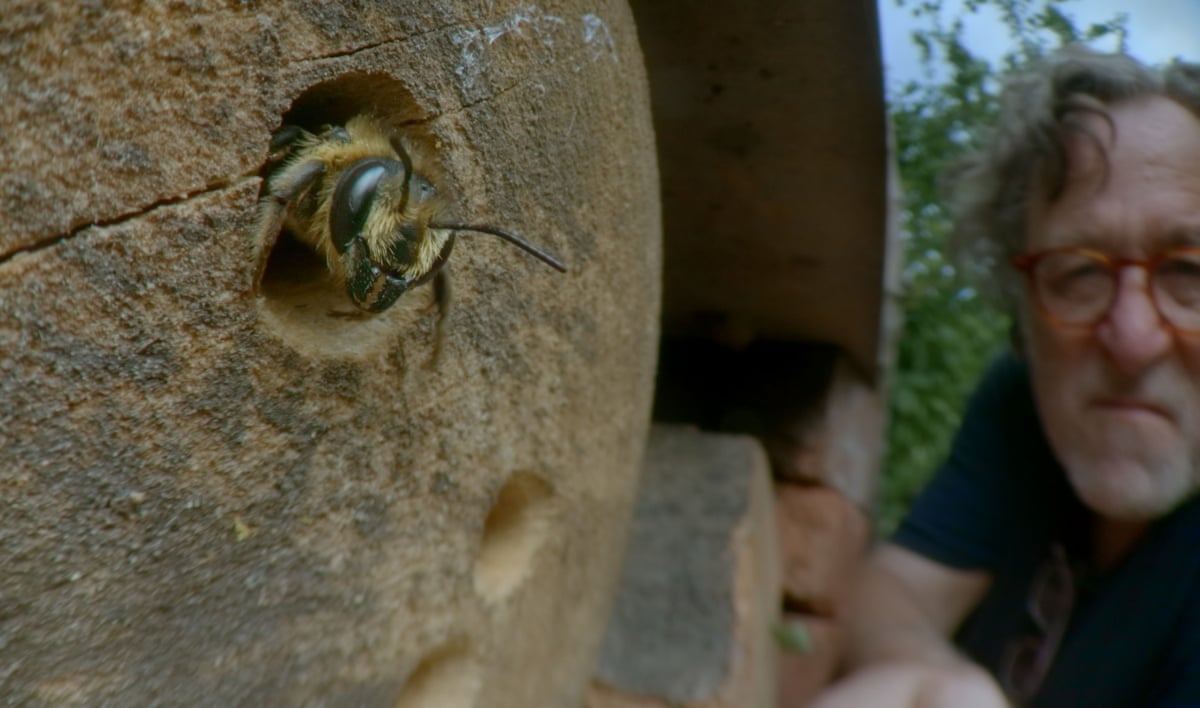
A particularly engaging segment features a leafcutter bee named Nicky, who captures Dohrn’s affection. He leans close to her nest, his nose filling the screen, and they form a connection.
“I could tell she was looking at me. Does she know these are my eyes?” he asks, pointing at his eyes. “Scientists have shown that honeybees can recognise individual people, so why wouldn’t she?”
This moment highlights the film’s exploration of the subtle and profound connections between humans and bees.
Bee City: A Microcosm of Urban Life
Dohrn has created a miniature habitat called Bee City within his garden, designed to provide shelter and resources for the local bee population. This “multicultural” environment includes starter homes and fragrant pathways where young bees play, a tower block housing tiny scissor bees, and a capsule hotel occupied by male mason bees observing their surroundings.
The film presents this microcosm as a reflection of broader ecological and social themes, subtly urging viewers to consider their role in protecting such delicate ecosystems.
Conclusion and Reflection
As the season ends, Nicky the leafcutter bee, after constructing four nests, ceases her efforts and departs, symbolizing the fleeting nature of life and connection.
“I had no idea I was going to get so involved,” says Dohrn, peering disconsolately into the deserted apartment that was once his friend’s home. He sighs. His lockdown project has, he says, “changed my view of bees”. A wistful smile. “It’s changed my view of the world.”