Introduction
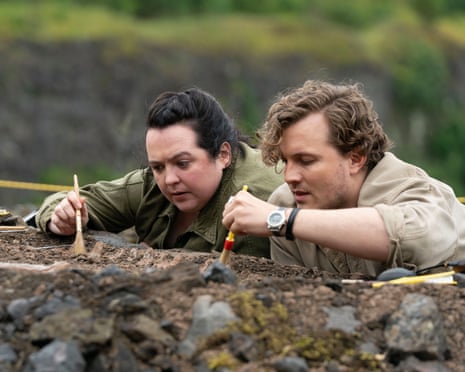
The second series of Dinosaur opens on the Isle of Wight, a seven-hour drive and ferry ride from Glasgow, the hometown of our protagonist, Nina (Ashley Storrie). Nina is eight months into an archaeological dig she began at the end of the first series. Despite uncovering a metazoic dung beetle and befriending Clayton, a charming American who affectionately calls her “Scotland,” Nina experiences homesickness.
She misses Lee, her almost-sort-of boyfriend who used to make her morning coffee outside the Kelvingrove Art Gallery and Museum, where she worked in the palaeontology department (distinct from the antiquities department). She also longs for watching The Real Housewives with her sister Evie, their takeaway Tuesdays, and walks around “wee dodgy parks in case we uncover a homicide.” Just as she prepares to return home, Nina is asked to extend her stay by another year. The dilemma arises: will she remain with her beloved rocks or travel to a midpoint between the Isle of Wight and Glasgow to reunite with Lee? This initiates a comical journey (in a slow buggy) to a park bench in Knutsford, marking the joyous return of this hilarious, heartwarming, and subtly groundbreaking sitcom.
Unique Perspective and Themes
At first glance, Dinosaur appears to follow familiar British sitcom tropes: loving yet dysfunctional families, regional quirks, farce, and a will-they-won’t-they romantic tension. However, the show’s distinctiveness lies in its portrayal through Nina’s autistic perspective. The irony is that neurotypicals are portrayed as the ones who are “too much.” Nina’s autism is integral to every scene yet is not the central theme, making the show feel refreshing, unique, and free from thoughtless stereotypes, even among the growing number of series focusing on autistic characters.
Plot Developments and Character Dynamics
The story returns to Glasgow via Knutsford, where—spoiler alert—Lee does not appear. Back home, Nina finds many changes: her museum office has been relocated, her desk replaced by a social pod and hydration station, and the local sandwich shop has ceased selling tuna melts because “no one likes hot tuna” and “we only served one a day to some woman who died last year.” Nina protests,
“That was me!”This nearly triggers a “tuna meltdown,” as Evie affectionately calls it.
The core strength of Dinosaur lies in the odd-couple dynamic between the sisters, closely followed by the charming awkwardness between Nina and Lee. Their interactions include finger hooks, sudden shifts into Real Housewives accents, and rapid-fire Glaswegian banter filled with terms like boofing, bing bongs, and big heids (left undefined here to encourage viewing). A poignant moment occurs when Nina is distressed, and Evie offers,
“Weighted blanket?”The scene cuts to Nina lying on a couch with Evie stretched atop her, providing comfort.

Humor and Ensemble Cast
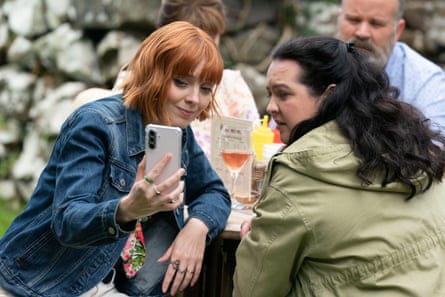
This series exhibits greater confidence than the first, accumulating jokes about Mary Anning and childbirth, Gloria Steinem and the Tebay services off the M6, David Attenborough, and a quirky book of short stories Nina authored titled Romancing the Bone. The ensemble cast remains outstanding. Nina’s irresponsible older brother, Bo, spends much time in the family shed, anxious about the possibility of impregnating Evie’s best friend, Amber. Ranesh, Evie’s feminist husband, continues his eccentric pursuits, including purchasing a dehydration machine to make fruit leathers and cooking pasta from a book by the pope. The portrayal of Declan, Nina’s older colleague who is probably undiagnosed but certainly autistic, is particularly notable.
Lee performs at an open mic night, prompting Amber’s witty comment:
“Mediocre white men singing in public is one of my kinks – it’s the switch from delusional confidence to defeat.”He sings a touching song whose chorus encapsulates the spirit of Dinosaur:
“It doesn’t matter what you do / As long as what you do is true.”
Setting and Cultural Significance
Similar to Hackney in Some Girls, with which Dinosaur shares a sweet, spiky messiness (though Dinosaur is more subversive, foul-mouthed, and superior), Glasgow emerges as a major character. Scotland’s largest and most warm-hearted city, where the reviewer spent a cherished decade, is depicted beautifully with glossy tenement closes, tree-lined avenues, and trendy bars. This portrayal is another way in which Dinosaur is quietly radical, as such a Glasgow rarely appears on television.
Origins and Impact
The integrity of Dinosaur and its rapid-fire Glaswegian humor stem from its origins. The show is co-created by Ashley Storrie, who was diagnosed with autism in her early 30s and is the daughter of comedian Janey Godley, who passed away between the first and second series, and Matilda Curtis, daughter of director Simon Curtis and actor Elizabeth McGovern. The series draws from Storrie’s real-life experiences and is a product of close female collaboration.
The result is a classic comedy filled with light, shade, and profound emotions. As a mother of an autistic child, the reviewer expresses that the show resonates deeply and evokes strong feelings. In summary, the reviewer states,
“I love it.”