The Rise of Celebrity Estate Auctions
From Diane Keaton’s bowler hats and polka dot scarves to Gene Hackman’s used paint brushes, Terence Stamp’s love letters from Jean Shrimpton, and even Matthew Perry’s black leather wallet—complete with credit cards and AAA membership card—fans are increasingly offered personal items from the estates of deceased celebrities, often at premium prices.
The growing trend of auctions featuring personal belongings of deceased famous individuals has surged significantly in recent years, even inspiring the portmanteau “deleb,” short for dead celebrity.
The first of four auctions featuring Keaton’s professional and personal items commenced at Bonhams in New York earlier this week. Among the highlights, her script from the film Annie Hall sold for $394,000, vastly exceeding its $2,000 estimate.
Several of Keaton’s iconic hats fetched thousands of dollars, including a black felt bowler hat she wore in an Instagram video demonstrating how hats can enhance facial features. This item sold for $5,888, including the buyer’s premium, far surpassing its $200-300 estimate. A box of her safety pins, initially estimated at $200-300, sold for $6,144, while a set of safety pins and nail clippers went for $960. Overall, the first Keaton auction raised $1.2 million, with 47 of the 50 lots selling above their estimates.
In total, Bonhams, in partnership with celebrity specialist The Fine Art Group, plans to auction 787 of Keaton’s items. These range from original collages created by Keaton and a Gucci sequin suit and beret worn to the LACMA charity gala in 2021, to more mundane personal items such as a collection of her trademark black turtlenecks, kitchen chopping boards, and dog food bowls.
Why Fans Are Drawn to Personal Celebrity Items
Shane David Hall, director of Fine Art Group’s high-profile client division, explains that fans are increasingly interested in owning celebrities’ personal belongings rather than just professional memorabilia like film scripts or art collections.
“Over the past 20 years the personal legacy market has really exploded,” he says. “People really feel a personal connection to celebrities and how they have influenced their own lives, and there is a real desire to own something of theirs to keep and deepen that connection.”
Hall notes that celebrities with cult followings, such as Keaton and Perry, generate the most interest, particularly in their personal objects rather than professional items.
“There is a new generation of collectors with disposal income, and they are more aligned to celebrities and athletes than their parents,” Hall says. “With people like Diane Keaton, they really mean something to their fans, these are people that grew up with her films and her iconic wardrobe. Items of Diane’s are sentimental to them, there are pieces that fit in the trajectory of their own lives and remind them of significant moments in their own story. And of course they make great conversation topics, one could argue more so than an artwork by a famous artist.”
Hall adds that knowing many of Keaton’s items would resonate with fans influenced the decision to offer such a large collection for sale.
“We like to have some value points that are accessible so there is the opportunity for everyone no matter their budget.”
At the more affordable end of the spectrum was lot number 46 of the second auction titled “Tailored & Timeless”—four pairs of Keaton’s thick-rimmed prescription reading glasses, estimated at $200-300, which sold for $2,176.
Bonhams’ Growing Role in Estate Sales
Bonhams, which has also managed auctions for the late Ruth Bader Ginsburg, Barbara Walters, Lauren Bacall, Michael Caine, and Gene Hackman, reports that estate sales have become an increasingly significant part of its business. Sales in this division rose by 185% last year and have increased by an average of 28.5% annually since 2022.

Anna Hicks, Bonhams’ head of private and iconic collections, highlights the success of the Hackman estate sale in 2025, which generated over $3 million. Notably, Hackman’s three Golden Globes exceeded presale expectations by up to 17 times, collectively bringing in over $125,000.
“Fans often place significant value on items associated with a public figure they care about, and as a result, those pieces frequently command a premium well beyond what similar items might achieve without the celebrity association.”
For example, every lot in Ruth Bader Ginsburg’s library sold above its estimate. Her heavily annotated copy of the 1957–58 Harvard Law Review—the year she became a member—sold for $100,312.
The Business of Securing Celebrity Estates
With substantial profits at stake, securing rights to celebrity estates has become a competitive and lucrative business. Specialist advisers like the Fine Art Group and celebrity-focused auction houses such as Julien’s Auctions in Los Angeles and Heritage Auctions in New York invest significant time and resources cultivating relationships with celebrities and their families to be the preferred choice when estates become available.
Shane David Hall emphasizes the importance of tailored approaches for celebrity estates.
“We’ve spent decades building up relationships with high profile families,” he says. “I would say we are the only firm that looks at the unique challenges of celebrities in this way. Other firms make the mistake of treating celebrities the same as any rich private client, but they’re not, they require significant hand-holding and a lot of personal connection.”
Martin Nolan, co-founder and executive director of Julien’s Auctions, recalls his early awareness of the potential in celebrity estate auctions when his former boss at Merrill Lynch, Martin Zweig, purchased Marilyn Monroe’s “Happy Birthday Mr President” dress for a record $1.27 million in 1999.
“I thought he was crazy, and it made me think twice about his stock-picking,” Nolan says. “But when he died his widow entrusted us to sell his collection, and she told me she just wanted him to be proved right that the dress was worth that much. We sold it in 2016 for $4.81m to Ripley’s Believe It or Not! museum.”
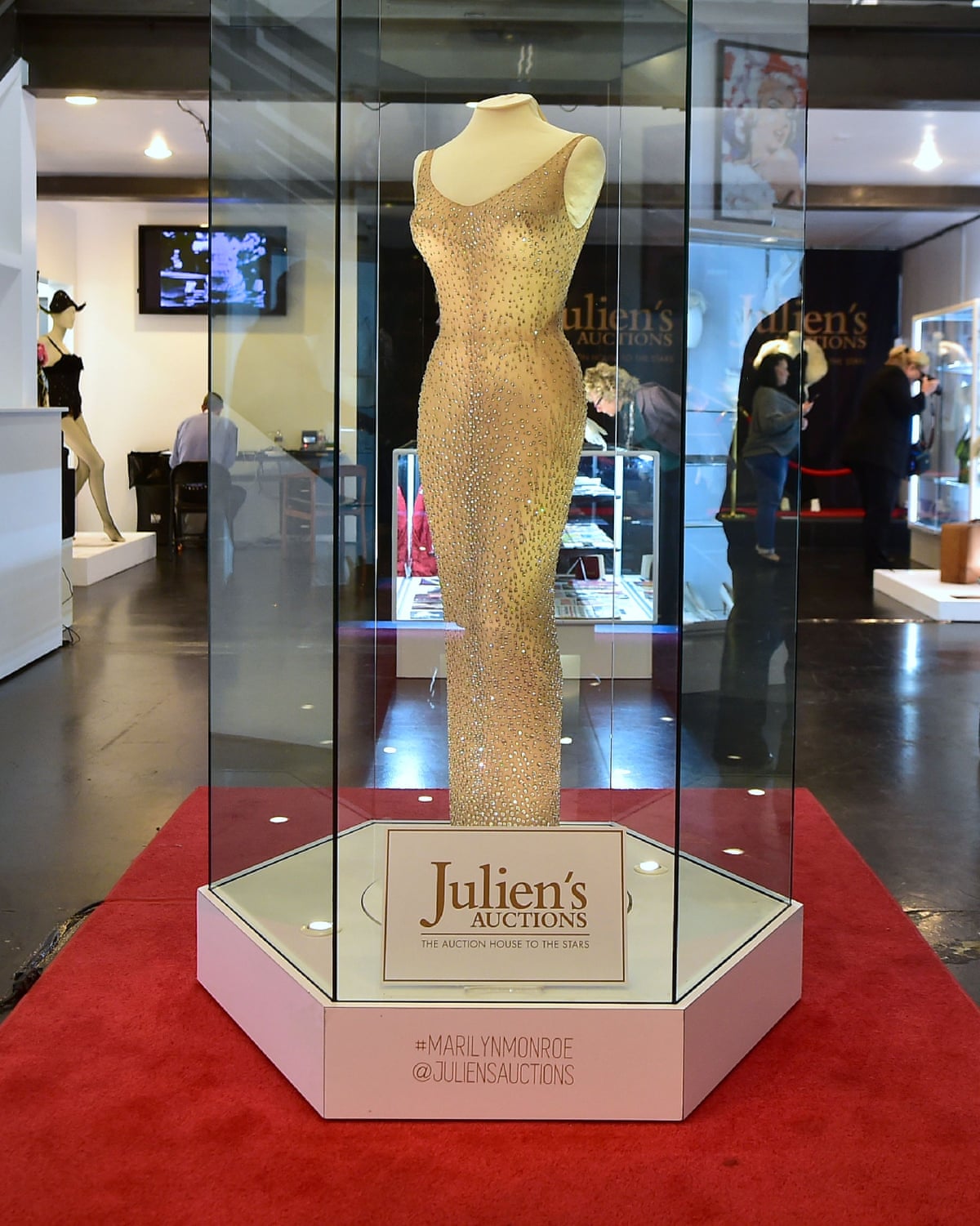
Nolan describes the competition to secure celebrity estates as “extremely competitive” and notes that he spends years building relationships.
“We’re the only auction house that specialises only in celebrities, while Sotheby’s, Christie’s and Bonhams dip in and out, we do this every day,” he says. “And celebrities talk to each other, and we have a good reputation in terms of preserving and celebrating their estates.”
Typically, auction houses take a 20% commission from sales, but Nolan acknowledges that competition can drive prices down, with some treating celebrity estates as “loss leaders” to gain the glamour associated with these sales.
He agrees that buyers of celebrity items are becoming younger, but they represent diverse demographics from around the world. Interestingly, many buyers are celebrities themselves.
“Celebrities are just like you or I, they have people that they look up to and admire and when they sadly pass they also want to have something to remember them by.”