

Brent Crude Surges 6% Following Trump Address
Brent crude oil, the global benchmark, surged by over 6% this morning to $107.63 per barrel. This follows a recent dip below the $100 per barrel threshold, which was driven by hopes for de-escalation in the Middle East conflict.
Our ongoing Middle East crisis blog is tracking all significant developments that could influence oil prices further today.
Asia-Pacific Markets Decline After Trump Speech
Stock markets across the Asia-Pacific region have experienced widespread declines following a speech by former US President Donald Trump, which diminished expectations for a swift resolution to the Iran conflict.
Major indices in the region fell after Trump’s primetime address, in which he pledged to strike Iran “extremely hard” in the coming weeks. This rhetoric has dampened hopes for an imminent end to hostilities.
“We’re going to hit them extremely hard over the next two to three weeks. We’re going to bring them back to the Stone Ages where they belong.”
Japan’s Nikkei index dropped 2.4%, China’s CSI 300 index declined by 1.36%, and South Korea’s KOSPI, particularly sensitive to the crisis, tumbled 4.8%.
Michael Brown, senior research strategist at brokerage Pepperstone, commented on the market reaction:
“President Trump’s ‘address to the nation’ hasn’t helped on this front, with market participants having wanted to hear a bit more than the President provided. While Trump did note that the US is ‘nearing completion’ of its strategic objectives, and reiterated that those countries reliant on crude flows through Hormuz should be the ones to re-open it, Trump failed to give a definitive timeframe for ending the conflict, while also noting that Iran will be hit ‘very hard’ over the next couple of weeks.”
Record Monthly Increases in UK Petrol and Diesel Prices in March
UK petrol and diesel prices experienced unprecedented increases in March, as the oil supply shock triggered by the Iran war rapidly impacted fuel stations.
Data from the RAC indicates that the average price per litre of unleaded petrol rose by 20p, from 132.83p on 1 March to 152.83p by month-end. This surpasses the previous record monthly increase of 16.6p seen in June 2022, following Russia’s invasion of Ukraine.
Diesel prices rose even more sharply, increasing by 40p in March to an average of 182.77p per litre from 142.38p. This nearly doubles the previous record rise of 22p recorded in March 2022.
Simon Williams, RAC head of policy, described the March price rises as “unprecedented,” stating:

“The increases drivers have had to endure in March 2026 far exceed those seen in the early days of the war in Ukraine. While the monthly rise in a litre of petrol is bad enough, the jump in the cost of diesel is even harder to swallow at 40p a litre. With long-term RAC research showing eight-in-10 people are dependent on their vehicles, these costs must really be taking their toll on households as well as businesses.”
The RAC notes that these record increases are nominal; in real terms, prices rose more during the 1973 oil shock.
Despite these rises, average fuel prices remain below the all-time highs recorded in summer 2022, when petrol peaked at 191.5p per litre and diesel at 199.0p per litre.
Introduction: Iran Conflict Triggers Largest UK Mortgage Market Shock Since Mini-Budget
Good morning, and welcome to our continuous coverage of business, financial markets, and the global economy.
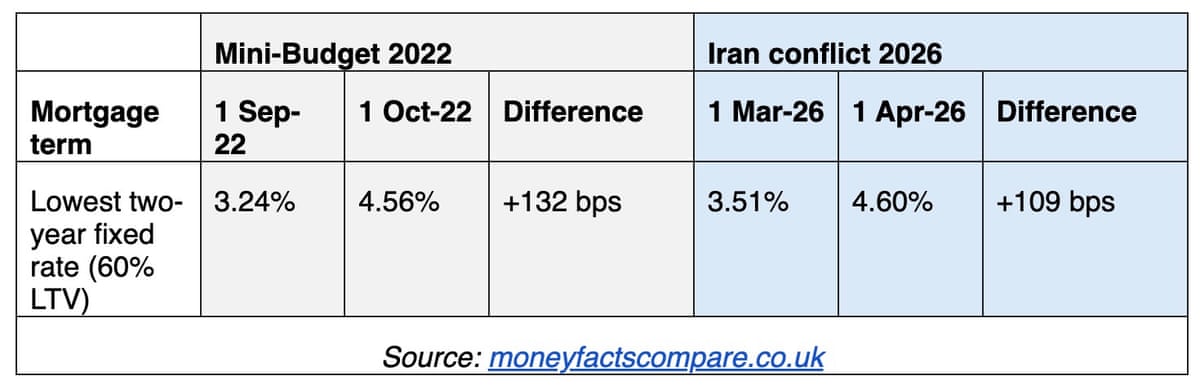
The UK is experiencing its most significant mortgage market disruption since Liz Truss’s 2022 mini-budget, as the Iran conflict has driven borrowing costs higher.
New research from data provider Moneyfacts reveals a sharp increase in fixed-rate mortgage costs over the past month, complicating access to homeownership for new borrowers and increasing repayments for those remortgaging.
Details of the lending environment changes since early March include:
- Rapid repricing of mortgage deals: Average two-year fixed rates surged by 100 basis points, from 4.84% to 5.84%, while five-year fixed rates rose by 79 basis points, from 4.96% to 5.75%. This marks the steepest increase since autumn 2022.
- Reduction in product availability: Mortgage options declined by a net 1,283 products, representing a 17% market contraction—the largest since the mini-budget turmoil.
- Impact on remortgage borrowers: Those transitioning from older five-year deals face rate increases exceeding 300 basis points, resulting in monthly repayment rises between £417 and £444 (£5,000+ annually).
- Deteriorating affordability: Typical borrowers now pay approximately £150 more per month (£1,777 annually) on a £250,000 loan compared to pre-conflict costs, with higher loan-to-value borrowers seeing increases up to £167 monthly.
- Sharp rise in lowest rates: The cheapest 60% LTV two-year fixed rate climbed by 109 basis points, from 3.51% to 4.60%, reflecting rapid repricing in response to funding cost increases.
Adam French, head of consumer finance at Moneyfacts, summarized the situation:
“Average mortgage rates have risen at pace, with two-year fixes increasing by 100 basis points from 4.84% to 5.84% in just one month and five-year fixes up by nearly 80 basis points, from 4.96% to 5.75%. The cheapest deals available to borrowers have moved dramatically too, the lowest two-year fixed rate at 60% LTV has increased by over 100 basis points from 3.51% to 4.60%. While this falls short of the extreme jumps seen in the aftermath of the mini-Budget, it is still a sharp and sudden shift that has materially worsened affordability in a very short space of time. For many borrowers, the cost could be significant. Someone taking out a typical two-year fix will find it costs £150 more per month on average compared to just a few weeks ago. However, the real payment shock will be felt by those coming off older five-year deals, where rates have more than doubled, pushing up repayments by many hundreds of pounds per month. The combination of rising rates, reduced choice and heightened volatility means borrowers and brokers are operating in a market where timing is critical and the window to secure competitive deals can be very short-lived. Unfortunately, anyone looking to buy or remortgage this year needs to prepare for substantially higher borrowing costs than expected before this conflict began.”
City money markets had been lowering expectations for the number of Bank of England interest rate hikes this year—from three to fewer than two—as of last night.
However, Donald Trump’s recent declaration that the month-long Iran conflict is a success “nearing completion,” without providing a clear plan for winding down the conflict over the next “two to three weeks,” has unsettled markets.
This statement has contributed to declines in Asia-Pacific markets, a rise in the US dollar, and an increase in oil prices, as optimism for an early resolution diminishes.
The Agenda
9.30am BST: Bank of England decision makers panel data release.


