Introduction: Oil Price Back Below Pre-Iran War Levels
Good morning, and welcome to our continuous coverage of business, financial markets, and the global economy.
Concerns about a potential global oversupply of oil have driven crude prices below the levels seen before the Iran war.
Today, Brent crude oil prices have fallen to as low as $72.24 per barrel, slightly under the price recorded the day before the Iran war commenced.
Oil prices have been declining since the United States and Iran initiated peace talks, raising hopes for a lasting resolution to the conflict and encouraging increased tanker traffic through the Strait of Hormuz.
According to CNN last night, MarineTraffic data indicated that vessel traffic through the Strait of Hormuz doubled over the previous 24 hours, reaching its highest level since late February.
News that vessels are now transiting the strait with their satellite signals activated contributed to the downward pressure on oil prices, reports Ipek Ozkardeskaya, senior analyst at Swissquote, who stated:
"A combination of strategic inventory releases, a collapse in demand from top buyer China and a substantial number of tankers quietly leaving the Persian Gulf ‘dark’ had contributed to a small oversupply in some key markets, according to traders interviewed by Bloomberg."
The Agenda
9am BST onwards: British Chambers of Commerce global annual conference
1.30pm BST: US PCE inflation index for May
Following recent local council elections in Scotland and Wales, Labour’s Rachel Reeves acknowledges the party needs to improve its connection with the public, communicate its government achievements more effectively, and present a clearer vision for the future.
Reeves, hinting at a possible departure from the Treasury, said:
"That is what Andy [Burnham] will be able to provide as our next Prime Minister. He is a great communicator. He’s got a great track record in delivering in Manchester, and I have no doubt that he will bring that to the position of prime minister.
And I look forward to working with him in whatever capacity."
Reeves: Middle East Conflict Will Impact Growth This Year
At the British Chambers of Commerce’s annual conference, Rachel Reeves warned that the UK’s economic growth will slow this year after a strong start.
She reminded attendees that the economy grew by 0.6% in the first quarter of 2026.
If sustained, this would amount to 2.4% annual growth, which Reeves described as exemplary for a G7 economy.
However, she cautioned that the Middle East crisis will dampen growth for the remainder of the year.
"Are we going to maintain that? No, because of the conflict in the Middle East.
It’s not a conflict that we started. It’s not a conflict we entered.
I think I’ve been pretty clear on and off the record about my views of that conflict.
It has implications here and at home, which is why I set that target of the fastest growing economy in the G7 as a relative target, because all countries are exposed to shocks."
Reeves has been outspoken on the issue; at the IMF’s spring meeting in April, she described Donald Trump’s war on Iran as a "mistake."
When asked about speculation that Andy Burnham might abandon her fiscal rules, Reeves responded that Burnham has been "really explicit" in supporting those rules, which require day-to-day spending to be funded through tax receipts and mandate that debt decreases as a share of the economy.
Reeves: Proud of My Record
During an interview with Sophy Ridge, Rachel Reeves addressed questions about her future.
She expressed pride in her record on inflation, interest rates, economic growth, rising real wages, and borrowing, noting that government borrowing is now below 5% of GDP, at 4.2%.
Reeves highlighted that her revisions to fiscal rules have enabled investment in projects such as the Sizewell C new nuclear power station, small modular nuclear reactors in Anglesey, and carbon capture and storage initiatives in Merseyside and Teesside.
She also cited transport infrastructure expansions including Heathrow and Gatwick airports, Northern Powerhouse Rail, the TransPennine route upgrade, and the Oxford Cambridge Growth Corridor.
Another notable achievement she mentioned is lifting more than half a million children out of poverty during this Parliament.

While proud of these accomplishments, Reeves acknowledged there is more work to be done.
"So yes, there is more to do, but all of that has to be anchored around that stability, that high return to the economy."
She also referred to "unfinished business on fiscal devolution."
When asked if she wishes to remain Chancellor, Reeves stated that the decision lies with Andy Burnham and she will not pre-empt decisions regarding his top team.
Reeves: Fiscal Discipline to Continue Under Burnham
Speaking at the British Chambers of Commerce conference in London, hours after endorsing Andy Burnham as the next prime minister, Chancellor Rachel Reeves addressed business concerns about economic stability.
In an interview with ’s Sophy Ridge, Reeves acknowledged a busy week but expressed pride in her Treasury record, citing six interest rate cuts over the past two years, a decline in inflation in April, and the UK’s position as the fastest growing economy in the first quarter of 2026.
She emphasized that Andy Burnham has been "really clear" about his commitment to the fiscal rules she introduced.
"Businesses here can be confident that that stability, that rigour to policymaking, that tight grip on the public finances, which is essential for getting inflation and interest rates down, will be continued."
: Iraq Considers Leaving OPEC Amid Quota Dispute
reports that Iraqi officials have contemplated leaving the OPEC oil cartel but currently plan to remain members while seeking a higher production quota under OPEC rules.
"Iraq will be compelled to consider all available options if its OPEC quota is not significantly increased," a senior Iraqi oil ministry official told on Thursday.
"Iraq is enduring a critical financial crisis on the back of the Iran war and a significant increase in its OPEC quota is a must and should be treated with utmost seriousness," the source added.
Two months ago, the United Arab Emirates shocked OPEC by quitting the group after 60 years of membership amid the largest supply crisis in history.
OPEC members agree on fixed production limits to control oil prices; they hold about 80% of the world’s proven oil reserves but produce only 40% of global crude to maintain market prices that support petrostate economies.
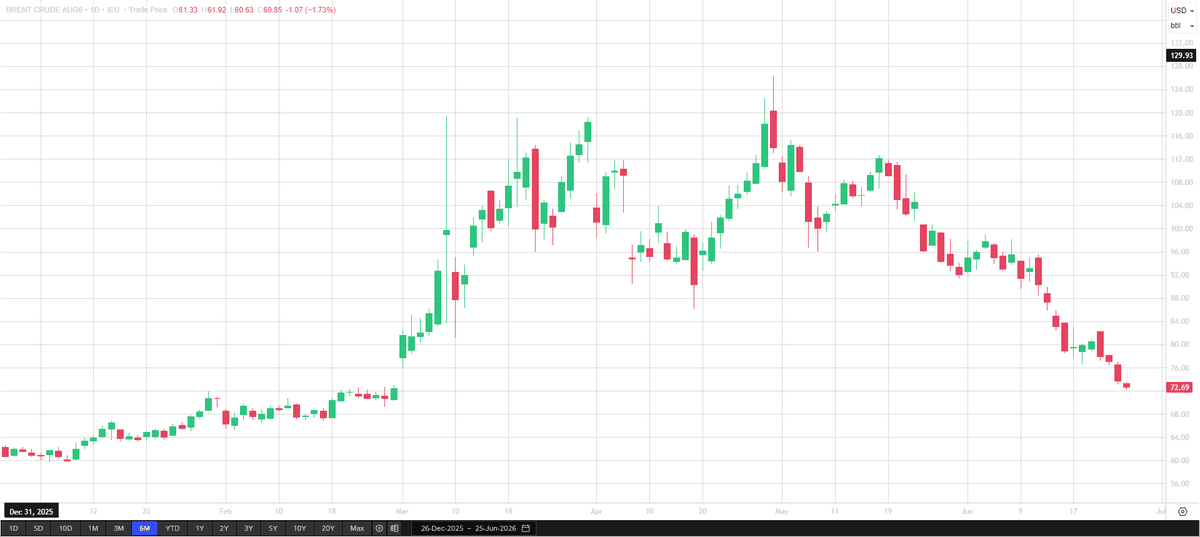
Chart: The Rise and Fall of Brent Crude
Oil prices have experienced significant fluctuations this year.
On 27 February, just before the Iran war began, Brent crude closed at $72.48 per barrel. Prices surged following the conflict’s outbreak, reaching $119 per barrel multiple times in March and peaking at $126.41 at the end of April.
Subsequently, prices declined through May and June as prospects for a peace agreement improved.
Stocks Surge in Japan and South Korea
Asia-Pacific stock markets rallied today, buoyed by relief that oil prices have returned to pre-Iran war levels.
Japan’s Nikkei index rose by 4.6%, while South Korea’s KOSPI increased by over 6%.
Jim Reid, market strategist at Deutsche Bank, commented:
"Markets are in a buoyant mood this morning, with Brent crude oil prices finally back at their pre-conflict levels.
It comes as flows through the Strait of Hormuz have continued to ramp up, with the number of vessels getting through at its highest since the conflict started. And more broadly, the oil price decline has eased fears about a stagflationary shock and aggressive rate hikes to deal with any inflation.
Traders are also relieved that chip giant Micron reported a surge in quarterly profits last night, easing fears that the AI boom might falter."
Chancellor Rachel Reeves, who is widely expected to be replaced if Andy Burnham becomes prime minister, is scheduled to speak at the British Chambers of Commerce conference today.
Other senior political figures slated to speak include:
- 9.00am: Chancellor the Rt Hon Rachel Reeves MP
- 9.25am: BCC Director General, Shevaun Haviland, CBE
- 10.00am: BCC President, Andy Haldane, CBE
- 11.00am: Shadow Chancellor, The Rt Hon Sir Mel Stride MP
- 12.10pm: Leader of the Liberal Democrats, The Rt Hon Sir Ed Davey MP
- 3.40pm: Reform Treasury Spokesperson, The Rt Hon Robert Jenrick MP
- 4.30pm: Green Party Leader, Zack Polanski AM
Businesses Urge Next PM to Ease Burden on Firms to Drive Growth
UK businesses have endured a challenging decade marked by the Brexit referendum, the Covid-19 pandemic, and energy shocks resulting from the Ukraine and Iranian conflicts.
With a new prime minister expected to take office soon, business leaders hope the incoming government will avoid imposing additional costs on companies.
Shevaun Haviland, Director General of the British Chambers of Commerce, will caution at the BCC’s Global Annual Conference that the next prime minister, likely Andy Burnham, should focus on restoring business confidence to foster higher growth rather than stifling it.
Haviland will explain:
"Weak confidence reduces appetite for risk, which reduces investment, which hampers growth, which knocks confidence further.
And this circular crisis of confidence is now shackling ambition. Blocking the actions needed to invest, innovate and trade.
And whoever sits in No10, or the Treasury, needs to understand that.
Businesses can only deliver growth, if the environment they operate in gives them the confidence to act. And that is where political leadership can make all the difference."