Oil falls back below $90 as Iran reports diplomatic exchanges with US
Oil has fallen back below $90 a barrel, trimming earlier gains after reports of diplomatic exchanges between the US and Iran. Iran said diplomatic exchanges with the United States via mediators were ongoing despite US military strikes on the country.
AFP reports that foreign ministry spokesman Esmaeil Baghaei said at a press conference in Tehran:
We have been informed by mediators, we have received messages – without going into details – but the main point is that the diplomatic apparatus has been active in recent days and ideas have been conveyed to us by certain mediators.
Brent crude, the international benchmark for oil, has pared back some of its earlier gains but is still up 1% to $89.07 a barrel. The Stoxx Europe 600, which tracks the biggest companies on the continent, is now up slightly by 0.1%, though the UK’s 100 is still down 0.3%.
Why has AliExpress been fined by the EU?
AliExpress, the Chinese online retail platform, has been fined a record €550m (£470m) by the EU over its failure to stop illegal goods including harmful clothing, cosmetics and kitchen gadgets being sold through its site. The European Commission fine is the biggest yet exacted by the bloc under the Digital Services Act (DSA), legislation that came into force in 2024 to protect consumers from illegal goods, deceptive or addictive marketing techniques.
Henna Virkkunen, the EC’s executive vice-president for tech sovereignty, security and democracy, said:
The spread of counterfeit clothing, unsafe toys, dangerous cosmetics and other illegal and harmful products is not an unavoidable cost of shopping online – it is a failure by AliExpress to comply with its obligations under the Digital Services Act.
Scale is not an excuse; risks must be identified and addressed systematically to ensure consumers can safely shop online. Today, we are holding AliExpress to this standard and request it to take action.
Is Ryanair safe after the window incident?
Ryanair has moved to reassure travellers that its planes are safe after a passenger was saved from being sucked out of a window and said it has been in touch with his family.
This month, Ljubisa Karović was sucked out headfirst after an engine failure resulted in parts smashing an acrylic window during a flight from Thessaloniki in Greece to Memmingen near Munich in Germany.
His wife, Svetlana Grković, saved the 61-year-old from falling out of the aircraft and managed to pull him back in with the help of two other passengers.
Neil Sorahan, Ryanair’s group chief financial officer, said:
Our customer care team have actively been in touch with the family since the incident.
Our crew did a phenomenal job and got the aircraft back to Thessaloniki. Everyone bar none walked off the aircraft. It was a great job done by the cabin crew and the pilots.
Sorahan said it was “way too early” to discuss whether Ryanair would have to compensate the couple while the airline awaited the outcome of an investigation into the incident.
Kathleen Brooks, of the broker XTB, notes that there will be plenty of new economic data in Burnham’s in-tray this week.
On Tuesday, the unemployment rate is expected to rise to 5%, which is further evidence that job growth in the UK has been hindered by Reeves’ s £25bn hike in employers national insurance.
…We will also get the latest public sector borrowing data, and analysts expect a continued rise in monthly public net sector borrowing. This would follow May’s much higher-than-expected borrowing rate. Surging welfare payments and elevated gilt yields, mean that the UK is likely to continue to be mired in high debt levels for years to come.
On Wednesday, the CPI data is expected to show an encouraging moderation in the headline and core CPI rate. However, Burnham won’t be able to bask in the glory for long, as price growth is still above the BOE’s target rate, and financial markets continue to price in one rate hike from the BOE this year.
…Overall, this week’s data could show a worrying economic backdrop.
The market’s judgement of Burnham will be reflected in government bonds.
The 10-year gilt yield is hovering close to 5% and has risen by 1% since Labour took office in 2024. This is a tipping point for the UK economy, and he must focus on reversing this rise.
A 5% yield weighs on economic growth, depresses investment and increases the government’s debt interest bill. He cannot risk anything that pushes yields up further. Drawing a line under inflation busting public sector pay rises, and welfare spend restraint will be the fastest way for Burnham to ease upward pressure on bond yields in the first months of his premiership.
We should know who Burnham’s chancellor is by this afternoon, Burnham is also expected to lay out his 10-year plan for the UK at Downing Street before 1330. Realistically, he only has 2.5 years as leader in the current parliament, so much of what he says could be meaningless, unless he lays out a timeline for a new election, which we don’t think that he will do.
Investors will be watching the bond market carefully today as Burnham prepares to pick his cabinet.
Russ Mould, an investment director at the broker AJ Bell, said bond markets reacted positively on reports last week that current home secretary Shabana Mahmood is frontrunner for chancellor.
Gilt yields eased back last week on speculation that Mahmood would get the job, which is the biggest clue that markets are accepting the governmental change in a calm manner.
That’s good for now, but it’s what comes next that really matters. Bond investors are looking for any clues on public spending intentions, how they will be funded, and any policies that deviate from the path pursued under the Starmer-Reeves regime. Burnham’s big speech later today might offer a glimpse at what he wants to achieve but is unlikely to give the full picture.
What is happening with Jeff Bezos and CuspAI?
Amazon’s founder, Jeff Bezos, and the UK government have invested in a £2bn British artificial intelligence startup that is aiming to become the “search engine for rare materials” that accelerates the next wave of technological breakthroughs.
The Cambridge-based CuspAI has received funding from investors including Bezos and the government’s sovereign AI fund, valuing the two-year-old business at $2.6bn.
The company has launched the AI Materials Foundry, a coalition of more than 48 tech companies, industrial firms and research facilities, with the aim of building software underpinned by artificial intelligence to discover and develop new materials for chipmakers and other industries.
CuspAI hopes to significantly cut research times and reduce or eliminate the use of rare metals – including iridium and ruthenium – in chipmakers’ supply chains.
Why is Segro calling Prologis’s bid opportunistic?
Warehouse company Segro has said a takeover bid is “opportunistic” and timed to “capitalise on a dislocated share price”, as tensions rise between the two businesses.
The company has said in a statement:
The Board of Segro carefully reviewed the further revised proposal, together with its advisers, and concluded that Segro’s compelling growth strategy and standalone prospects underpin superior value creation versus the further revised proposal. Accordingly, the Board unanimously rejected the further revised proposal.
Despite this rejection, Segro engaged and met with Prologis management yesterday to understand Prologis’ ability to improve its financial terms to a level that could be capable of being recommended by the Board of Segro. Prologis provided no new information in this meeting and made no improvement to the further revised proposal.
Prologis’s proposals have been opportunistically timed to capitalise on a dislocated share price and just as Segro’s markets are inflecting and momentum is accelerating. The effect would be to transfer the benefits of Segro’s considerable embedded value and this significant progress to Prologis shareholders before they are fully reflected in Segro’s earnings and valuation.
Europe is “particularly vulnerable” to a squeeze on finished fuel supply, according to PVM Associates, an energy and commodities broker.
John Evans, an analyst at the firm, said:
The European continent is at present particularly vulnerable to the lack of finished fuels as demand has severely increased due to the ongoing, unforgiving heatwave reflected in the demand on the electricity grid. The Gasoil/Brent crack rallied nearly $10/barrel last week and is up nearly $25/barrel since the world thought Hormuz was cured in the middle of June.
…One could argue that the recent scrutiny received by AI and technology companies, and stock market falls, are due to the increased awareness of both overstretched valuations and investment, and now, in AI buildouts, overcapacity.
Yet it cannot be denied on how this current flare-up in and around the pinch of Hormuz, and its inflationary influence, causes nervousness for investors as they consider their portfolio exposure to companies which might feel a heavy load if indeed the notions of ‘higher for longer’ interest rates play out.
As for oil prices, with Brent knocking on the door of $90/barrel and only one errant bombing or incident away from pushing on to $100/barrel once again, and supply of gasoline and diesel getting ever shorter, time is running out for the US President to assuage the current anxiety building within the oil fraternity.
How are European stock markets reacting?
It is a shaky start for European stock markets this morning: the Euro Stoxx 600, which tracks the biggest companies on the continent, is down 0.2%.
The UK’s blue chip 100 index is down 0.6%, led by losses in the real estate sector, which is own 1.2%. Energy companies BP and Shell are however rising on the elevated oil price, with shares up 1.5% and 0.7% respectively.
Over in the bond market, oil prices are feeding a rise in gilt yields. The 10-year yield is up by about 4 basis points. Meanwhile the pound is up slightly against the dollar by 0.05% to $1.34.

Why did Segro reject the latest takeover bid?
The UK warehouse landlord Segro has rejected the latest takeover bid from its US rival Prologis, which valued the 100 company at £13.5bn.
Segro has repeatedly rejected Prologis’ takeover attempts, saying it was “opportunistically timed” and significantly short of fair value.
Today Prologis said Segro’s board had unanimously rejected its third proposal made on 16 July, which included a partial cash alternative of up to £2.7bn and 0.0890 new Prologies share for each Segro share.
It represented an almost 10% premium to Segro’s net asset value, and a 34% premium to its share price before Prologis revealed its takeover interest, according to the US company’s statement this morning. Segro rejected the offer a day after it was made.
The takeover attempt by Prologis – which called on investors today to back the deal – is the latest in a series of approaches.
Segro is best known for, with a multi-billion pound portfolio that includes warehouses, data centres and industrial property, mostly in the south-east of England.
Shares in Segro are down 1.4% this morning, but are up by about 19% since the first Prologis offer was made in June.
What is Morgan Stanley warning about diesel supply?
Europe faces a squeeze on its diesel supply this year, according to analysts at the bank Morgan Stanley, with stockpiles expected to decline over the coming months.
Analysts including Martijn Rats wrote in a note yesterday:
The picture is genuinely tight. Our supply/demand modeling points toward European diesel inventories falling to multi-year lows toward year-end.
…The real bottleneck in the oil system right now is refining, more so than crude…The epicenter of all this is the diesel market, and Europe in particular.
It comes as global energy markets grapple with the impact of renewed conflict in the Middle East.
Morgan Stanley now expects that European stockpiles will fall steadily from August, reaching a low of about 299m barrels in November. That would be the lowest level for that time of year since at least 2015, according to their analysis, which was first reported by Bloomberg.
Jim Reid of Deutsche Bank says the rapid rise in the oil price and fresh waves of strikes underscores “how quickly the situation is deteriorating”.
Three US service members were killed in separate incidents in Jordan and Iraq, while US strikes hit targets including Qeshm Island and multiple locations in southern Iran. At the same time, Iran broadened its retaliation beyond military sites, targeting critical infrastructure across the Gulf, including power and desalination facilities in Kuwait, as well as launching drone and missile attacks towards US bases and regional allies. And prospects for any diplomatic breakthrough remained dim, with Iran’s Foreign Minister Araghchi suggesting that some nuclear issues may ‘remain unresolvable’.
Tensions also escalated further in the strait of Hormuz, with Iran signalling a far more assertive stance over shipping flows and claiming to have intercepted vessels attempting to transit the waterway.
Introduction: Oil rises above $90 as Middle East conflict escalates
Oil prices have hit their highest level in more than a month as Brent crude, the international benchmark for oil, is now up by 2.7% to $90.49 a barrel, shortly after hitting as high as $91.41 – its highest level since June.
The jump in oil prices comes as the US carries out another fresh wave of attacks against Iran, after a fragile ceasefire agreement signed a month ago unravels and deepens a struggle for control over the strait of Hormuz.
The US announced the death of a third American service member over the weekend, after two people were killed in an Iranian attack on a Jordanian base on Friday, with another missing in action.
US president Donald Trump said “we hit them very hard again tonight” as he returned to Washington after the World Cup final, adding “we did that in honour of the, probably three, it’s probably three great patriots.”
The British military has also reported that a ship caught fire in the strait of Hormuz near the coastline of Oman, though it is unclear what triggered the blaze. Iran’s Revolutionary Guard (IRGC) later claimed two oil tankers were blown up after attempting to transit through the southern route of the strait, but there was no independent confirmation.
It also claimed on Monday that two oil tankers had exploded and been immobilised after attempting to transit the southern route through the strait of Hormuz.
The IRGC said the strait would remain unsafe as long as what it called US “aggression” in the region continued, warning that “this passage will not be safe for the transit of petrochemical products, nor even a single drop of oil and gas”.
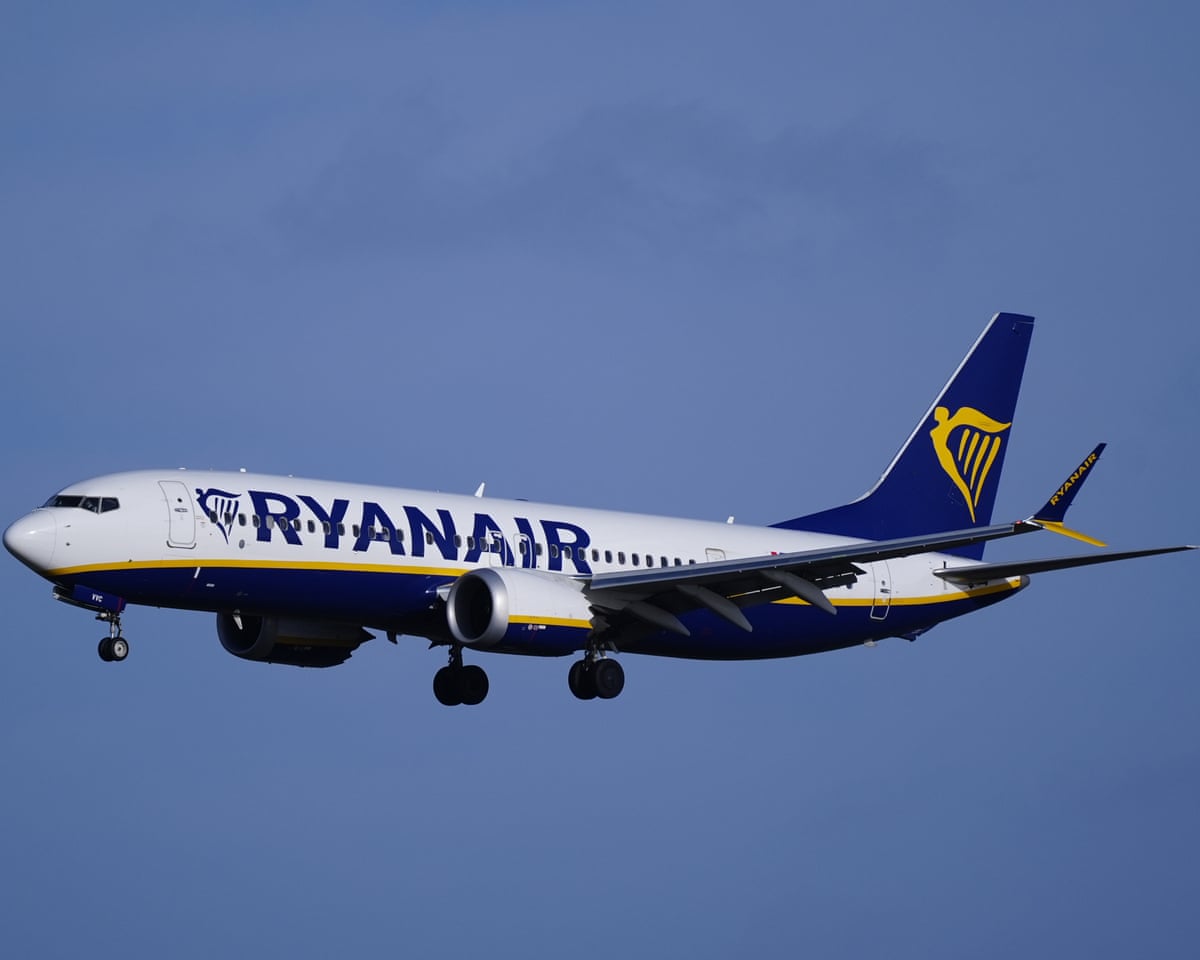
Elsewhere this morning, uncertainty around the Middle East war has meant Ryanair has had to cut fares during the peak summer travel season.
The budget airline has said this morning that its first quarter average fares were 6% lower than last year.
Chief executive Michael O’Leary said in a statement:
The Middle East conflict led to consumer hesitancy, concerns about EU jet-fuel shortages, economic uncertainty and later bookings.
…Despite a recent, slight, uptick in volumes, and less price stimulation, Q2 pricing is trending modestly down (y-o-y) and the final H1 fare outcome is heavily dependent on the strength of close-in bookings in Aug. and Sept.
The company said its first quarter profit after tax fell 34% to €538m (£457m), down from €820m at the same point last year and compared with a forecast of €579m in a company poll of analysts.
The agenda
Today: Andy Burnham becomes prime minister